Su's first visit to Korea since AMD announced bid to acquire World Labs
Three-hour dinner with Samsung semiconductor chief Jeon Young-hyun
Low-power DRAM, next-generation SoC foundry work seen as potential areas of cooperation
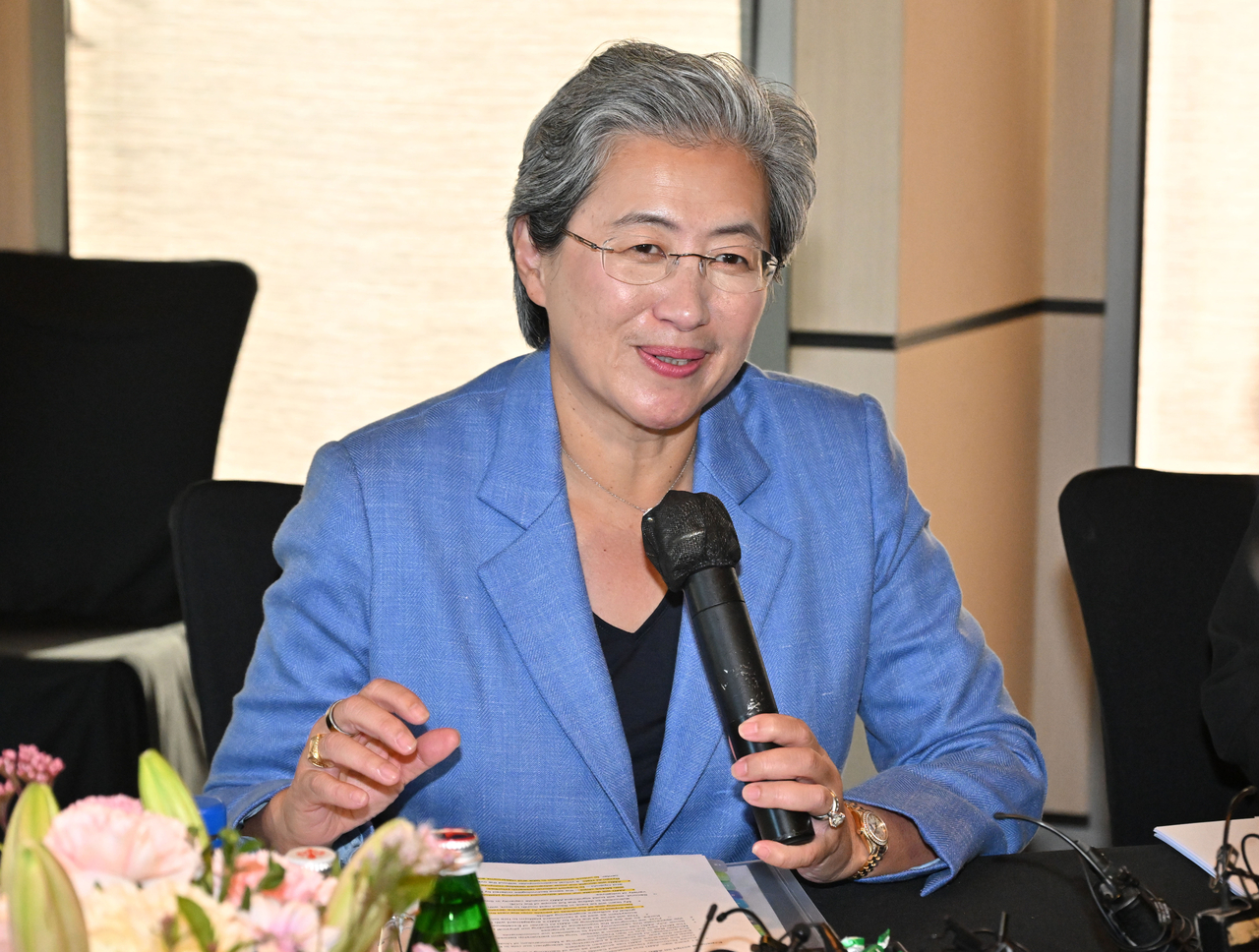
As AMD accelerates its push into the physical AI market, attention is turning to whether the global AI chipmaker's partnership with Samsung Electronics will expand beyond high-bandwidth memory into robot-oriented memory chips and foundry services.
AMD Chair and CEO Lisa Su arrived in Korea on Wednesday and sat down with Samsung Electronics co-CEO and Vice Chairman Jeon Young-hyun and other senior Samsung executives for a dinner that lasted roughly three hours, beginning at 5 p.m. at Samsung Electronics' Seocho office in Gangnam-gu, Seoul.
Kim Jae-jun, executive vice president and head of strategic marketing at Samsung's DS (Device Solutions) division memory business, and Cho Sang-yeon, executive vice president and head of DS Americas operations, greeted Su in the building's lobby and escorted her inside. On the AMD side, Su was joined by Chief Technology Officer Joseph Macri and Jack Huynh, senior vice president and general manager of the computing and graphics group.
Leaving the dinner around 8 p.m., Su was asked by reporters what had been discussed. "We had a very good discussion," she said. "Samsung is a great partner for us, and we always have good strategic discussions."
Particularly notable was the question of cooperation in physical AI. Asked whether AMD would work with Samsung Electronics in that field, Su said, "We will collaborate in a very wide range of areas." The meeting is also significant as the first executive-level encounter since AMD announced its planned acquisition of World Labs. Should AMD's physical AI business gain full momentum, Samsung Electronics is expected to expand its role beyond memory supply to include production of robot system-on-chips and advanced packaging.
AMD announced on Sept. 28 that it plans to acquire World Labs, a US-based world-model developer, for $8.2 billion. World Labs was founded by Fei-Fei Li, a Stanford University professor known as the "godmother of AI," and develops spatial intelligence technology that enables AI to understand, predict and simulate three-dimensional real-world environments. That capability is central to physical AI, in which robots perceive their surroundings and make autonomous decisions.
![AMD announced mass production of its "Versal AI Edge Series 2" semiconductor platform for physical AI on Sept. 22. [Provided by AMD]](https://wimg.heraldcorp.com/news/cms/2026/10/08/news-p.v1.20261008.e37bb1a73a914b2eb0606bbd82cdf3a4_P1.png)
Through the acquisition, AMD aims to build AI model research capabilities and develop semiconductors optimized for next-generation AI applications such as robotics and simulation. AMD announced mass production of its physical AI semiconductor platform, the Versal AI Edge Series 2, on Sept. 22. The chip processes sensor data collected by robots in real time and performs AI inference, with support for LPDDR5X low-power memory.
For robots to perceive their environment and make decisions, they must process vast amounts of data rapidly while minimizing power consumption. As the physical AI market grows, demand for high-performance, low-power memory is expected to rise accordingly. Samsung Electronics has also been developing next-generation memory technologies including LPDDR6, raising the prospect that cooperation between the two companies could extend from data center HBM to robot-oriented memory.
The growing importance of robot SoCs — which largely determine a robot's performance — is also fueling expectations of foundry cooperation. Samsung Electronics already has relevant experience, having partnered with US AI chipmaker Ambarella to develop a next-generation edge AI platform based on a 2-nanometer process.
Samsung and AMD have discussed foundry cooperation as well. At a meeting in March, the two sides explored ways to collaborate on next-generation chip manufacturing. At the time, Vice Chairman Jeon said Samsung holds "unrivaled turnkey capabilities to support AMD's AI roadmap, spanning industry-leading HBM4, next-generation memory architecture, and cutting-edge foundry and packaging technology." Su also met separately with Han Jin-man, president and head of Samsung Electronics' foundry business division, during that visit.
On this visit, Su was again asked whether there had been progress on foundry cooperation. "Overall, we have a very broad partnership," she said. Asked whether she loves Samsung, she replied, "Of course."
The outlook for the physical AI semiconductor market is bright. In its third-quarter humanoid robot report this year, market research firm TrendForce projected that the chip market for humanoid robots — encompassing SoCs and semiconductors for power, sensors and communications — will reach 105.7 billion yuan ($15.8 billion) by 2035. A recent report from the firm also noted that "as edge AI technology performing AI inference inside robots becomes increasingly important, the memory capacity installed in robots is growing."
go@heraldcorp.com