![A bookstore. [123RF]](https://wimg.heraldcorp.com/news/cms/2026/10/08/news-p.v1.20260909.5c24a489908d49278179cea338ddc154_P1.jpg)
Even as the global spread of K-culture has elevated hangul's international profile, declining literacy among younger generations has emerged as a pressing social concern at home. Books on Korean vocabulary, writing and language comprehension have been drawing growing interest as a result.
According to the publishing industry, interest in literacy has been rising since 2020, driving a steady increase in the publication and sales of related titles.
Data from Kyobo Book Centre, the country's largest bookstore chain, illustrates the shift. In 2017 — a decade ago — only 12 literacy and vocabulary titles were published in the January-to-September period, and sales that year fell 8.3 percent from the previous year, reflecting little public interest.
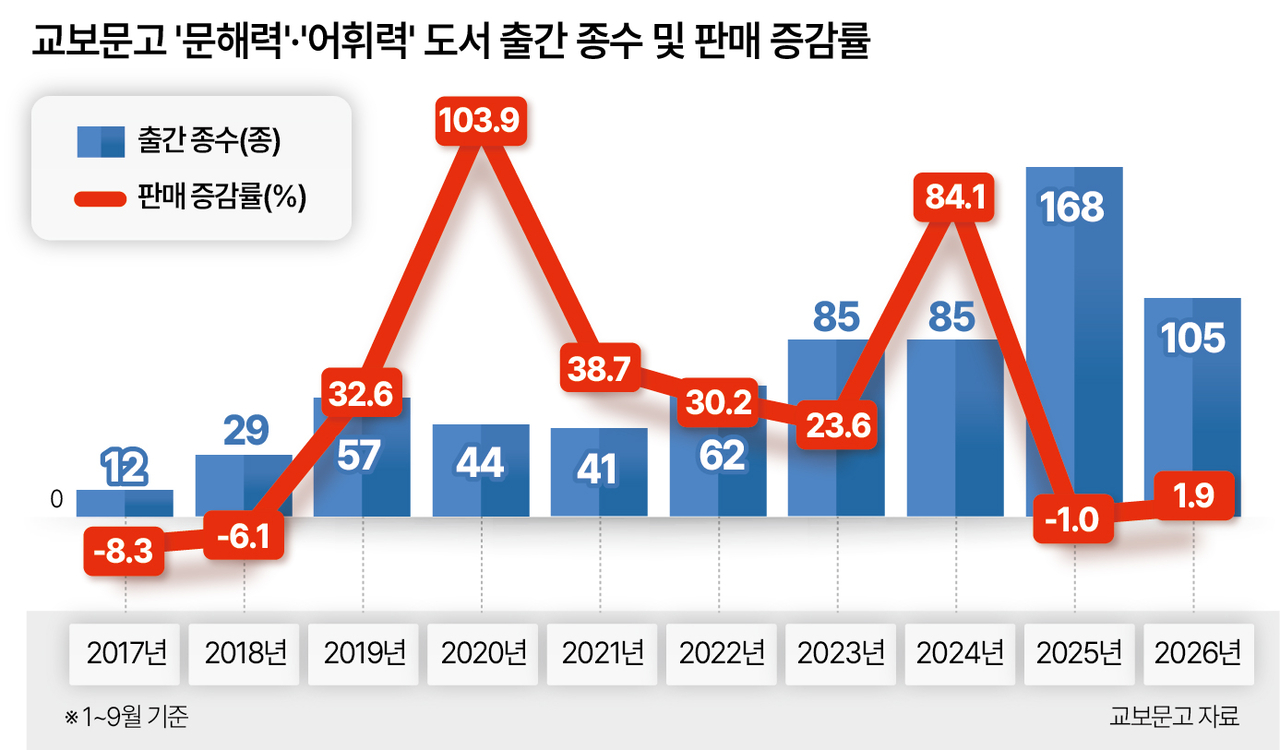
By 2020, however, the number of new titles in the category had jumped to 44 — roughly four times the 2017 figure — and sales rose 103.9 percent. Last year, 168 titles were published, about 14 times the 2017 count. This year, interest has continued to grow, with 105 titles released and sales up 1.9 percent from the previous year.
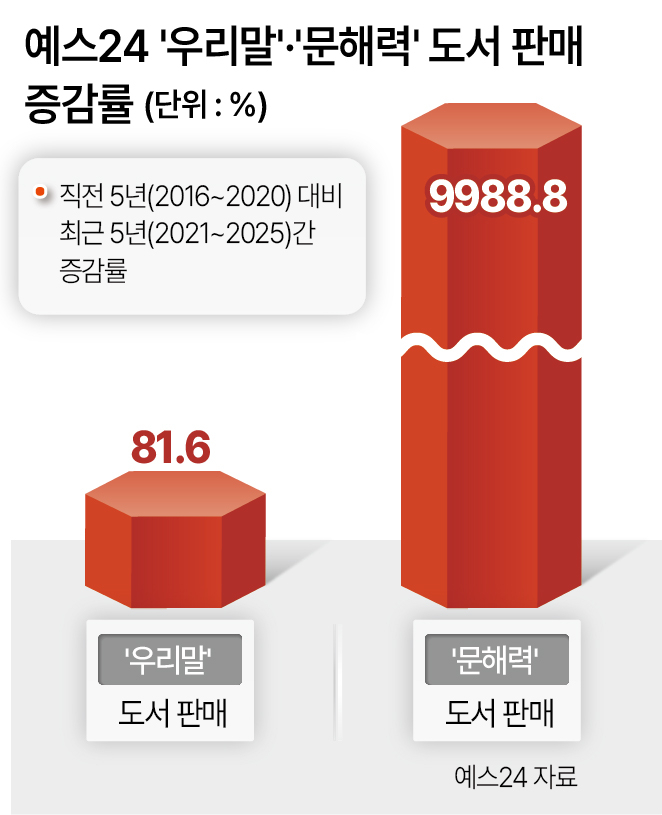
Online bookseller YES24 reported a similar trend: sales of Korean-language books over the five years from 2021 to 2025 rose 81.6 percent compared with the preceding five-year period from 2016 to 2020. Within that category, literacy-focused titles jumped 9,988.8 percent — more than 10,000 times the earlier level.
The surge in interest reflects growing alarm over a decline in literacy among younger Koreans. Incidents of people failing to understand common everyday words have multiplied — such as "uucheonsi" (in case of rain), "simsimhan sagwa" (a heartfelt apology), "jungsik" (lunch) and "saheul" (three days). As these episodes spread online as memes, parents in their 30s and 40s began seeking out literacy books for their children's education.
Analysts also point to a backlash against the short-form content and SNS era. As concerns grow that constant exposure to brief, fast-moving information is eroding people's ability to comprehend longer texts, younger readers in particular have been turning to literacy and writing books. The rise of "texthip" — a trend among people in their 20s and 30s that treats reading and text-based culture as fashionable — has further fueled demand for literacy improvement.
Some observers argue that the spread of AI in daily life has also heightened interest in literacy. Getting the most out of AI tools depends less on asking questions freely and more on asking them well — and evaluating AI-generated content requires a higher level of reading comprehension than most people currently possess. Because AI can present inaccurate information convincingly, literacy is essential not only for judging the credibility of information but also for distinguishing fact from opinion.
"As short-form content and SNS have normalized the consumption of brief, rapid information through digital platforms, people's literacy has weakened," an official in the publishing industry said. "As this phenomenon has drawn social attention, interest in related books has grown."
carrier@heraldcorp.com