Homes with assessed value above 1.2 billion won up 92% in Gyeonggi Province year-on-year
99% of gains concentrated in 10 cities including Seongnam, Suwon and Gwacheon
![An aerial view of Bundang-gu, Seongnam. [Seongnam City]](https://wimg.heraldcorp.com/news/cms/2026/10/08/news-p.v1.20260120.520fa8baaa704f319e874c05ed481b1c_P1.jpg)
The number of homes in Gyeonggi Province with a government-assessed value exceeding 1.2 billion won ($896,000) has nearly doubled in a single year, as the surge in Seoul housing prices spills over into surrounding areas. High-end homes are multiplying rapidly not only in established pricey enclaves such as Seongnam, Suwon and Gwacheon, but also in Anyang, Gwangmyeong and Hanam.
Gyeonggi homes assessed above 1.2 billion won surge 93.7% in a year
Property tax data that the Gyeonggi Provincial Tax Administration submitted to the National Assembly's Finance and Economy Planning Committee show that the number of homes in Gyeonggi Province with a publicly assessed value above 1.2 billion won reached 100,516 this year, up 48,248 from 52,268 last year — a 92.3% increase. In effect, the province's stock of high-end homes doubled in a single year.
The jump in homes priced above 1.2 billion won stood out across all price brackets. Homes assessed at 300 million won or less fell from 3,810,236 last year to 3,767,252 this year, a decline of 42,984 units, or 1.1 percent. Those in the 300 million to 600 million won range also edged down, from 1,641,848 to 1,639,977, a drop of 1,871 units, or 0.1 percent.
By contrast, homes assessed between 600 million and 900 million won rose from 344,298 to 384,424, an increase of 40,126 units, or 11.7 percent. Those in the 900 million to 1.2 billion won range climbed from 96,146 to 137,392, up 41,246 units, or 42.9 percent.
Analysts note that the assessed-value realization rate — the ratio of the official assessed price to market value — held steady at 69 percent in both years, meaning the sharp rise in homes crossing the 1.2 billion won threshold reflects actual price gains rather than any change in assessment methodology. This year's assessed values incorporated only market price movements, with the realization rate unchanged from the prior year.
At a 69 percent realization rate, an assessed value of 1.2 billion won corresponds to a market price of roughly 1.74 billion won. The near-doubling of homes above that assessed threshold signals that properties trading at around 1.7 billion won or more have been multiplying rapidly across Gyeonggi Province as well.
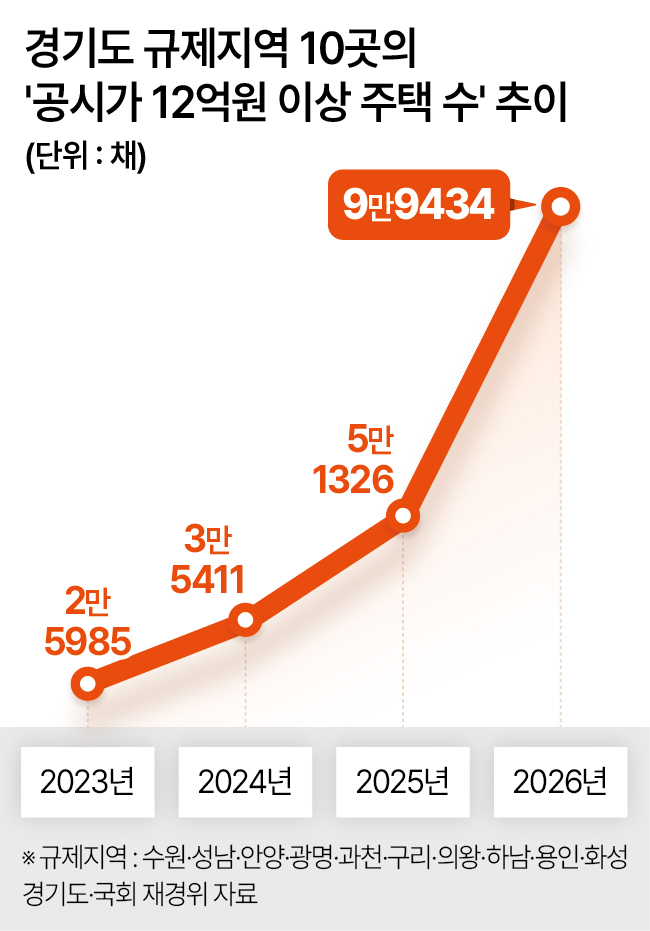
The growth in high-end homes was concentrated in major cities close to Seoul. Ten cities — Suwon, Seongnam, Anyang, Gwangmyeong, Gwacheon, Guri, Uiwang, Hanam, Yongin and Hwaseong — designated as speculative overheating districts, adjustment target areas or land transaction permit zones, together recorded 99,434 homes with assessed values above 1.2 billion won this year. That accounts for 98.9 percent of the province-wide total of 100,516.
The number of homes above 1.2 billion won in those 10 cities rose from 51,326 last year to 99,434 this year, an increase of 48,108 units. The 93.7 percent growth rate exceeded the province-wide average and represents nearly a fourfold increase from the 25,985 units recorded three years ago in 2023.
According to the Ministry of Land, Infrastructure and Transport, assessed values for apartments in Gyeonggi Province rose 6.37 percent this year from a year earlier. While that trails Seoul's 18.60 percent increase, assessed values in areas where home prices climbed sharply have been crossing the 1.2 billion won mark in rapid succession.
Seongnam adds 34,000 units; Anyang sees nearly ninefold surge
By city, Seongnam recorded the largest absolute increase. The number of homes there with assessed values above 1.2 billion won rose from 34,115 last year to 68,302 this year, an increase of 34,187 units — a 100.2 percent gain that more than doubled the total in a single year.
Suwon added 2,282 units over the same period, rising from 2,890 to 5,172, a 79.0 percent increase. Gwacheon grew from 12,608 to 21,169, up 8,561 units, for a 67.9 percent gain.
In terms of growth rate, Anyang and Gwangmyeong stood out. Anyang's count of homes assessed above 1.2 billion won jumped from 79 last year to 690 this year, an increase of 611 units — roughly 8.7 times the prior-year figure.
Gwangmyeong more than quintupled, rising from 70 to 359 units, up 289. Hanam more than tripled, climbing from 718 to 2,451, an increase of 1,733 units.
Elsewhere, Uiwang rose from 43 to 91 units, Yongin from 391 to 522, and Hwaseong from 303 to 542. Guri also edged up from 109 to 136.
High-end homes spread to Seoul-adjacent cities and semiconductor belt
Analysts are paying particular attention to the rapid spread of homes assessed above 1.2 billion won beyond the traditional high-end strongholds of Seongnam and Gwacheon into Seoul-adjacent cities such as Anyang, Gwangmyeong and Hanam.
In Seongnam and Gwacheon, reconstruction expectations centered on Bundang and Pangyo are seen as the main driver of price gains. Anyang has similarly seen reconstruction hopes for the Pyeongchon new town feed into higher prices, fueling its sharp rise in high-end homes.
In Gwacheon, a 59-square-meter unit at Gwacheon Prugio Summit traded at 1.6 billion won in February 2025, but the most recent transaction — in August this year — came in at 2.24 billion won, more than 600 million won higher. In Anyang's Dongan-gu, a 131-square-meter unit at Mongnyeon 6 Complex set a new record high, rising from 1.5 billion won in May last year to 2 billion won ($1.49 million) in August this year — a 500 million won gain in just 12 months.
![An aerial view of apartments in Gwacheon, Gyeonggi Province. [Herald DB]](https://wimg.heraldcorp.com/news/cms/2026/10/08/news-p.v1.20260430.002a38c5cd3f47b2b883ff838eabef52_P1.png)
Gwangmyeong's price gains are attributed to its proximity to Seoul's Guro and Geumcheon-gu districts, compounded by active reconstruction and redevelopment projects. In Hanam, Yongin and Hwaseong, easy access to Seoul combined with expanding semiconductor industrial complexes and growing investment and employment by related companies are seen as additional factors pushing up home prices.
Ham Young-jin, head of Woori Bank's Real Estate Research Lab, said reconstruction issues in Seongnam's Bundang-gu and Sujeong-gu under the Special Act on Aging Planned Cities have been a key driver of price gains in Seongnam. He added that performance bonuses and in-house loans from Samsung Electronics and SK hynix — sometimes called "Samjeonnix" — have lifted prices not only in Hwaseong's Dongtan district but also in Yongin's Suji-gu, Suwon's Yeongtong-gu and Hanam.
In Dongtan, the 84-square-meter unit at Dongtan Station Lotte Castle — widely regarded as the area's flagship apartment — traded at 2.225 billion won in June this year, surpassing the 2 billion won mark.
Ham added that while price gains had previously been confined to Bundang and Gwacheon, other areas are now seeing a "price alignment" effect driven by lending regulations, with values rising more broadly across the region.
hss@heraldcorp.com