Capital gains tax applies even when gifted land is compulsorily acquired
Gift-then-sell within 10 years triggers carryover taxation on real estate
Project approval date determines tax treatment
Non-business land subject to 10-percentage-point surcharge
15% exemption available for cash compensation — if conditions are met

Housing costs, food, transportation — money seems to drain away just by being alive. But there is one more expense that quietly runs through everyday life without drawing much attention: taxes. Drawing on real consultations with tax-planning specialists, this column breaks down the tax dilemmas ordinary people face. Welcome to the Tax Advice Desk.
"The government is taking my land — and I owe that much in taxes?"
Lee Woo-ri received a piece of land in Gwangmyeong, Gyeonggi Province as a gift from her father four years ago. She recently received a shock: the land, reported at 500 million won ($373,000), was included in the Gwangmyeong-Siheung public housing district, and she was set to receive 1 billion won in cash compensation this year. Only then did she learn that compulsory acquisition by the state does not exempt a landowner from capital gains tax.
What baffled her even more was how the tax would be calculated. She was told that in some cases the taxable gain would be based not on the 500 million won value at the time she received the gift, but on the 200 million won her father paid for the land back in 2001. She had already paid gift tax and acquisition tax when she received the property — so why, she wondered, should her father's original purchase price enter the picture at all?
Unable to make sense of it, Lee sought out a tax consultant to understand how capital gains tax is calculated on compulsorily acquired land and whether there was any way to reduce the burden.
Q. I was thrilled to finally receive compensation for my land — but does the state really collect capital gains tax even when it takes land for a public project?
A. Yes. What matters under capital gains tax law is not whether you sold voluntarily, but whether you transferred the asset and received money in return.
When you sell a house or land, you hand over ownership and receive payment. Compulsory acquisition for a public project works the same way: the landowner transfers the property and receives compensation from the state or the project operator. Tax law treats this as a "transfer" — the disposal of an asset for consideration — and capital gains tax applies accordingly. Even a forced auction triggered by unpaid debt is subject to capital gains tax.
That said, the tax is not levied on the full 1 billion won in compensation. The taxable gain is calculated by subtracting the acquisition cost and any related expenses from the proceeds. In Lee's case, the gain itself will differ depending on which acquisition cost is recognized — the full compensation amount is not simply multiplied by the tax rate.

Q. I received the land as a gift from my father four years ago and am now handing it over to the state — so why is my capital gains tax calculated as if my father sold it?
A. This is due to the "carryover taxation" regime, which is designed to prevent people from gifting property to family members and immediately selling it to reduce their capital gains tax liability.
Lee's father bought the land for 200 million won, and Lee later received it as a gift reported at 500 million won. If Lee's tax were calculated using the 500 million won figure, the gain on a 1 billion won transfer would be 500 million won. Using the father's original purchase price of 200 million won, the gain is considerably larger.
To prevent the acquisition cost from being artificially inflated through a gift — thereby shrinking the capital gains tax bill — tax law requires that when gifted real estate is sold within a certain period, the tax is calculated using the price the donor originally paid, not the value at the time of the gift. In plain terms, the fact that the father transferred land he bought for 200 million won to his child does not reset the tax calculation to 500 million won.
Under current rules, real estate gifted by a spouse or a direct-line family member is subject to carryover taxation if sold within 10 years of the gift. Gifts made on or before Dec. 31, 2022 are governed by the previous five-year threshold. Because Lee received the gift in January 2022 and the land was acquired by the state four years later, whether carryover taxation applies must be carefully examined.
Q. This feels deeply unfair. I did not receive the gift to avoid taxes, and I paid both gift tax and acquisition tax in full. Does my father's purchase price still apply in a case like mine?
A. Not necessarily. Carryover taxation does not apply automatically just because land was compulsorily acquired for a public project. Exceptions may apply depending on when the gift was received.
The key date here is the "project approval announcement date" — the day the government or project operator officially confirmed and publicly announced that the land would be used for a public project.
If the land was gifted more than two years before that date and was subsequently purchased through negotiation or compulsorily acquired for the public project, carryover taxation may not apply. Carryover taxation is also set aside when it would result in the property qualifying for the one-household, one-home capital gains exemption, or when the tax calculated without carryover taxation would actually be lower.
Lee received the gift on Jan. 10, 2022, and the project approval announcement date for the Gwangmyeong-Siheung public housing district was Nov. 29 of the same year. The gift therefore does not meet the requirement of having been received more than two years before the project approval date.
That, however, does not settle the carryover taxation question on its own. The tax must be calculated both ways — using the father's original purchase price and using the value at the time of the gift — and the results compared. The actual figures are worked through below.
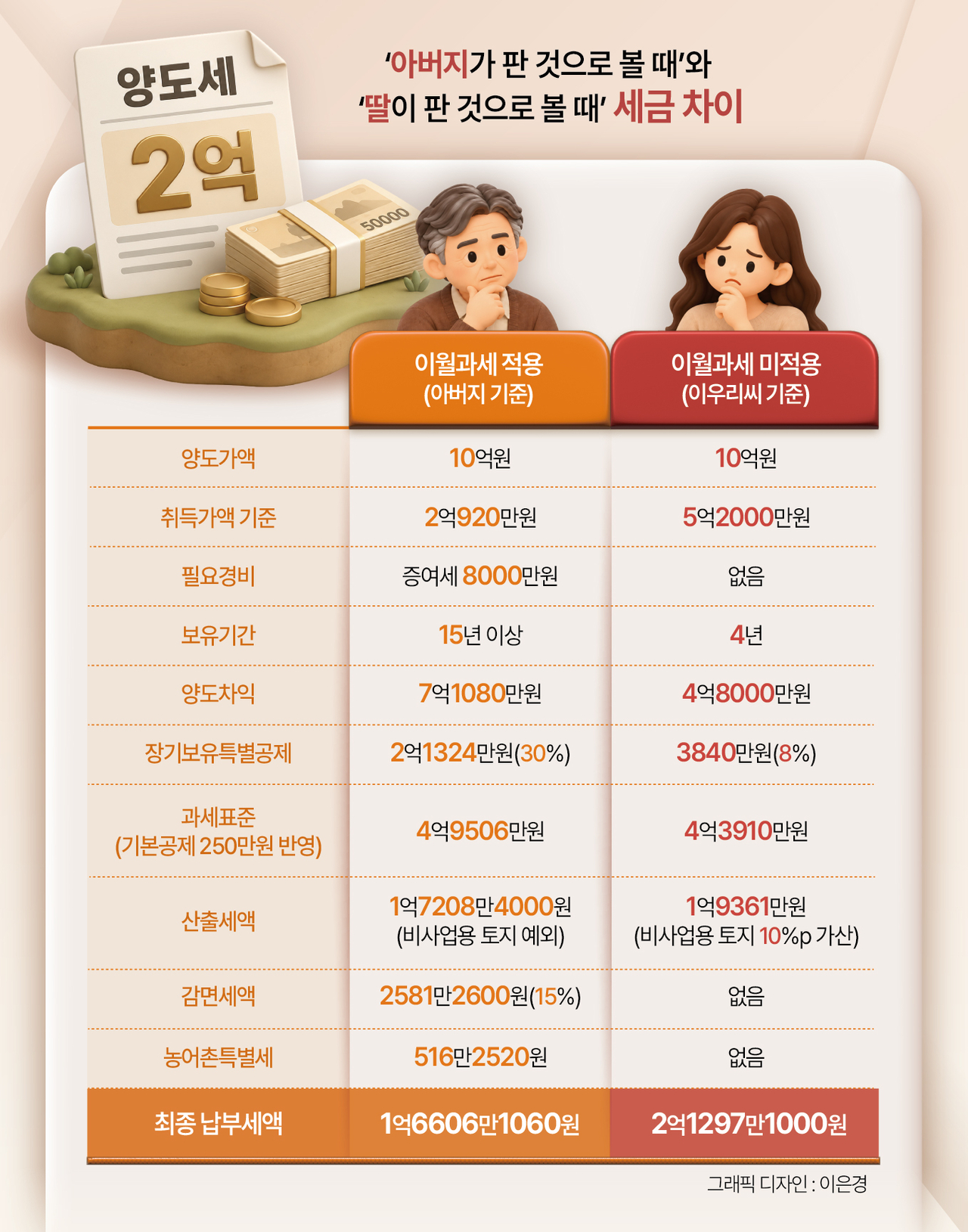
Q. Looking at the calculations, there are parts I do not understand. What is the 10-percentage-point surcharge for non-business land, and why is a special rural development tax added? Also, why can't I receive the same tax exemption as my father when we are both handing over land through the same acquisition process?
A. Let us go through each point.
First, "non-business land" refers broadly to land not being used for its designated purpose. The land Lee received as a gift is farmland, but neither her father nor she has farmed it directly. When the tax is calculated using Lee's acquisition cost, the land is therefore treated as non-business land, and 10 percentage points are added to the standard capital gains tax rate.
That said, land compulsorily acquired for a public project is not automatically classified as non-business land. Land acquired more than five years before the project approval announcement date may be excluded from the non-business land category.
Lee received the gift on Jan. 10, 2022, and the project approval announcement date was Nov. 29 of the same year — a gap of only about 10 months, which falls well short of the five-year requirement. When carryover taxation is applied and the holding period is traced back to the father's 2001 acquisition, however, the five-year threshold is easily met. That is why the 10-percentage-point surcharge does not apply when the calculation is based on the father's figures.
The tax exemption follows the same logic. When land is transferred for a public project, a 15 percent reduction in capital gains tax is available for cash compensation — but only if the land was acquired more than two years before the project approval announcement date.
Because Lee received the gift roughly 10 months before the project approval announcement, she does not meet that requirement. Calculated on her own acquisition cost, she receives no exemption. When the calculation is traced back to the father's 2001 acquisition, however, the two-year requirement is satisfied and the 15 percent reduction applies.
Finally, the special rural development tax. This levy is essentially a surcharge on the benefit received: when a capital gains tax exemption reduces the tax owed, a portion of the amount saved is collected separately as the special rural development tax — specifically, 20 percent of the exempted amount.
Under the father-based calculation, the capital gains tax exemption amounts to 25.81 million won, so 5.16 million won — 20 percent of that — is owed as the special rural development tax. Under Lee's own acquisition cost, no capital gains tax exemption applies in the first place, so no special rural development tax is owed either.
![[Herald DB]](https://wimg.heraldcorp.com/news/cms/2026/10/08/news-p.v1.20260813.01dff841bddb4ec1882f797f943c1569_P1.jpg)
Q. Looking at the numbers, it seems the gift actually made my tax bill larger. Did I agree to compensation too quickly? I have heard that requesting a formal adjudication can raise the compensation amount and lower the tax.
A. Not necessarily. Requesting a formal adjudication does not guarantee higher compensation or a lower tax bill.
A formal adjudication is a procedure in which the Land Expropriation Committee determines compensation and whether expropriation should proceed, invoked when a landowner and the project operator cannot reach agreement.
For tax purposes, the critical question is when the land is considered to have been transferred. When compensation is settled through negotiation — as in Lee's case — the date the compensation is received is treated as the transfer date. When the process moves to formal adjudication, the transfer date becomes the expropriation commencement date, the day legal ownership actually passes.
This distinction can be used strategically in some situations. A landowner facing acquisition of multiple parcels at once could, for example, transfer some through negotiation this year and route others through formal adjudication so that ownership passes next year, spreading the transfers across two tax years and potentially reducing the overall burden.
Formal adjudication does not guarantee higher compensation and can add time and cost to the process. Rather than assuming that adjudication will automatically raise the payout and cut the tax, landowners should weigh the compensation amount, the tax implications and the procedural costs together before deciding.
If you hear that your land may be included in a public project, resist the impulse to transfer it immediately. Seek thorough advice from a tax professional before taking any action.
[By Park Hye-rim / Hong Ja-young, tax consulting team, WM Business Strategy Division, Woori Bank]

rim@heraldcorp.com