Former general testifies troop readiness was unaffected; opposition lawmakers blast him for showing no remorse
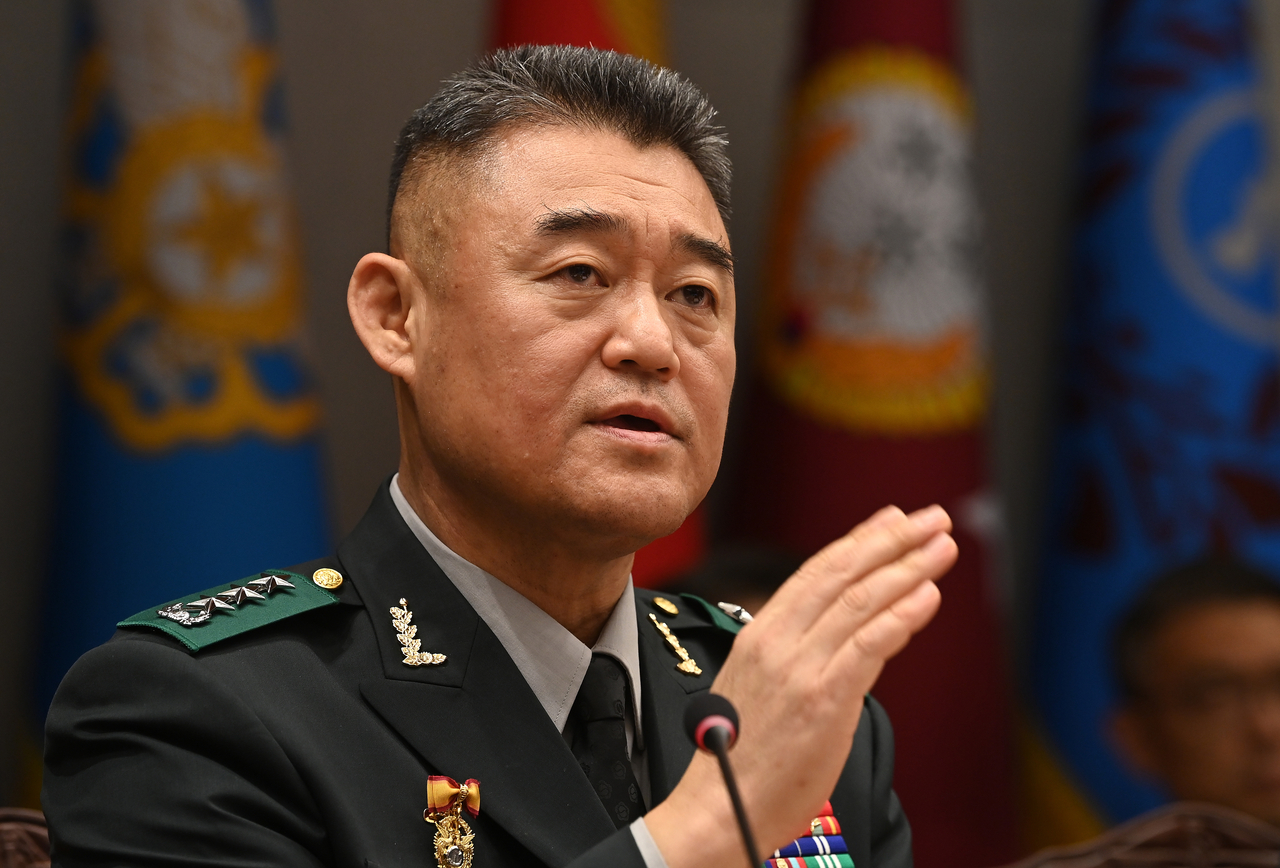
Han Ki-sung, the former commander of the Army's 1st Corps who sparked controversy by ordering frontline guard posts to keep their crew-served weapons unloaded, appeared as a witness at a national audit Thursday and insisted there had been "absolutely no problem with combat readiness."
Han, a lieutenant general, testified before the National Assembly's Defense Committee during its national audit of the Joint Chiefs of Staff. He has been relieved of his duties since August, when the unloaded-guard controversy first emerged.
Han opened by saying he was "sorry for causing concern to the public over this matter." He pushed back on the characterization of the policy, however, saying the term "unloaded gun" was inappropriate. "The ammunition box was attached to the crew-served weapon," he said, "but the difference was that the first round was not seated in the feed tray."
While the ammunition box itself remained connected to the K6 and K4 heavy machine guns, the actual rounds were not chambered. To fire, a soldier would have to open the weapon's cover, seat the first round, close the cover again, and work the charging handle back and forth before the weapon could be fired.
Han said that while loading rounds is standard procedure for frontline guard operations, he changed the guidelines to address manpower shortages and other operational constraints at forward posts. "The number of troops at guard posts has dropped significantly, and as remote-operating systems such as the KR6 and KR4 were introduced, the number of weapons increased — raising the demand for equipment safety inspections," he said. "I assessed that lowering one round from the feed tray would not compromise combat readiness." Han said the change was made after discussions with his staff and after gathering input from subordinate units, but that he did not separately report the measure to his superior command, the Army Ground Operations Command.
People Power Party lawmakers lambasted Han for endangering the lives of frontline troops without showing remorse. Lawmaker Lim Jong-deuk said, "The K6 heavy machine gun fires 10 rounds per second — even one second spent loading a round exposes soldiers' lives to danger. He still shows no reflection. Military discipline has completely collapsed." Lawmaker Seong Il-jong also criticized Han, saying, "When an enemy approaches a guard post, troops must return fire immediately and accurately — how is that possible if the weapon isn't loaded? The excuses Gen. Han is making are ones the public will not accept." Joint Chiefs of Staff Chairman Jin Yeong-seung addressed the controversy separately, saying there "had been a problem" and that he had ordered corrections. "All units are currently maintaining loaded weapons," he said.
kty@heraldcorp.com