Young adults with severe obesity face roughly 40% higher 10-year cancer risk than those of normal weight; Catholic and Soongsil university researchers tracked about 6.3 million adults aged 20–39
The more obese young adults in their 20s and 30s are, the higher their risk of developing cancer within 10 years — and abdominal obesity measured by waist circumference is linked to cancer risk that body mass index alone may fail to capture, a large-scale study has found.
The research was conducted jointly by Son Jang-won, a professor of endocrinology at Catholic University's Bucheon St. Mary's Hospital; Yoon Jae-seung, a professor of endocrinology at St. Vincent's Hospital; and Han Kyung-do, a professor of information statistics and actuarial science at Soongsil University. The research team tracked about 6.3 million adults aged 20 to 39 with no prior cancer history who had undergone national health screenings, following them for an average of 11.2 years.
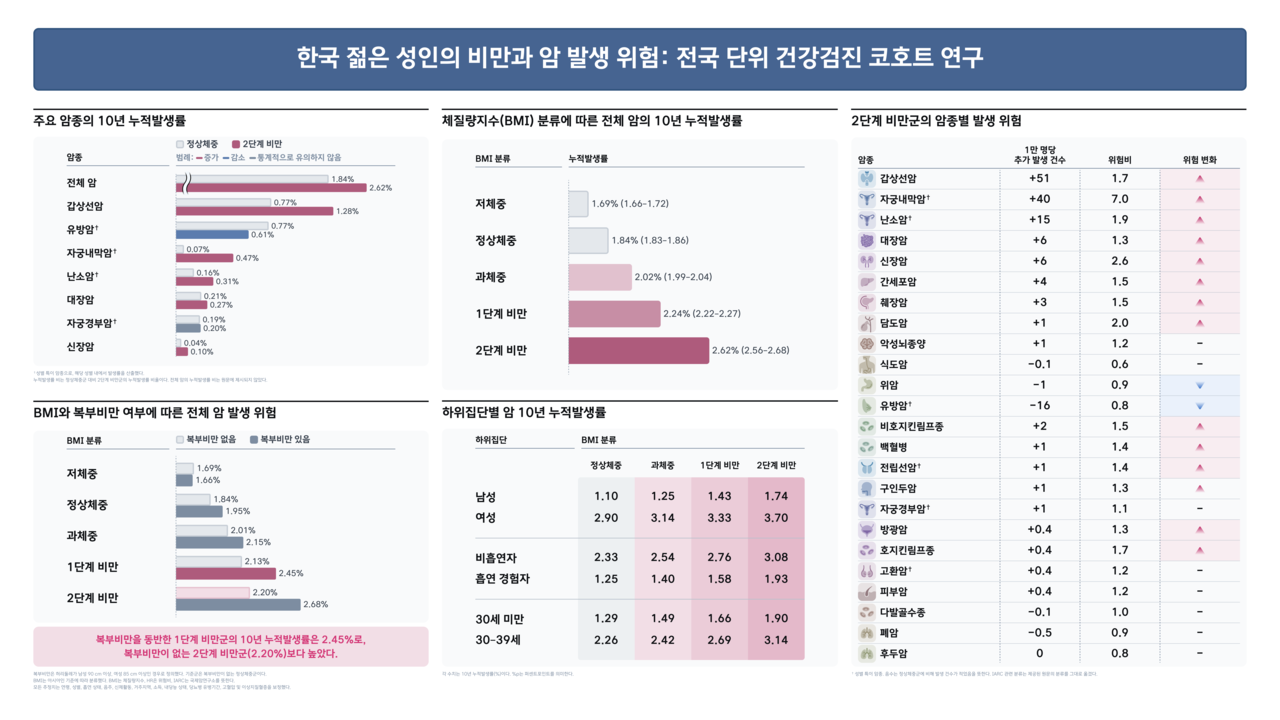
Using Asian-standard BMI thresholds, participants were divided into underweight, normal weight (18.5–22.9), overweight (23–24.9), class 1 obesity (25–29.9) and class 2 obesity (30 or above), and cancer incidence was analyzed across groups. After adjusting for lifestyle factors and metabolic conditions, the 10-year cumulative cancer incidence was 1.84 percent in the normal-weight group, 2.24 percent in the class 1 obesity group and 2.62 percent in the class 2 obesity group — rising consistently with obesity severity. In practical terms, roughly 1 in 54 people in the normal-weight group and 1 in 38 in the class 2 obesity group received a cancer diagnosis over the decade.
The research team also analyzed abdominal obesity — defined as a waist circumference of 90 centimeters or more in men and 85 centimeters or more in women — alongside BMI. The 10-year cancer incidence in the class 1 obesity group with abdominal obesity was 2.45 percent (about 1 in 41), higher than the 2.20 percent (about 1 in 45) recorded in the class 2 obesity group without abdominal obesity. The finding suggests that even a higher BMI carries relatively lower risk when abdominal obesity is absent.
The increase in cancer incidence associated with obesity was particularly pronounced among women and adults in their 30s. By cancer type, thyroid cancer, endometrial cancer and ovarian cancer showed the most marked differences by obesity level. The endometrial cancer incidence in the class 2 obesity group was about seven times higher than in the normal-weight group.
Early-onset cancers — those occurring before age 50 — have been rising in recent years, and obesity rates among young people have consistently increased as well. However, most existing research on obesity and cancer has focused on middle-aged and older populations, leaving a gap in large-scale evidence on how obesity relates to cancer risk in young adults. This study addresses that gap by tracking more than 6.3 million young adults over an extended period to examine the association between obesity and cancer incidence.
Son and Yoon said the study confirmed that obesity in young adults has an important association with rising cancer rates seen even in younger age groups. "Abdominal obesity can serve as a key indicator for distinguishing cancer risk, which is why it is important to manage not just body weight but also waist circumference from a young age," they said.
As an observational study, however, the research cannot establish a causal relationship between obesity and cancer development. Further research is needed to determine whether weight loss reduces cancer risk. The findings were published in Annals of Internal Medicine (impact factor 17.3), a leading international journal of internal medicine. The paper is titled "Obesity and Cancer Risk in Young Adults in Korea: A Nationwide Health Screening Cohort Study."
kty@heraldcorp.com