Special exhibition 'Typewriter, a Machine That Writes'
Opens Friday to mark 100th anniversary of Hangul Day; runs through Jan. 23
More than 40 hangul typewriters on show at G Valley Industrial Museum
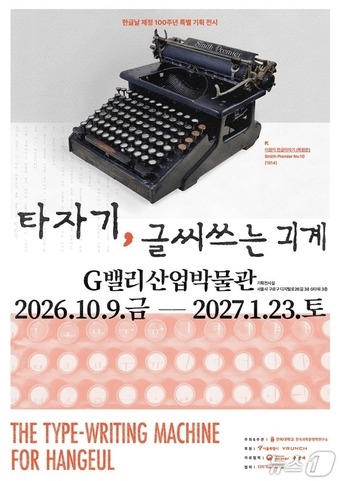
To mark the 100th anniversary of Hangul Day, Seoul will display more than 40 typewriters tracing the evolution of the hangul keyboard — including a restored replica of the first hangul typewriter, built in 1914.
The Seoul Metropolitan Government's G Valley Industrial Museum said it will open a special exhibition titled "Typewriter, a Machine That Writes" at its planning gallery starting Friday, coinciding with both the centennial of Hangul Day and the 100th anniversary of the promulgation of Hunmaengjeongeum, the tactile writing system for the visually impaired.
Running through Jan. 23, the exhibition will feature more than 40 hangul typewriters alongside photographs, video materials and other visual resources.
Highlights include a restored replica of the "Yi Won-ik Eonmun Typewriter," widely regarded as the first hangul typewriter, as well as Gong Byeong-u's three-set typewriters and custom-modified machines that reflect individual makers' styles following the standardization of the hangul keyboard.
Together, the exhibits document more than 80 years of transformation — from vertical to horizontal writing, from mixed hanja usage to pure hangul, and the various mechanical approaches explored to render hangul on a machine, including block-style and linear arrangements of characters.
The exhibition is divided into four zones. The first covers early hangul typewriters produced between the 1910s and 1950s, with a particular focus on the restored Yi Won-ik Eonmun Typewriter — making its public debut. Yi Won-ik, a Korean American, built the machine in 1914 by modifying a Smith Premier No. 10 typewriter in the United States.
The second zone compares three-set and five-set typewriters that appeared before the hangul keyboard was standardized in 1969. On display are the first through fourth generations of Gong Byeong-u's three-set typewriter and Kim Dong-hun's five-set typewriter.
The third zone examines the standardization process itself. After Prime Minister Directive No. 81 of July 1969 established four-set and two-set hangul keyboard standards, domestic and foreign manufacturers produced a range of typewriters — several of which are featured here.
The final zone showcases modified typewriters used by enthusiasts who still type on them today, alongside collaborative works created with artists.
The history of the hangul typewriter is also a history of technical experimentation — of competing ideas about how to arrange and combine the initial, medial and final consonants and vowels of hangul on a mechanical keyboard. Government standardization and the spread of computers eventually settled the debate, establishing the two-set keyboard now in common use.
Four academic forums tied to the exhibition will also be held, bringing together researchers and members of the public to discuss the background behind the government's standard keyboard policy, questions of user choice in hangul keyboard design, and the industrial and cultural significance of mechanizing hangul.
The museum is open Tuesday through Saturday, 10 a.m. to 6 p.m., and admission is free. Further details are available on the G Valley Industrial Museum website.
Kim Hyeon-u, director of the Seoul Metropolitan Government's economy bureau, said the hangul typewriter "is an important medium that reflects not only the standardization of the hangul keyboard but also the broader changes in industrial technology and everyday culture." He added that he hoped the exhibition would offer visitors "a fresh opportunity to discover the unique technological and cultural value that this analog machine brought to our society, and to deepen their understanding of hangul culture."
ken@heraldcorp.com