Companies partner with AI firms to monitor fake listings online
Customs agencies, law enforcement enlisted for on-site crackdowns
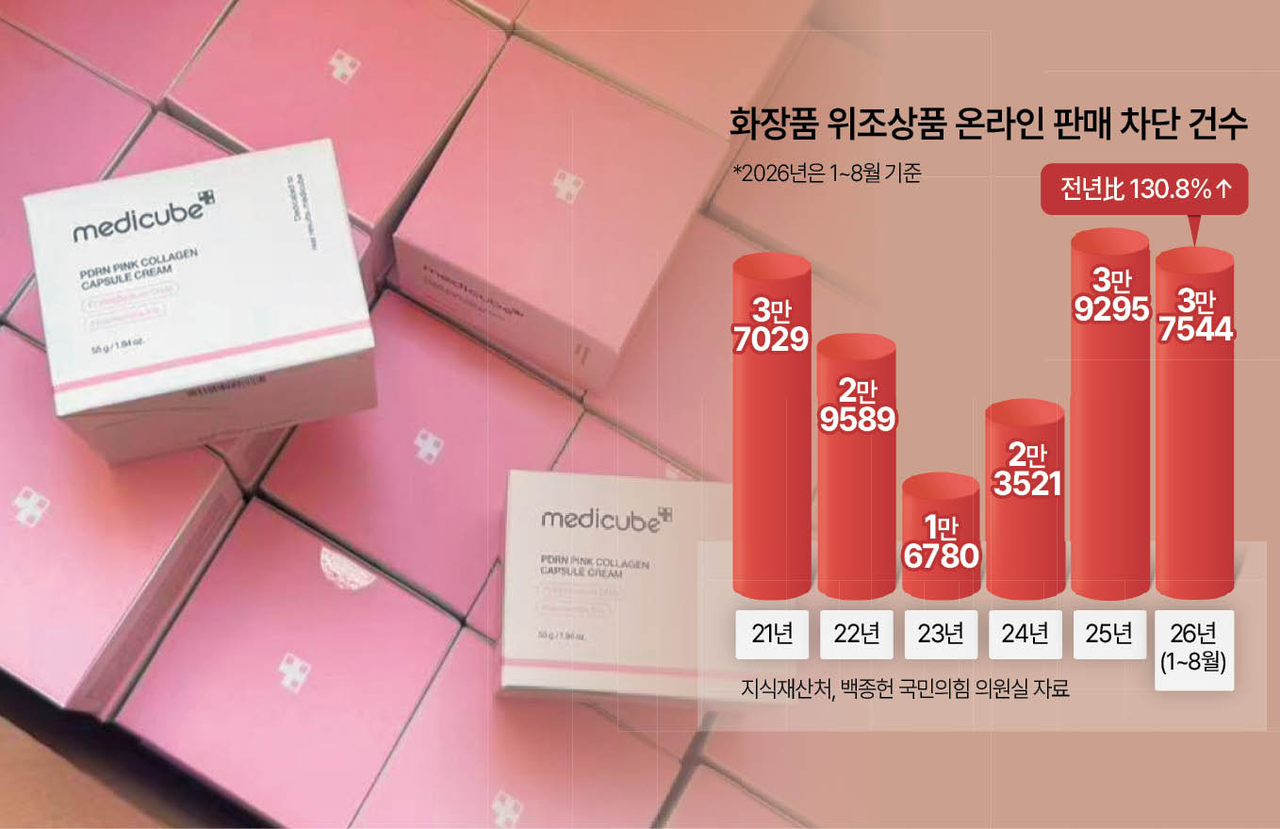
37,544 counterfeit listings blocked in first eight months of this year
Government launches official authentication program to protect K-brands
South Korea's popular cosmetics industry brands are stepping up their fight against a growing wave of counterfeits that threatens to erode consumer trust. Companies have built dedicated anti-counterfeiting systems, and the government has joined the effort with a new authentication program.
PharmaResearch, known for its skin booster Rejuran, recently won a trademark infringement lawsuit and has signaled it will take a hard line against copycat branding and imitation marketing, according to industry sources.
PharmaResearch had filed suit at Seoul Central District Court against parties manufacturing and selling a herbal acupuncture product containing polynucleotide (PN) ingredients. The court ruled in PharmaResearch's favor, finding that the defendant's "Mijuran" mark was highly similar in appearance and name to Rejuran. The court noted that both products target the same consumer base, that Mijuran had been directly compared to and promoted alongside Rejuran at oriental medicine clinics, and that ordinary consumers would have difficulty distinguishing between the two given differences in regulation and licensing — all factors pointing to a likelihood of consumer confusion over the products' origins.
To block counterfeits, PharmaResearch uses around-the-clock AI image and text analysis through a specialized security firm that monitors major domestic and international e-commerce platforms, open marketplaces and social media. When signs of irregular distribution are detected in overseas markets, the company works with local customs authorities and law enforcement to conduct on-site crackdowns.
Goodal Global, which owns brands including Beauty of Joseon, TIRTIR and Skin1004, has built a response system covering every stage from manufacturing to customs clearance to retail distribution. At the manufacturing stage, the company works with local investigators and law enforcement in China — where counterfeit production is concentrated — to track down production and storage facilities. At the customs stage, it has registered its trademarks with more than 30 customs agencies in South Korea, the United States, the EU, China and Japan, and has set up a system to flag suspicious shipments. At the distribution stage, it partners with an AI firm to detect counterfeit listings online in real time. Reports and takedowns in the first half of this year rose 25 percent and 31 percent, respectively, compared with the same period last year.
![Goodal Global's intellectual property team conducts training for customs officers on how to distinguish genuine products from counterfeits. [Provided by Goodal Global]](https://wimg.heraldcorp.com/news/cms/2026/10/09/news-p.v1.20261009.4a8c7fd8395c4d699cc3714393c0022d_P1.jpeg)
Brands have been pushed into action as counterfeits deal a direct blow to their reputations. A case in point came in August, when APR — the top K-beauty company by market capitalization — faced a product recall in Singapore involving its Medicube PDRN Pink Collagen Capsule Cream. Singapore's Health Sciences Authority ordered the recall after detecting Sudan Red-class dyes, a prohibited ingredient, in samples of the product distributed through a local retailer called Venus Beauty.
APR found no record of the sampled products having been officially exported to Singapore, and Venus Beauty turned out to be a company APR had never supplied. The Health Sciences Authority subsequently lifted its sales and supply suspension, and industry observers raised the possibility that the products in question were counterfeits. Still, APR's share price swung sharply on the news.
Online, foreign consumers have posted guides on how to spot fake K-beauty products on YouTube and other platforms. On Reddit, numerous posts ask questions such as "Did I get fake Beauty of Joseon?" — reflecting widespread consumer anxiety about counterfeit purchases.
The number of suspected counterfeit listings blocked each year has been rising steadily. According to data submitted to the office of People Power Party lawmaker Baek Jong-heon of the National Assembly's Health and Welfare Committee by the Korea Intellectual Property Office, 37,544 listings of counterfeit cosmetics were blocked on domestic and international online platforms between January and August this year — a 130.8 percent increase from 16,270 cases in the same period last year. Annual blocked listings have climbed from 16,780 in 2023 to 23,521 in 2024 and 39,295 in 2025.
The government is also tightening its response. The Korea Intellectual Property Office announced Wednesday that it would launch a "Government Certification for K-Brands" program. Under the program, a state-certified trademark — with the government acting as the rights holder — is affixed to K-brand products, and the government exercises trademark rights if those rights are infringed. Consumers can scan the trademark with a smartphone camera to instantly verify whether a product is genuine. So far, 31 companies have applied to join, including Samyang Foods, Amorepacific and Korea Ginseng Corp., along with a number of small and medium-sized enterprises.
soho0902@heraldcorp.com