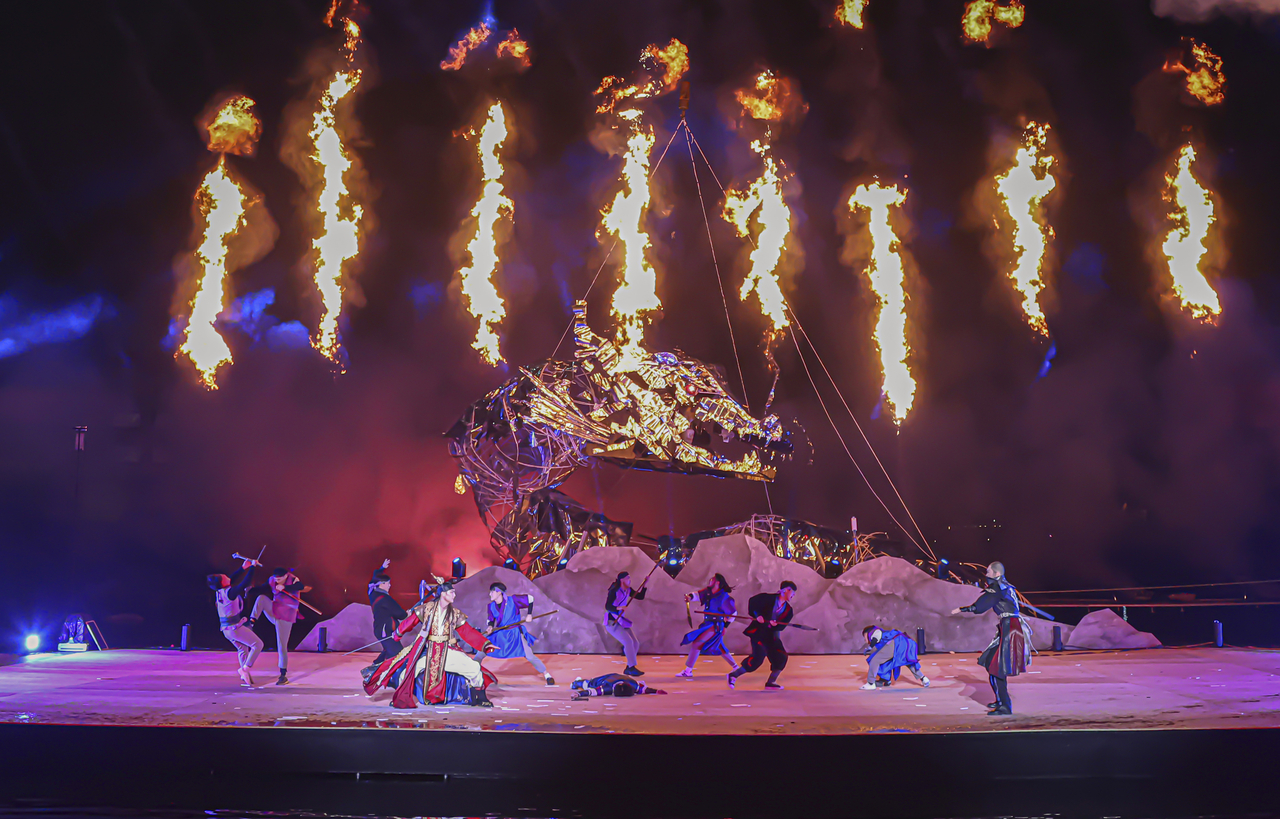
'Ahra,' choreographed by Bae Jin-ho, runs through Sunday as part of 'Double Bill: Sinawi'
Duo with no excess, no habit — a duet like an action-film fight sequence
Met at Yewon School over 20 years ago: 'One look and we just know'
![Lee Yo-eum and Park Hye-ji perform a duet in "Ahra," choreographed by Bae Jin-ho, as part of the National Dance Company's "Double Bill: Sinawi." [National Theater of Korea]](https://wimg.heraldcorp.com/news/cms/2026/10/09/news-p.v1.20261009.93b2ce26ae0b4d98b8a4fe81d6d1492c_P1.jpg)
Heavy footsteps press into the stage, one after another. The Arirang pass has been crossed a hundred times — this is the hundred and first. When those feet have ground their way across the boards, the air shifts, driven by the pulse of electronic music that squeezes at the chest. A group walks in a catwalk strut, torsos tilted roughly fifteen degrees off-center. Is it the prelude to battle, or the first crack in something about to break? At opposite ends of the vast stage, two figures lock eyes across the distance and begin to move toward each other.
The standoff is breathless. As the BPM climbs and the audience's heartbeats tighten with it, the two close the gap — slow and heavy as lionesses on the hunt, yet sharp and quick. They approach each other warily, claws of aggression kept hidden. They seize each other with animal hands, bodies tangling, faces erupting into roaring expressions of threat. Every push and retreat, every flash of attack and defense, is woven together with not a fraction of an error between them. The same breath, the same gaze, not a gesture wasted. Each becomes the other's body, the other's emotion. Like a fight sequence in a tightly crafted action film, the movement hurtles forward breathlessly; in the pitch-black dark, their hands and feet interlock like precision gears.
"Dating, marriage, having children — over twelve years together in the company, we have watched each other from so close up. Even in the scenes where we are fighting, we are actually leaning on each other enormously." (Park Hye-ji and Lee Yo-eum)
This is "Ahra," choreographed by Bae Jin-ho (32), part of the National Dance Company's new production "Double Bill: Sinawi," running through Sunday at the National Theater of Korea's Haeoreum Grand Theater. The work is filled with a boldness rarely seen on the National Dance Company's stage. At the center of that taut tension stand the company's marquee dancers, Park Hye-ji (38) and Lee Yo-eum (37).
Park, who sat down for an interview at the National Theater recently, said the work felt like "a single human life told in its entirety."
![National Dance Company dancers Lee Yo-eum (left) and Park Hye-ji. [Yoon Chang-bin]](https://wimg.heraldcorp.com/news/cms/2026/10/09/news-p.v1.20260929.52ab1ee09d36438da19985e9927685ed_P1.jpg)
A duet like an action film — bodies stripped of all excess
If K-pop girl group aespa has its "Jiminjeong" pairing (Karina and Winter) and IVE has its "Annyeongz" (An Yu-jin and Jang Won-young), the National Dance Company has these two. Perfect visuals, seamless chemistry. Park Hye-ji and Lee Yo-eum are the company's own Jiminjeong and Annyeongz.
The thought of synchronized group choreography flickers to mind, then dissolves. Full-body tights that leave nothing of the physique to the imagination strip the movement down to its clearest, most unadorned form. Two dancers who have spent their entire lives in Korean dance produce a contemporary movement vocabulary with no sense of incongruity — instinctive, predatory gestures that look ready to spring at any moment, and layered within that release and eruption, the footwork and clean lines of Korean dance accumulated over a lifetime. Dance and performance wash in like a tide, and the emotion that crosses the stage transfers directly to the audience. It is the emotion of every agonizing moment.
Even for veteran company members, the work was not easy. The unexpected obstacle was not the difficulty of the choreography but the costumes — full-body tights that left the body, as Park put it, "nakedly exposed." "In previous works we wore skirts or wide-legged trousers, so having the body on show felt very strange," she said with a laugh. She explained that Korean dance diverges from Western dance precisely in the lower body. "Wearing tights changed how I moved when I extended my legs — the way I used my feet, legs and hips shifted," she said. "Dancing with the body held tight brought a tension to the movement, and I became much more conscious of position and line. It was a fresh challenge even for us."
Above all, neither dancer carries superfluous movement. They do not bring along the habits or ornamental flourishes that tend to settle into a dancer's body over the years. Where those have been shed, only the clean outline of each gesture remains. That is not something they were born with — it is something they have kept.
![Lee Yo-eum and Park Hye-ji perform a duet in "Ahra," choreographed by Bae Jin-ho, as part of the National Dance Company's "Double Bill: Sinawi." [National Theater of Korea]](https://wimg.heraldcorp.com/news/cms/2026/10/09/news-p.v1.20261009.d0b6f0a7cacd47ebb0713f32d60a5fc0_P1.jpg)
"I have a fairly firm belief that you should dance cleanly, without habits or mannerisms. I think they become an obstacle when you are learning choreography from different choreographers. We call it 'kuze' — the Japanese word for a wall, a habit — and the conviction that we must avoid that has become something of a personal creed." (Park Hye-ji)
Lee nodded as she listened to Park speak. Their dancing resembles each other: precise and clean. "Unni's dancing is truly exact in its timing and movement — there is nothing to fault," Lee said. "I learn from her that emotion can be conveyed through the feeling of the movement and gesture alone, without having to push the emotion outward." For Park, Lee's dancing holds the same quality.
The paradox of the hundred-and-first pass — the gaze that sustains a fighting dance
"Let's see how long those two last." "Give it six months and they'll have gone their separate ways."
Such words circulated among the company's senior dancers as they watched the two inseparable newcomers. In a world of fierce competition — where one dancer's rise to a lead role means another stays in the supporting cast — it was a prophecy of sorts: that the harsh reality would eventually shake even their bond.
![National Dance Company dancers Lee Yo-eum (left) and Park Hye-ji pose before an interview with The Herald Business at the National Theater of Korea in Jung-gu, Seoul. [Yoon Chang-bin]](https://wimg.heraldcorp.com/news/cms/2026/10/09/news-p.v1.20260929.094ee2285d1b47329b9e052716534d42_P1.jpg)
Both joined the company in 2014 and have since become its most celebrated pair. Their connection goes back further still. They first met as students at Yewon School — two years apart in school grade — and went on to attend Seoul Arts High School and the Korea National University of Arts together, a pair of dance prodigies moving in lockstep. "We studied under the same teacher," Park said. "We have been together for twelve years in the company, spending more time with each other than with our own families," Lee added. The prophecy turned out to be completely wrong.
Sharing a duet on stage is something of a rarity for them. Within the company, it is their first since "Man Made" in 2018 — eight years ago. The roughly two-to-three-minute confrontation, fierce and unrelenting, is possible precisely because it is these two. Park plays a mother and leader who guides the group; Lee plays a member who follows her yet also stands against her. Their fight is a scene from human life — holding each other close while keeping each other in their sights. What sustains them through that fight is the very person they are fighting. The duet comes at the point in the piece where the dancers are most physically spent, after running through everything that came before.
"I think it is just the look in each other's eyes. There is a strength that comes from the eye contact we share. In those moments, we draw energy from each other." (Park Hye-ji)
The rehearsal days were intense. There was no shortage of things to align in every scene. "The choreographer is incredibly meticulous and detail-oriented, so we kept rehearsing until everything matched not just on the beat but on the 'one-and,'" Lee said. Both are certain that their seamless unison is the product of the hours they put in.
![Lee Yo-eum and Park Hye-ji perform a duet in "Ahra," choreographed by Bae Jin-ho, as part of the National Dance Company's "Double Bill: Sinawi." [National Theater of Korea]](https://wimg.heraldcorp.com/news/cms/2026/10/09/news-p.v1.20261009.2ace4b401b9e4357b3bfd6a9363ade97_P1.jpg)
Sheer rehearsal hours, of course, are not the whole story. The length of time they have spent together has given those hours their luster. "Because we know each other's dancing so well," Park said, a single gesture is enough — no words needed. The fact that they are "like family, able to share any opinion freely," and can read each other with nothing more than a glance, as Lee put it, is what makes their dancing look different from anyone else's.
These days, every time they find their rhythm together, something passes between them. "Sometimes during rehearsal I suddenly feel a wave of emotion," Lee confided.
A swan on a still lake and a deep-rooted tree — each other's anchor
The National Dance Company's own Jiminjeong and Annyeongz never made a deliberate effort to grow close or reach out to each other. "It was not closeness through conversation — our bodies were just near each other," Lee said. "We were dyed by each other, naturally," Park added.
Their stage histories run in parallel. Park joined the company as an intern in 2011 and was cast in the lead role of the premiere of "Hoiori" in 2014, still as an intern. In the 2017 dance drama "Rijin," Lee played the title role of Rijin while Park played Dohwa — two court dancers oscillating between friendship and envy. Nine years on from that production, the two have always been at each other's side. "If our personalities had not been compatible, we might not have been able to stay together," Park said with a laugh, noting that they are alike not only in temperament but even in taste in food.
They are not alike in every way, however. On and off the stage, the decisive difference between them lies in their emotional temperature — and it is that difference which breathes distinct feeling and expressiveness into the same movement. It is why they fill each other with different colors and why the stage shines when they are on it together.
![National Dance Company dancers Lee Yo-eum (left) and Park Hye-ji. [Yoon Chang-bin]](https://wimg.heraldcorp.com/news/cms/2026/10/09/news-p.v1.20260929.01add09285d84caf998dbead1d831315_P1.jpg)
In Park's eyes, Lee is "a single swan floating on a tranquil lake." "When I was young, what I envied about Yo-eum was her sensitivity," Park recalled. "When I was forcing emotion out of myself, she was already in a state of complete immersion doing the exact same thing." In school grade they are two years apart, in age barely one — yet to Lee, Park is a great tree. "On the outside she seems delicate, but inside you feel deep roots driven firmly into the ground," Lee said. "The energy that comes out in her dancing puts men to shame." She went on to say: "I sometimes lose the movement because the emotion takes over first, and watching unni makes me think a lot about becoming a dancer who can be more precise." Having watched each other for so long, the two have used each other's dancing as a mirror and arrived at the same place.
"If there were no admiration, no sense that we still have further to go together, company life could become tedious work. But dancing together always gives me the feeling that we are still moving forward, so it always feels exciting." (Lee Yo-eum)
The two, who had always been inseparable, each passed through their own private time as marriage and childbirth came. Racing ahead as lead dancers, they crossed yet another pass in life as they built their families. "After having my baby, strangely enough, we started getting cast in separate projects," Park recalled. Each faced her own trials.
"When I first joined, I felt such a rush of liberation. I thought, I do not have to compete anymore, I do not have to audition anymore — I was so happy that I did not even notice how hard it was, and I just did everything I was told. Running forward with blinders on like a racehorse, I eventually hit a wall of complacency. The routine was always the same, like a hamster wheel, and within that I kept getting stuck." (Park Hye-ji)
![A scene from "Ahra," choreographed by Bae Jin-ho, as part of the National Dance Company's "Double Bill: Sinawi." [National Theater of Korea]](https://wimg.heraldcorp.com/news/cms/2026/10/09/news-p.v1.20261009.df26abd922784ba1be9cae6f6707d150_P1.jpg)
That was around her seventh year. Then COVID-19 arrived, and pregnancy naturally drew her away from the stage for a time. After giving birth, a severe bout of postpartum depression added more passes to cross. Lee, too, made her way over one winding Arirang pass after another. Hardship, as it always does, arrived all at once. When a series of serious events struck her family, it was Park who stayed by her side.
"Unni sent me a prayer message every single day. It was such a strong source of support. It was a fairly long stretch of time, and there was a powerful storm raging inside me. When I could not find my way — did not know how to bear it, how to get through without being swept away by emotion — unni was there like a tree, and that is how I got through it." (Lee Yo-eum)
While Lee was away from the stage, a deep loneliness settled over Park. "I started to feel that there was no one I could open up to, and the loneliness grew," she said. "It was a time when I kept thinking: I hope Yo-eum comes back soon. I hope she can just dance the dance she loves and let it all go."
They still remember their days as new members in their twenties, full of dreams. "Back then I wanted someone in the audience to remember me," Lee said. Now she looks in a different direction and dreams of something different. "I want to be a dancer who enjoys herself more within this space," she said — with one condition attached. "You can only really enjoy it if you are more perfect."
Park came to the company with a burning desire "to go somewhere I could dance freely and just dance." What she pictures now is a body like a blank canvas. "Just as a blank canvas with nothing on it takes color better when it comes, my body needs to be the same," she said. There are moments when the worry creeps in — what if I grow rigid with age? — but the resolve she holds onto is a single one: "Do not be stubborn; go in the direction the choreographer wants. That is what I keep telling myself." Today, as every day, the two cross their hundred-and-first pass — holding each other tight, eyes fixed on each other. In those eyes lives a tenderness they cannot quite hide.
shee@heraldcorp.com