"It portrays Park Chung-hee as the mastermind." "No, it does nothing of the sort."
As debate rages over director Heo Jin-ho's film "The Assassin," which depicts the assassination of first lady Yuk Young-soo, more and more viewers are choosing to see it for themselves before passing judgment.
According to data from the Korean Film Council's integrated ticketing system, "The Assassin" drew 188,468 admissions on Sunday and 178,854 on Monday, topping the domestic box office on both days.
Over the Gaecheonjeol holiday period from Friday through Monday, the film drew about 590,000 viewers to hold the No. 1 spot.
Since its Sept. 23 opening, the film has accumulated 2,412,817 admissions over 13 days.
That marks a slowdown from its opening weekend, when it drew about 430,000 viewers on Sept. 26 and 260,000 on Sept. 27.
The film centers on the Aug. 15, 1974 assassination of Yuk Young-soo, wife of then-President Park Chung-hee.
A joint investigation team at the time concluded that Mun Se-gwang, a Korean resident of Japan, had acted alone under the direction of North Korea and the General Association of Korean Residents in Japan. However, critics have long argued the investigation was inadequate, pointing to the fact that Mun's pistol held only five rounds while six shots were fired at the scene, and that the bullet that killed Yuk disappeared. Conspiracy theories have persisted ever since.
The film builds on these historical ambiguities to raise the possibility that another force was behind Mun. As a journalist and a police officer struggle to uncover the truth, the Presidential Security Service and the Korean Central Intelligence Agency work to obstruct them and silence witnesses. While the film never explicitly identifies the hidden power, it invites speculation that some arm of the state was involved. Crucially, it neither names nor implies that former President Park Chung-hee was behind the killing — the ending is left open, allowing each viewer to draw their own conclusions.
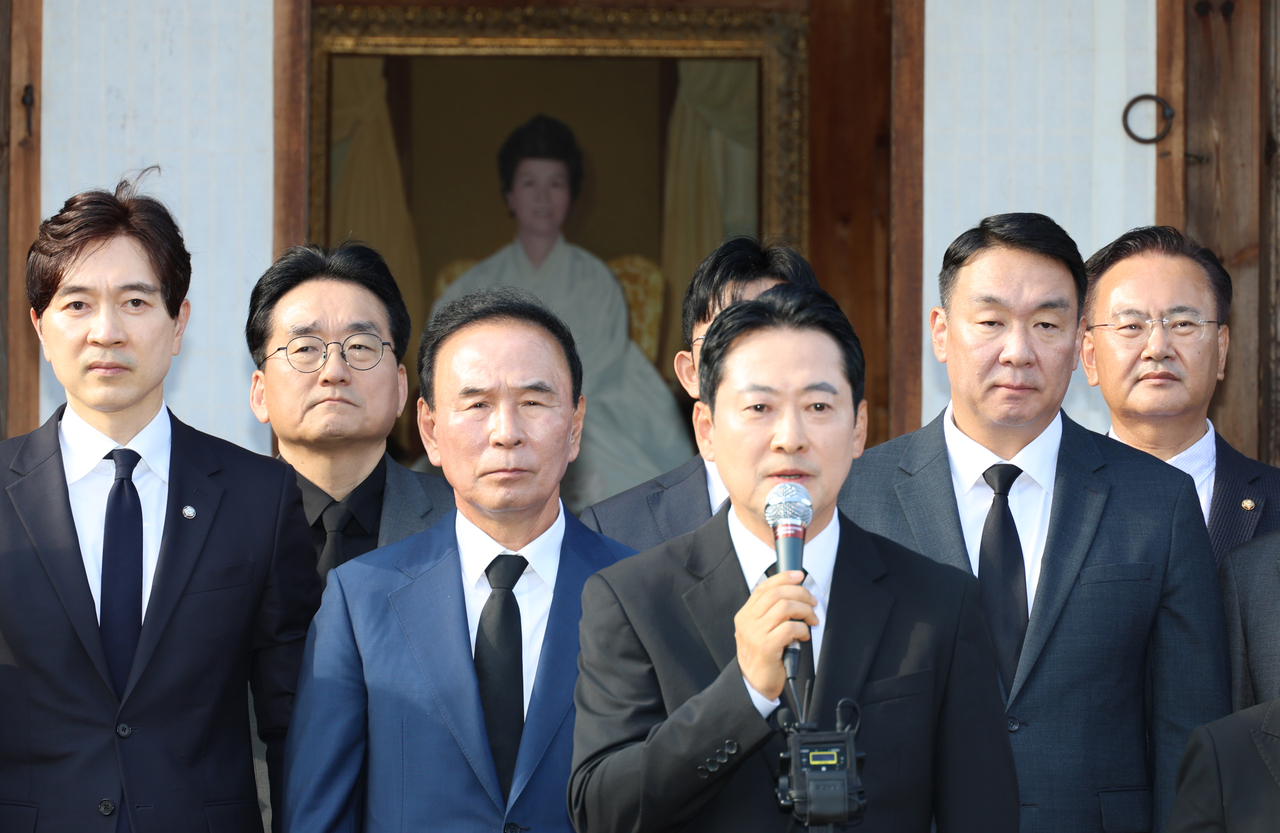
Conservative and progressive camps have staked out opposing interpretations of the film's ending, trading sharp criticism.
Conservatives argue the film implicitly casts Park as the mastermind behind the assassination. Beyond what they call historical distortion, critics say the film inflicts further harm on surviving family members — including former President Park Geun-hye — who are still alive to witness the portrayal of their late parent.
Progressives push back, arguing the film does not point to Park at all. They note that Park appears on screen only briefly, in a short sequence depicting the moment of the shooting, and is neither shown nor mentioned in any context related to who orchestrated the attack.
paq@heraldcorp.com