Samsung Electronics shares are trading lower Thursday even after the company posted third-quarter preliminary earnings that beat market expectations. Analysts are urging investors to brace for heightened volatility, citing a rare convergence of semiconductor ETF rebalancing, an options expiry, and the conclusion of the company's share buyback program.
According to Korea Exchange, Samsung Electronics shares were trading at 266,500 won ($199) as of 9:46 a.m. Thursday, down 0.74 percent from the previous session.
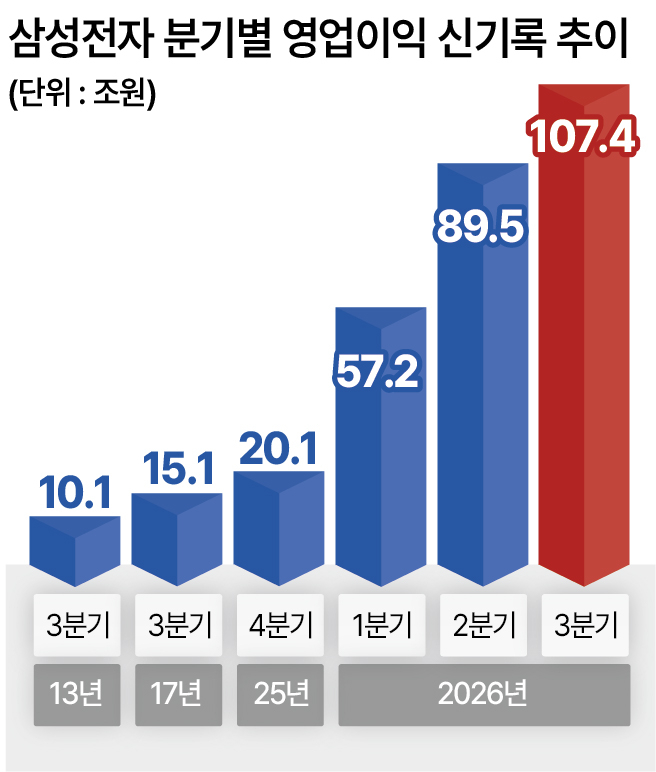
Samsung Electronics disclosed Thursday that its consolidated operating profit for the third quarter surged 782.5 percent year-on-year to 107.4 trillion won, topping the market consensus of 105.75 trillion won compiled by Yonhap Infomax by 1.6 percent. Revenue rose 126.6 percent year-on-year to 195 trillion won.
Despite the strong results, Samsung Electronics shares have been oscillating near the flat line, suggesting that supply-demand factors are weighing on the stock. Domestic and foreign brokerages alike warned of wider intraday swings Thursday.
Goldman Sachs said in a Tuesday report that Samsung Electronics' share price could see amplified volatility Thursday — the day of the preliminary earnings release — as ETF rebalancing, an options expiry, and the end of the buyback program all fall on the same date.
ETF rebalancing is expected to generate concentrated mechanical selling pressure on Samsung Electronics. Jeon Gyun, a researcher at Samsung Securities, said Samsung Electronics currently exceeds the per-stock weighting cap in semiconductor-related ETFs subject to October's regular index review, adding that roughly 200 billion won in shares could be offloaded to bring the stock back within its cap.
The FnGuide Semiconductor TOP10 index undergoes its regular reconstitution Thursday. Asset managers typically execute rebalancing trades on the last business day before the effective date of an index change. Although the official reconstitution date is Monday, the actual trades are expected to take place Thursday because Friday is the Hangeul Day public holiday.
ETFs tracking the FnGuide Semiconductor TOP10 index include the TIGER Semiconductor TOP10 and the TIGER Semiconductor TOP10 Leverage. As of Wednesday, the two funds had assets under management of 10.63 trillion won ($7.94 billion) and 692.4 billion won, respectively.
Samsung Electronics accounts for 26.45 percent of the TIGER Semiconductor TOP10, exceeding the 25 percent per-stock cap. The TIGER Semiconductor TOP10 Leverage holds Samsung Electronics at a 34.93 percent weighting.
Yoon Jae-hong, a researcher at Mirae Asset Securities, said volatility could widen around stocks being added to or removed from the index. He projected that the FnGuide Semiconductor TOP10 reconstitution would trigger roughly 240 billion won in Samsung Electronics selling and around 220 billion won in SK hynix buying.
The options expiry adds another layer of supply-demand uncertainty. Samsung Electronics accounts for roughly 30 percent of the KOSPI 200 by market capitalization — the underlying index for KOSPI 200 options. On expiry days, the unwinding and hedging of derivatives positions typically generates additional spot-market trading, widening intraday volatility.
There are also concerns about a demand vacuum following the end of the buyback program. Buying by other corporations — a category that had emerged as a key source of demand thanks to share repurchases by Samsung Electronics and SK hynix — is expected to fade. Samsung Electronics is believed to have fully deployed the 15 trillion won ($11.2 billion) it had committed to buying back by Tuesday.
Persistent foreign selling of large-cap semiconductor stocks adds to the pressure. Foreign investors have net sold a combined more than 19 trillion won worth of Samsung Electronics and SK hynix shares over the past month.
Analysts say the key variables that will determine the stock's direction are foreign investor flows and the sustainability of the earnings recovery. Han Ji-young, a researcher at Kiwoom Securities, said investors should pay closer attention to how the share price and foreign investor positioning shift immediately after the earnings release, and to changes in next-year profit estimates, rather than focusing solely on whether the third-quarter results beat consensus.

moon@heraldcorp.com