
BOK faces National Assembly audit
Robust economic growth expected to continue
Inflation to stay above target for considerable time
Housing price surge and rising household debt pose imbalance risks
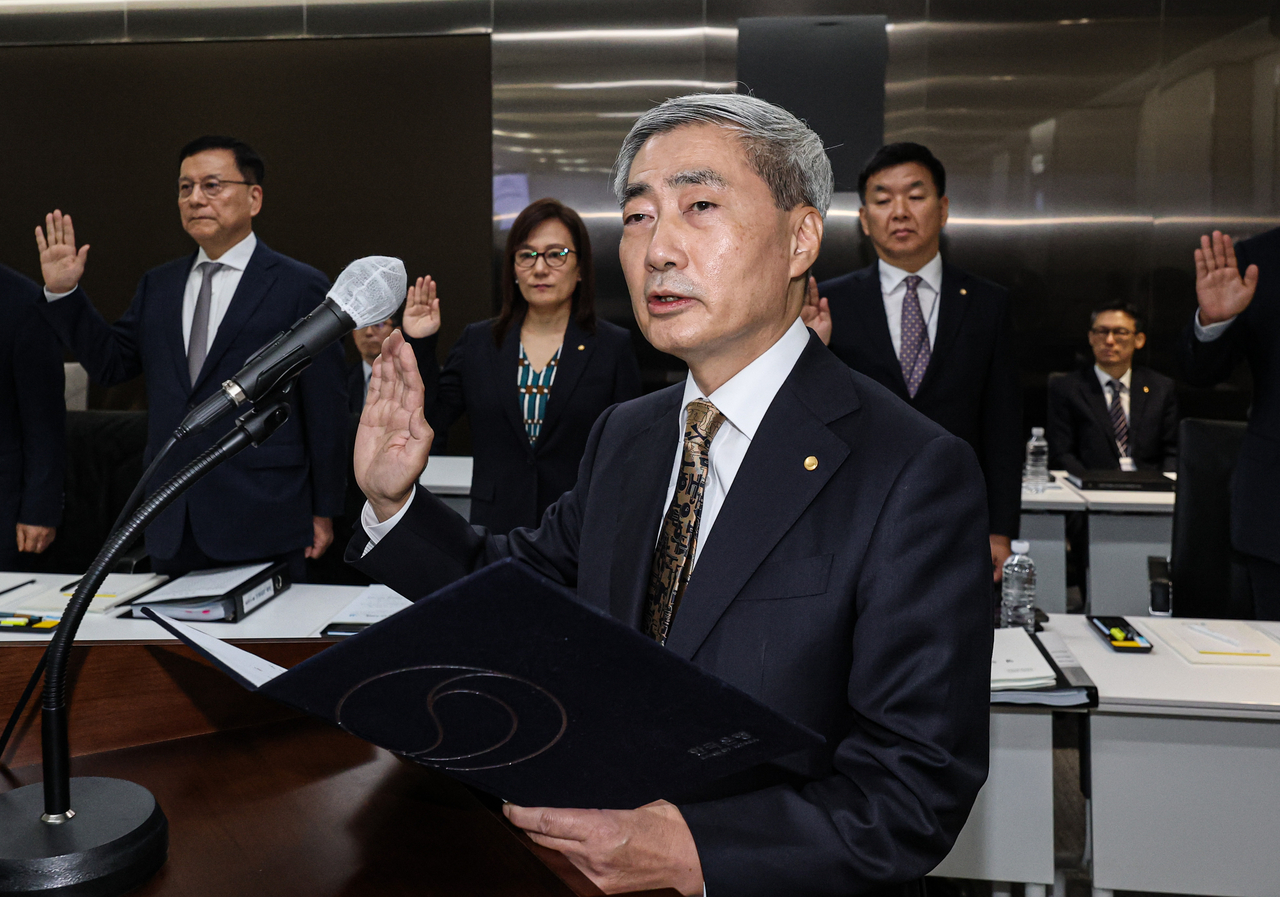
Bank of Korea Gov. Shin Hyun-song reaffirmed the central bank's rate-hiking stance Monday, saying it plans to "carefully monitor inflation, economic trends and financial stability conditions to determine the timing and pace of further rate increases."
Shin made the remarks during a briefing at the National Assembly's Finance and Economy Planning Committee national audit, held at the Bank of Korea on Monday morning, where he said economic growth would continue and inflation would remain elevated.
"The Korean economy posted stronger-than-expected growth, supported by a robust semiconductor cycle despite instability in the Middle East," Shin said. "Going forward, the economy is expected to maintain solid growth as strong momentum in exports and investment continues, while consumer spending gradually recovers on the back of improving income conditions."
On inflation, he said prices are expected to "continue rising above the target level for a considerable period as the pass-through of accumulated cost pressures persists and demand-side pressures gradually build."
Regarding financial and foreign exchange markets, Shin said major price variables had shown high volatility amid growing external uncertainty. Government bond yields rose sharply, he said, driven by sustained Middle East tensions pushing up international oil prices, strengthened expectations of rate hikes in major economies, and rising bond yields abroad. Share prices underwent a sharp correction centered on the semiconductor sector before partially rebounding, and have since fluctuated in response to developments in the Middle East and the global AI investment outlook. On the won-dollar exchange rate, he said the currency had fallen considerably despite external uncertainty, supported by solid economic fundamentals, and had since remained broadly stable.
On financial stability, Shin said the domestic financial system was "broadly stable, underpinned by sound resilience among financial institutions and adequate external payment capacity." He cautioned, however, that "concerns over financial imbalances stemming from rising housing prices in the Greater Seoul area and growing household debt remain significant, and the potential for deterioration in vulnerable sectors also lurks as a risk factor."
Shin said the Bank of Korea raised its benchmark interest rate twice consecutively, in July and August, "considering the importance of preemptive action to prevent the spread of inflationary pressures and the need to remain vigilant about financial stability risks." He added that future monetary policy would be guided by close monitoring of inflation, economic conditions and financial stability, with the timing and pace of further hikes to be determined accordingly.
Shin also outlined institutional reforms aimed at enhancing the effectiveness of monetary policy and responding to changes in the financial and economic environment. He said the bank's intermediary lending support facility would be restructured to sustain support for small and medium-sized enterprises while strengthening assistance for SMEs based outside the capital region and bolstering its role as a complement to interest rate policy. He added that the bank had improved the issuance system for monetary stabilization bonds to enhance liquidity and strengthen the reserve adjustment function.
Shin said the Bank of Korea has been operating the foreign exchange market around the clock since July to improve access to Korea's foreign exchange and capital markets, and that a pilot run of the Bank of Korea won international settlement network began in September, with full operations set to launch in January next year.
He added that the bank is making wide-ranging efforts to build a stable and efficient digital currency ecosystem in response to the accelerating digital transition, including plans to advance Phase 2 of Project Han River — covering real transactions and a pilot program for government fund disbursement — without delay. He said the Bank of Korea is also continuing in-depth research into medium- and long-term challenges such as the spread of AI technology, demographic shifts, balanced regional development and climate change, with the aim of proposing policy alternatives from a neutral, long-term perspective to help strengthen the growth potential of the Korean economy.
kimstar@heraldcorp.com





