
Ministry of Land, Infrastructure and Transport drafts revised enforcement rules under Construction Industry Basic Act
Top 200 general contractors covered first; all construction companies to follow from 2028
![The Ministry of Land, Infrastructure and Transport will revise the enforcement rules under the Construction Industry Basic Act to require project owners of private construction works worth 5 billion won or more to pay wages directly to workers and subcontractors starting next January. The photo shows a housing reconstruction site in Seoul. [Herald DB]](https://wimg.heraldcorp.com/news/cms/2026/10/12/news-p.v1.20260813.049cdd417b484080b8203d5ce4326796_P1.jpg)
Starting next year, project owners of private construction works valued at 5 billion won ($3.74 million) or more will be required to pay contractors directly, in a move aimed at eliminating wage theft at construction sites. The requirement will initially apply to prime contractors ranked within the top 200 in general construction and the top 100 in specialty construction. From 2028, all construction companies carrying out private projects worth 5 billion won or more will be subject to the direct payment mandate, regardless of their size.
The Ministry of Land, Infrastructure and Transport announced Monday that it had drafted revised enforcement rules under the Construction Industry Basic Act and issued a legislative notice. The move follows the passage of an amendment to the act at a National Assembly plenary session on Sept. 20, which requires project owners to use an electronic payment system to directly process and disburse construction fees and equipment rental payments starting Jan. 1 next year, with private construction projects above a certain scale also required to follow the same procedure.
The revision was prompted by the persistent failure to pay construction fees in the private sector. The ministry said wage theft has continued to occur, amounting to 436.3 billion won in 2023, 478 billion won in 2024 and 416.6 billion won in 2025.
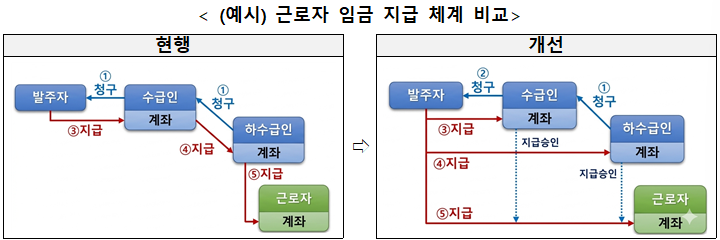
Under the existing payment structure — in which funds flow from the project owner through the prime contractor and subcontractors before reaching workers — there is a risk of cascading payment defaults. The new system requires project owners to deposit payments directly into claimants' accounts through the electronic payment platform, ensuring timely disbursement and cutting off the possibility of wage theft at the source.
The ministry said it would not immediately extend the electronic payment system to all private construction projects next year, opting instead for a phased rollout over two years. Under the draft revised enforcement rules, the mandate will first apply to sites with contract values of 5 billion won or more. The ministry said sites of that scale already carry obligations such as mandatory enrollment in the construction workers' retirement mutual aid scheme and mandatory use of electronic card systems, making them the logical starting point for efforts to stamp out wage theft.
However, taking into account the operational readiness of construction companies, the ministry said the requirement next year will be limited to prime contractors ranked within the top 200 in general construction by construction capability assessment and within the top 100 in specialty construction. General contractors outside the top 200 will not be subject to the mandate even if their projects exceed 5 billion won.
The top 200 ranking in the general construction capability assessment corresponds to an average annual revenue of around 102.4 billion won, while the top 100 in specialty construction corresponds to around 281.4 billion won.
From 2028, the draft rules require all construction companies carrying out privately commissioned construction projects worth 5 billion won or more to use the electronic payment system.
"Given the nature of construction work, which involves multiple layers of subcontracting, there is a risk of cascading defaults, and in fact hundreds of billions of won in unpaid wages continue to occur every year," a ministry official said. "We revised the relevant regulations to require project owners to use a system that pays subcontractors, workers, and material and equipment suppliers directly, in order to prevent defaults caused by factors such as the seizure of prime or subcontractor accounts."
smh@heraldcorp.com





