
Inspection rate falls from 5.9% to 5.2% as oversight fails to keep pace with growth
Foreign worker industrial accidents up 19.1%, workplace harassment reports up 181.5%
![Hanwha's construction division conducts first-aid and CPR training for foreign workers. [Hanwha Construction Division]](https://wimg.heraldcorp.com/news/cms/2026/10/13/news-p.v1.20260107.c63fd0e3afae40398c2235d0703010d4_P1.jpg)
The number of workplaces employing foreign workers grew by nearly 17 percent over three years, but the number that received routine inspections by the Ministry of Employment and Labor increased by only 3 percent over the same period.
As inspections have failed to keep pace with the growth in workplaces, the share of establishments subject to routine checks has declined. Observers say the government needs to strengthen preventive oversight, given rising rates of industrial accidents and workplace harassment complaints among foreign workers.
According to data submitted to Rep. Choi Ki-sang — who leads the Democratic Party of Korea's side on the National Assembly's Climate, Energy, Environment and Labor Committee — the number of workplaces employing foreign workers rose from 51,051 in 2022 to 59,669 in 2025, an increase of 8,618, or 16.9 percent.
Over the same period, the number of workplaces that underwent routine inspections grew from 3,021 to 3,123 — an increase of just 102, or 3.4 percent. As a result, the share of foreign-worker workplaces receiving routine inspections fell from 5.9 percent to 5.2 percent.
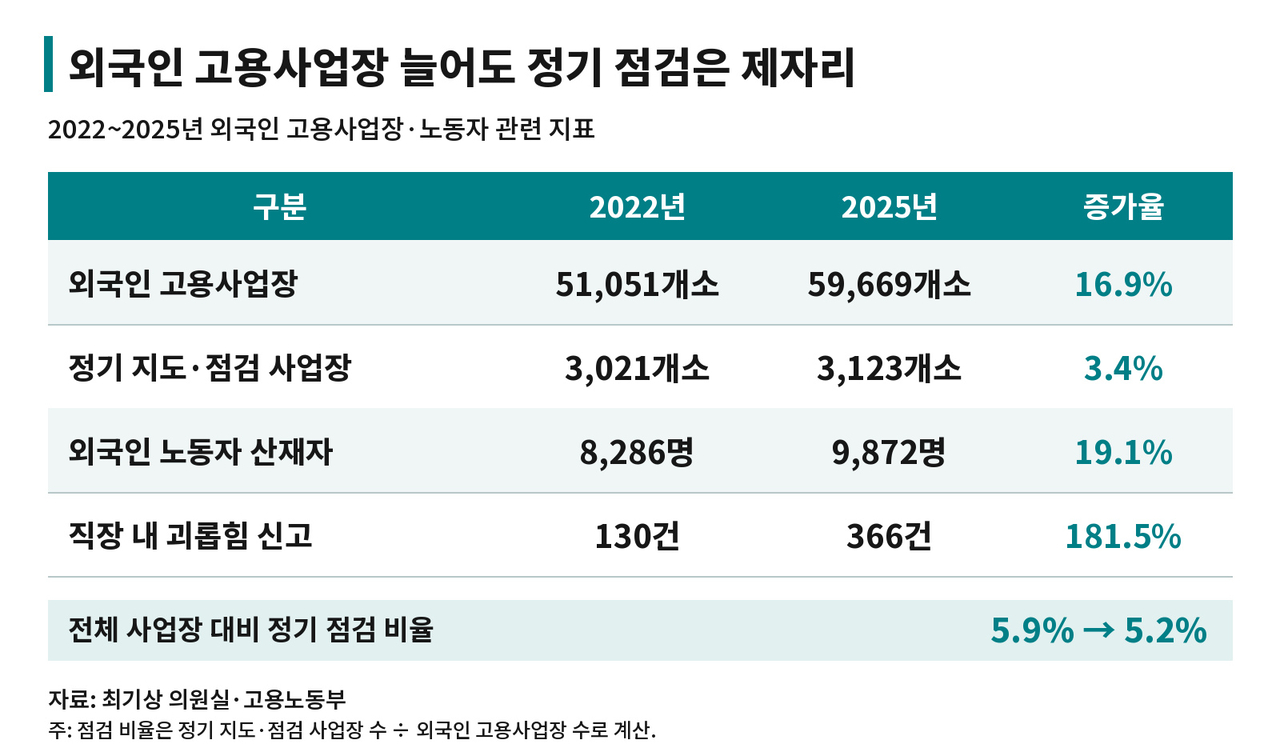
Indicators of harm to foreign workers have also worsened. The number of industrial accident victims rose from 8,286 in 2022 to 9,872 in 2025, an increase of 1,586, or 19.1 percent. Workplace harassment complaints filed over the same period rose from 130 to 366 — a rise of 236 cases, or 181.5 percent.
While the increases in industrial accidents and harassment reports alone do not establish a direct causal link to the inspection shortfall, experts say they reflect growing demand for on-site oversight to protect the safety and rights of foreign workers.
Routine inspections of workplaces employing foreign workers are designed to verify compliance with working conditions, occupational health and safety requirements, and relevant laws. With the number of such workplaces continuing to grow, concerns are mounting that the failure of inspections to keep pace could leave gaps in preventive management.
Small businesses in particular may lack dedicated safety personnel and the fiscal resources to meet compliance requirements. Migrant workers, meanwhile, often face language barriers and precarious employment and residency status that make it difficult to report violations even when they occur — underscoring the need for proactive on-site inspections alongside responsive follow-up after complaints are filed.
The ministry announced in June a set of measures to prevent human rights violations against migrant workers, including plans to establish advance monitoring systems such as anonymous surveys in workers' native languages and an anonymous tip center. The plan also called for stepped-up proactive inspections in areas with high concentrations of migrant workers or elevated risks of rights violations.
A separate framework announced in September to build a local government labor inspection system focused on strengthening preventive oversight at small workplaces with fewer than 30 employees. Choi urged the government to move quickly to embed these measures so they function effectively on the ground.
"Migrant workers may find it difficult to report labor law violations or human rights abuses due to language barriers and the instability of their employment and residency status, which is why more detailed preventive measures are needed," Choi said. "Migrant workers are valued members of our society and economy, and no one should have their safety or dignity threatened in the workplace."
fact0514@heraldcorp.com





