Women earn 72.2% of men's wages, topping gap rankings among 13 countries with available data; wage inequality between top and bottom earners stalled since 2019
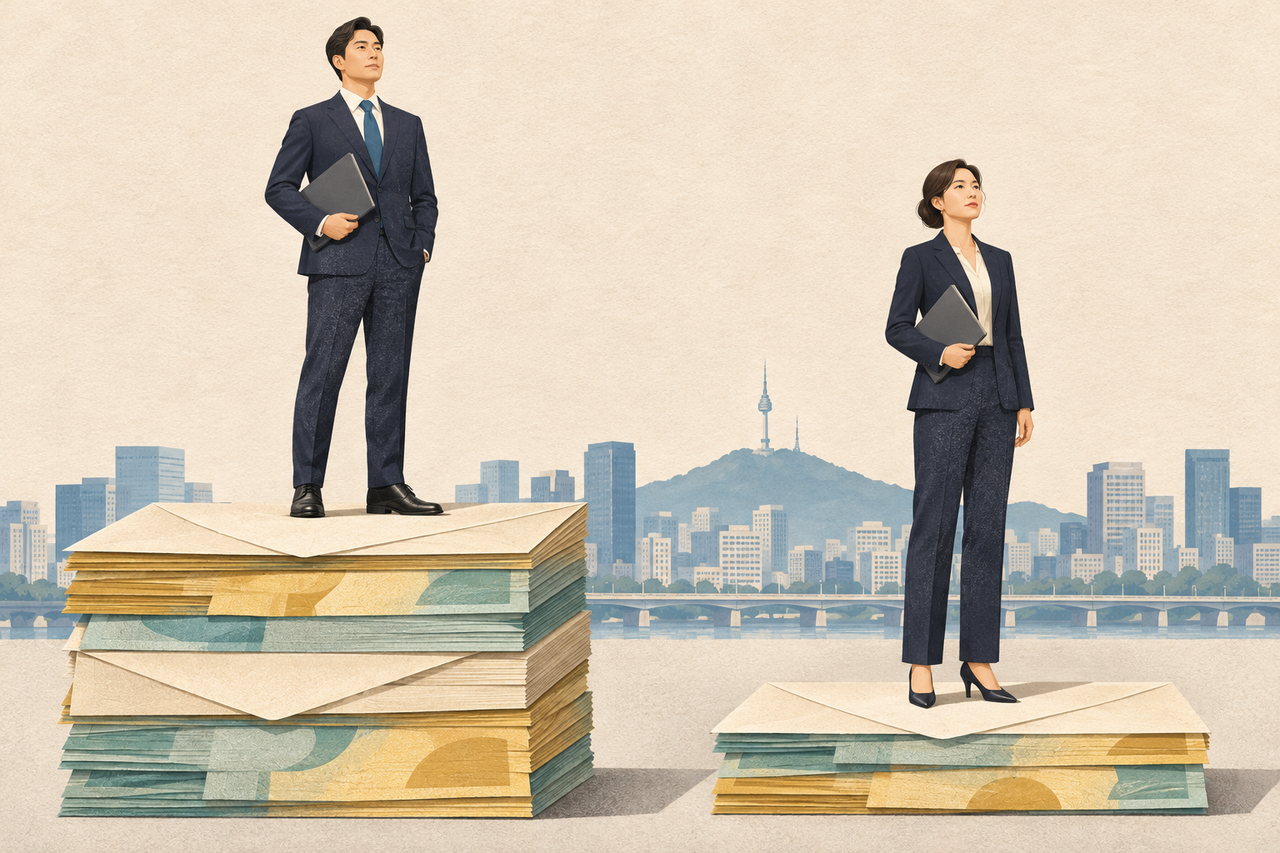
South Korea's gender pay gap has narrowed by 9.4 percentage points over the past decade, yet the country still holds the widest gap among OECD members. Last year, women's wages came to 72.2 percent of men's — the largest disparity among the 13 member countries that published comparable data. The gap between the highest- and lowest-paid workers also remained at roughly 3.6 times, signaling a stall in progress on wage inequality.
According to OECD earnings statistics released Monday, South Korea's gender wage gap stood at 27.8 percent last year, meaning women earned 27.8 percent less than men. That was down 1.2 percentage points from 29.0 percent in 2024, but the country still ranked last among peers in international comparisons.
Japan had the second-largest gap among the 13 OECD countries that reported last year's figures, at 20.1 percent — 7.7 percentage points behind South Korea. The United States followed at 17.9 percent. The five countries with the smallest gaps all recorded single-digit figures, with Colombia posting the lowest at 2.6 percent.
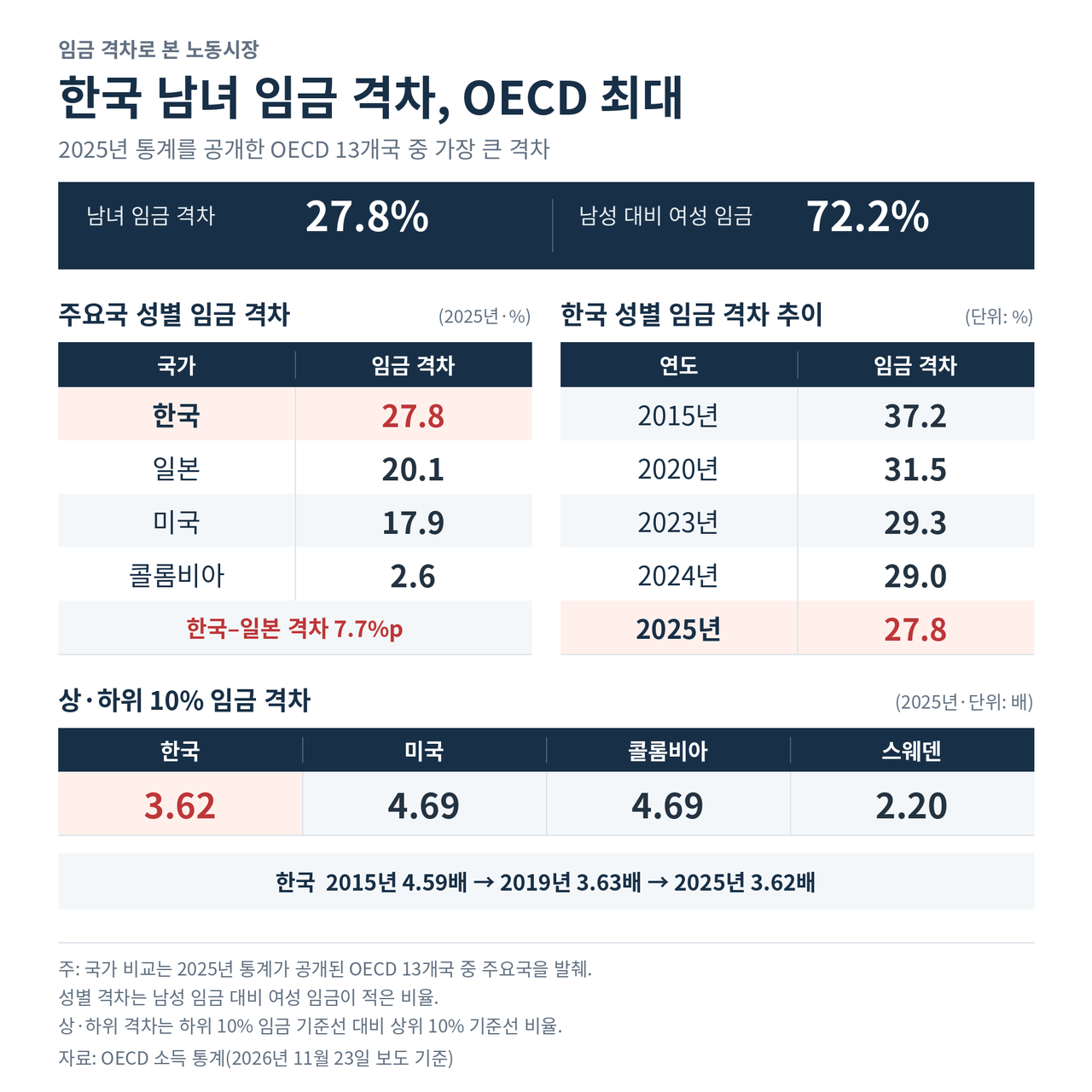
South Korea's gender pay gap has been on a long-term downward trend. It fell from 37.2 percent in 2015 to 31.5 percent in 2020, then dropped below 30 percent for the first time in 2023 at 29.3 percent — a total reduction of 9.4 percentage points over the decade through last year. Still, the country has held the widest gap in the OECD continuously since 2000.
South Korea also ranked near the top of the OECD on wage inequality by income level. Last year, the ratio of the top 10 percent wage threshold to the bottom 10 percent threshold was 3.62 times — third highest among the 13 countries with available data, behind the United States and Colombia, which both stood at 4.69 times. Sweden recorded the lowest ratio at 2.20 times.
In 2024, when the comparison covered 35 countries, South Korea ranked eighth at 3.60 times. Colombia led that year at 5.42 times, followed by the United States at 4.79 times, Latvia at 4.49 times, Chile at 4.26 times and Estonia at 3.68 times. Sweden again posted the lowest ratio at 2.21 times.
The gap between top and bottom earners narrowed rapidly for a time but has since plateaued. South Korea's ratio fell from 4.59 times in 2015 to 3.63 times in 2019 — moving from fourth among 22 countries to ninth among 33. Since then, however, the figure has remained stuck at around 3.6 times.
Analysts say differences in job quality underlie both the gender and income-level gaps. Women who leave the workforce for childbirth and child-rearing often struggle to return to positions with comparable pay and working conditions, which is why greater female labor market participation has not translated more fully into a narrower pay gap.
The wide spread between high- and low-wage workers is also attributed to the disparity in treatment between large corporations and small and medium-sized enterprises. Workers who start out in lower-quality jobs find it difficult to move up, and those who exit the labor market struggle to return to stable employment — dynamics that entrench wage inequality over time.
Kim Gwang-seok, head of the economics research division at the Korea Economic and Industrial Research Institute, cited the large performance bonuses paid by major semiconductor firms and said "when 2026 figures are reflected, the wage gap could widen further."
Kim added that policies are needed to support small and medium-sized enterprises in improving working conditions so that vulnerable groups — including youth — can choose such employers, and to narrow the gap between jobs.
fact0514@heraldcorp.com