
Federation of Korean Trade Unions' Seongsu Union Lab and Democratic Party lawmaker release survey on Seoul workers aged 20–39; 'comprehensive wage' contracts cited as top reason for unpaid overtime; 66.8% open to union counseling services
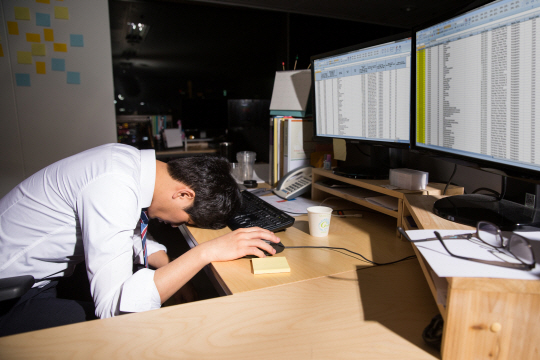
Six in 10 salaried workers in their 20s and 30s in Seoul who worked overtime did not receive full compensation for it, according to a new survey.
The most commonly cited reason for the shortfall was comprehensive wage contracts, which bundle overtime pay into a fixed monthly salary. The survey also found that workers had few avenues to address workplace problems, including harassment.
The findings come from a survey of Seoul workers aged 20 to 39, released Tuesday by the Federation of Korean Trade Unions' Seongsu Union Lab and the office of Democratic Party of Korea lawmaker Kim Ju-young. Of the 352 respondents who had worked overtime, night shifts or on holidays in the past three months, 201 — or 57.1 percent — said they received only partial compensation or none at all.
Among those who were not fully paid, 46.8 percent said it was because of a comprehensive wage arrangement. Another 18.9 percent cited discretionary or flexible work schedules, 15.9 percent said no explanation was given, and 13.9 percent said they had not been able to request payment in the first place. Across all respondents, 53.0 percent said their monthly salary already included overtime, night and holiday pay regardless of actual hours worked.
The unpaid or partially paid rate was even higher — 64.9 percent — among workers in six job categories the survey classified as typical of Seongsu-dong's industry mix: software development, design, merchandising, retail sales, marketing and data and AI. That was 13.9 percentage points above the 51.0 percent rate for workers in other fields.
Record-keeping of working hours was also found to be inadequate. While 65.4 percent of all respondents said they had worked more than 40 hours a week in the past three months, 33.6 percent said their company had no attendance-tracking system. Even among the 332 respondents whose companies did have such a system, 56.0 percent said some of their actual working hours had gone unrecorded.
Addressing workplace harassment proved equally difficult. Of the 60 respondents who said they had personally experienced harassment in the past year, 43 — or 71.7 percent — did not report it, and 15.0 percent said they were unaware that a reporting procedure existed. Of the eight who did file a report, only one said the matter was handled properly.
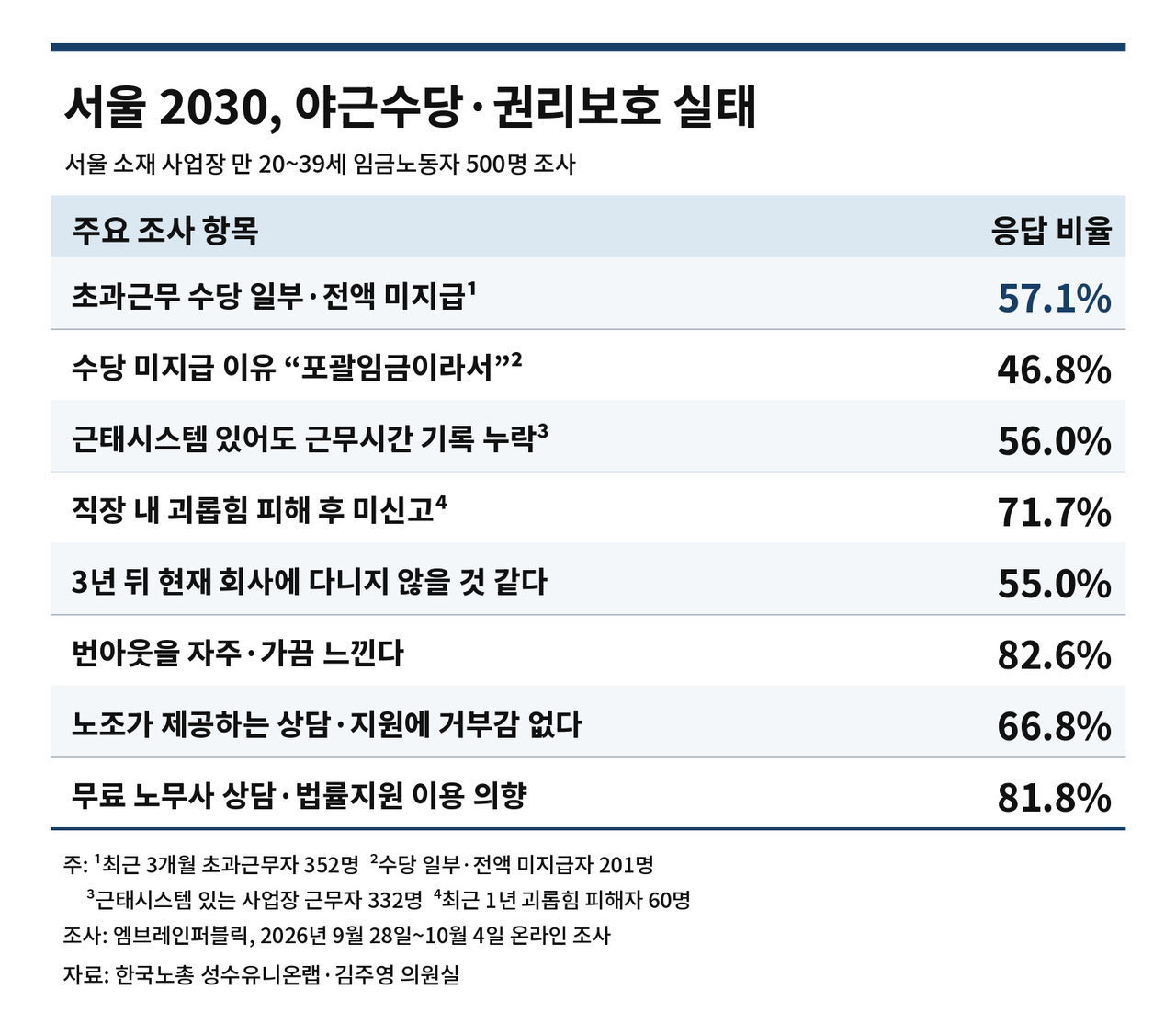
More than half of the young workers surveyed were also looking to leave their current jobs. Some 55.0 percent of all respondents said they did not expect to still be at their current company in three years, either because they were actively seeking other work or considering a move. Among contract workers, that figure reached 69.7 percent. Meanwhile, 82.6 percent said they experienced burnout frequently or occasionally, and 63.8 percent said their company's compensation structure was inadequate.
Despite widespread dissatisfaction, respondents showed a relatively open attitude toward counseling and support services provided by labor unions. When told that such services would be offered by a union, 52.0 percent said it made no difference to them and 14.8 percent said they would actually trust the service more — meaning 66.8 percent expressed no resistance. The survey noted this was distinct from the question of whether respondents would join a union.
Some 81.8 percent said they would use free legal and labor consultation services. The most sought-after offerings were salary and benefits comparison data for their industry (48.4 percent), job-change and career counseling (40.2 percent), help calculating and claiming unpaid overtime (28.4 percent), and anonymous company reputation and workplace culture assessments (28.4 percent).
The Federation of Korean Trade Unions launched Seongsu Union Lab on Wednesday as a base for organizing young workers.
Through an online "Seongsu pop-up store," the lab offers an overtime pay calculator — where users enter their salary and average weekly overtime hours — alongside a tool to compare their results with the survey data. One-on-one consultations are available through an anonymous KakaoTalk channel. The lab also plans to hold regular morning campaigns near Seongsu Station, job-category networking events and career counseling sessions.
The survey was conducted by Macromill Embrain from Sept. 28 to Oct. 4 among 500 salaried workers aged 20 to 39 employed at workplaces in Seoul. It used quota sampling by industry and age group and was conducted online, reflecting respondents' own perceptions of their working conditions.
Choi Mi-ra, standing vice chairperson and youth committee chair of the Federation of Korean Trade Unions, said young workers had not abandoned unions — unions had simply been absent from where young people work. "Seongsu Union Lab will reach out first to young workers who have no one to talk to inside their companies and quietly leave on their own," she said. She added that what young workers want is not grand slogans but answers to basic questions — whether their salary is fair and whether they are being properly paid for overtime. "We will rebuild the labor union starting from answering those questions," she said.
fact0514@heraldcorp.com





