
Agriculture Minister Song Mi-ryung explains follow-up measures after farmland probe in South Gyeongsang Province
Farmland bank entrustment to remain optional; Farmland Act revision planned for next year
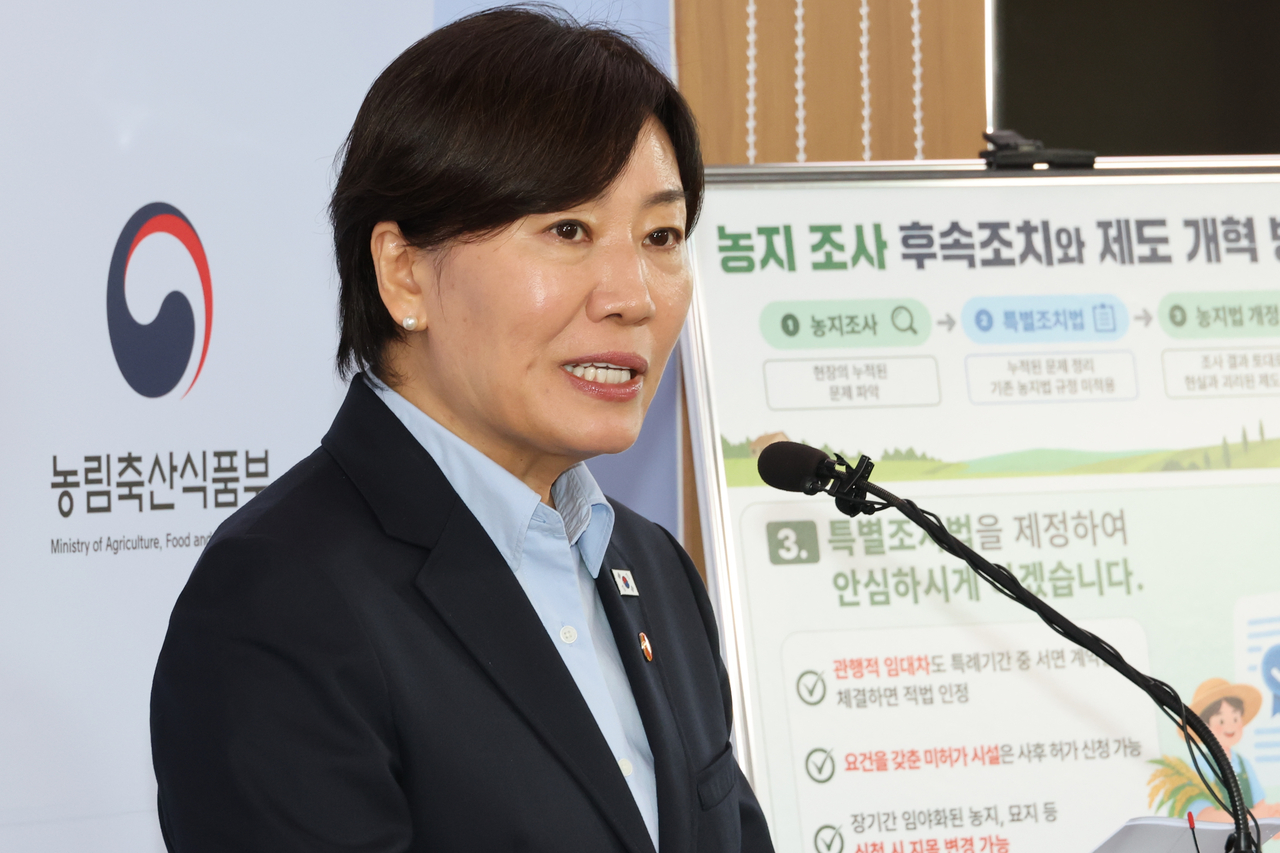
The government plans to exempt farmland unrelated to speculation — including inherited plots and land leased under customary arrangements by elderly farmers — from disposal obligations and penalty surcharges arising from the ongoing nationwide farmland survey. To that end, it will enact a special measures act and revise the Farmland Act next year to bring the regulatory regime in line with rural realities.
The Ministry of Agriculture, Food and Rural Affairs said Agriculture Minister Song Mi-ryung held a meeting Wednesday at the Hamyang-gun county office in South Gyeongsang Province with village heads and farmers to explain the follow-up measures and institutional reform direction stemming from the farmland survey.
The meeting was organized to address farmers' concerns that they might be required to dispose of their land following the survey, and to communicate the government's follow-up plans directly in the field.
"The farmland survey is not meant to punish farmers who diligently work their land," Song said. "We are pursuing the enactment of a special measures act to ensure that disposal procedures are not initiated — based on the survey results — for ordinary cases that arise from rural realities."
The categories of farmland being considered for exemption from disposal orders include inherited farmland, land leased under customary arrangements by elderly farmers, land owned by clan organizations or Buddhist temples, and unregistered inherited farmland. Plots that are difficult to farm — such as landlocked parcels or steeply sloped land — will also be spared from disposal obligations and penalty surcharges based on the survey results, provided they represent ordinary cases unrelated to speculation.
Entrustment to the farmland bank will remain a matter of farmer choice, not an obligation. The government plans to expand the farmland bank's purchase and entrustment functions so that farmers wishing to lease or sell their land can make use of the service.
Temporary special provisions will also be introduced to allow farmers to convert customary lease arrangements into lawful contracts and to regularize agricultural facilities built without the required permits. Next year, the government plans to revise the Farmland Act to narrow the gap between rural practice and the law, and to make farming more straightforward for agricultural workers.
Clear-cut speculation and serious illegal conversion of farmland will, however, be treated separately from ordinary cases. The government identified three types of speculative conduct: fraudulently acquiring farmland in land-transaction permit zones and then leaving it fallow without authorization or leasing it out illegally; operating a real estate business through an agricultural corporation; and jointly acquiring farmland through auctions or similar means and then leaving it fallow without authorization or leasing it out illegally. Illegally installing non-agricultural facilities — such as campsites or open-air storage yards — in farmland promotion zones also constitutes serious illegal conversion.
The Ministry of Agriculture, Food and Rural Affairs and the Korea Rural Community Corporation have been operating a farmland survey counseling center since Monday. The center advises farmers on whether their situations involve speculation or serious illegal conversion, and connects elderly farmers and others who find farming difficult with farmland bank services — including lease entrustment, farmland purchase and the farmland pension program.
"I take seriously the fact that, despite the intent of the farmland survey, there has been insufficient explanation of what happens to farmland after the survey is conducted," Song said. "Going forward, we will provide more careful guidance on the government's course of action, focusing on the cases that farmers are genuinely worried about."
adastra@heraldcorp.com





