
Korea Institute for Advanced Studies chief speaks at Future Leaders Forum
'Innovative firms that can surpass Samsung must emerge en masse'
Megaprojects pitched as answer to large conglomerate-dominated ecosystem
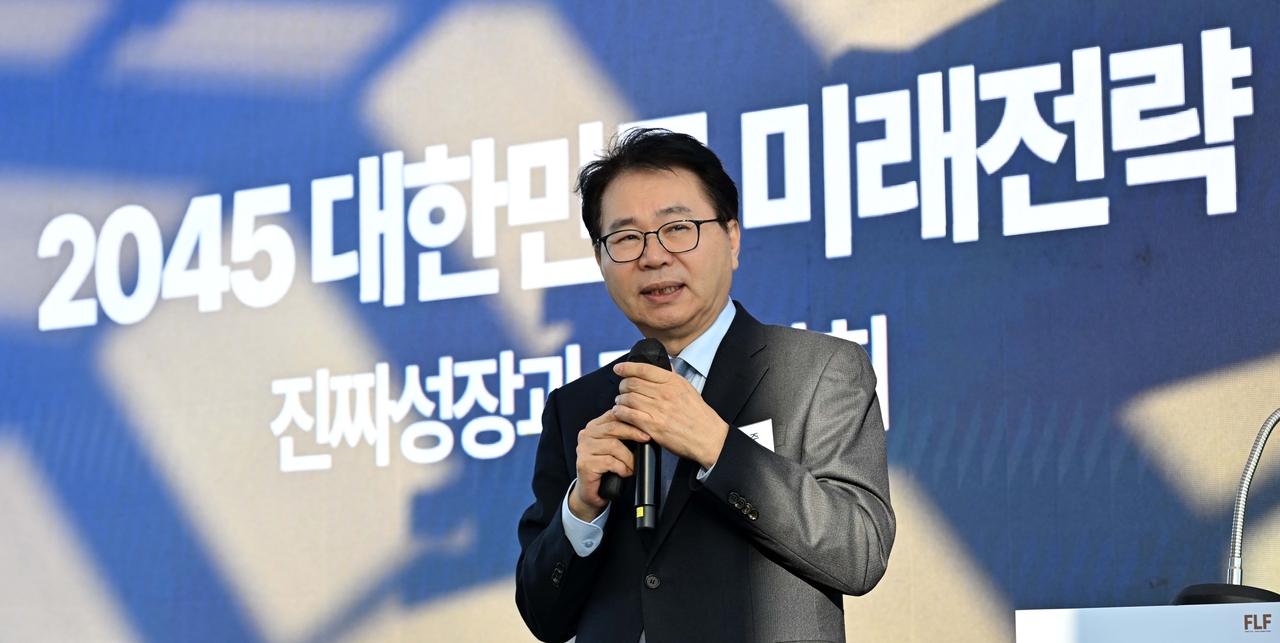
Lee Han-ju, chairman of the Korea Institute for Advanced Studies and one of the chief policy architects of the Lee Jae Myung administration, on Wednesday presented the government's "megaproject" initiative — combining regional balanced development with technological innovation — as the core model for what he called the current government's "real growth." He also offered a critical assessment of South Korea's innovation ecosystem, which he said remains heavily skewed toward large conglomerates, and said innovative companies capable of surpassing Samsung must emerge in large numbers.
Speaking at the Future Leaders Forum co-hosted by The Herald Business and law firm Daeryuk Aju at Ambassador Seoul Pullman Hotel in Jung-gu, Seoul, Lee outlined the structural limits of the concentration of economic activity in large conglomerates and the Greater Seoul area, and explained the direction of efforts to nurture innovative firms and advance megaprojects centered on the southern regions of the country. Lee holds a doctorate in economics from Seoul National University and has served as a professor and special vice president at Gachon University, president of the Gyeonggi Research Institute, president of the Democratic Research Institute, and chairman of the Presidential Committee on National Policy Planning.
Lee put megaprojects front and center as the solution to what he described as the crisis of metropolitan concentration and regional depopulation — a path toward "growth for all." "Fifty-two percent of the population lives in an area that makes up just 11 percent of the national territory," he said. "If 6 million people in the Greater Seoul area decide they'd rather live somewhere nicer and move south, the problem of Seoul housing prices will naturally be solved." He added, "What I mean is that to address the issues of large conglomerates, the gap between large and small companies, and regional inequality, we need growth that everyone can share in — growth that moves forward together with the regions."
Lee doubled down, saying, "The megaprojects are being pursued on the premise that they will be concentrated entirely in the southernmost areas — the Yeongnam and Honam regions. This is one strategy for 'real growth' that combines 'growth for all' with 'innovation-driven growth.'"
Lee identified as one of the Korean economy's key weaknesses a structure in which even innovation is driven by large conglomerates. "We have a very peculiar structure where even innovation happens inside large companies," he said. "Innovation requires disruption, but we have a structure where those who already have the most and are already the furthest ahead move even faster."
Recalling a lecture he once gave to Samsung's executive corps, he said, "At the time, I told them I hoped the day would come soon when Samsung was pushed down to around 10th place — not because I wanted Samsung to fail, but because I wanted nine companies better than Samsung to emerge quickly." He added, "Innovation keeps happening, but because it keeps happening inside large companies, the gap between large and small enterprises is widening."
As a corporate development strategy to break that pattern, Lee proposed expanding the entry of venture firms and small and medium-sized enterprises and accelerating their AI adoption. "I want to create opportunities for ventures and small and medium-sized enterprises to actively respond to change by leveraging AI, so that innovation can take root there," he said. "We also need to carefully and thoroughly nurture the innovative companies that emerge from that process so they can grow — and we need to give them the chance to try again if they fail."
Lee also expressed strong confidence in the macroeconomic record of the Lee Jae Myung administration over its first year or so. "I am proud and certain that we have achieved truly remarkable results," he said. "Anyone who works in economics will evaluate what we have done as shockingly good." He noted that the Bank of Korea governor had recently acknowledged that his own projections had been off, saying the GDP growth rate — initially estimated at 3.4 percent — now appeared likely to reach 3.6 percent. "A 3.6 percent growth rate is unimaginable compared to the previous year," Lee said. "Normally, when growth rises, prices surge — but we kept that to a minimum, and the employment rate has improved significantly as well." He added that income inequality had also improved, and said that by any economic measure, the results of the past year had been so strong that the administration deserved not just applause but genuine praise.
Lee also touched on the frustration of facing criticism from within the administration's own ranks. "It's strange and baffling when people on the same side say, 'You did something wrong,'" he said. "To be honest, Cheong Wa Dae and the president are somewhat taken aback — that is true." He added, "I think what matters is not being swayed by every passing criticism, but steadily pressing ahead as planned. At the very least, those people will come to understand."
sunpine@heraldcorp.com





