
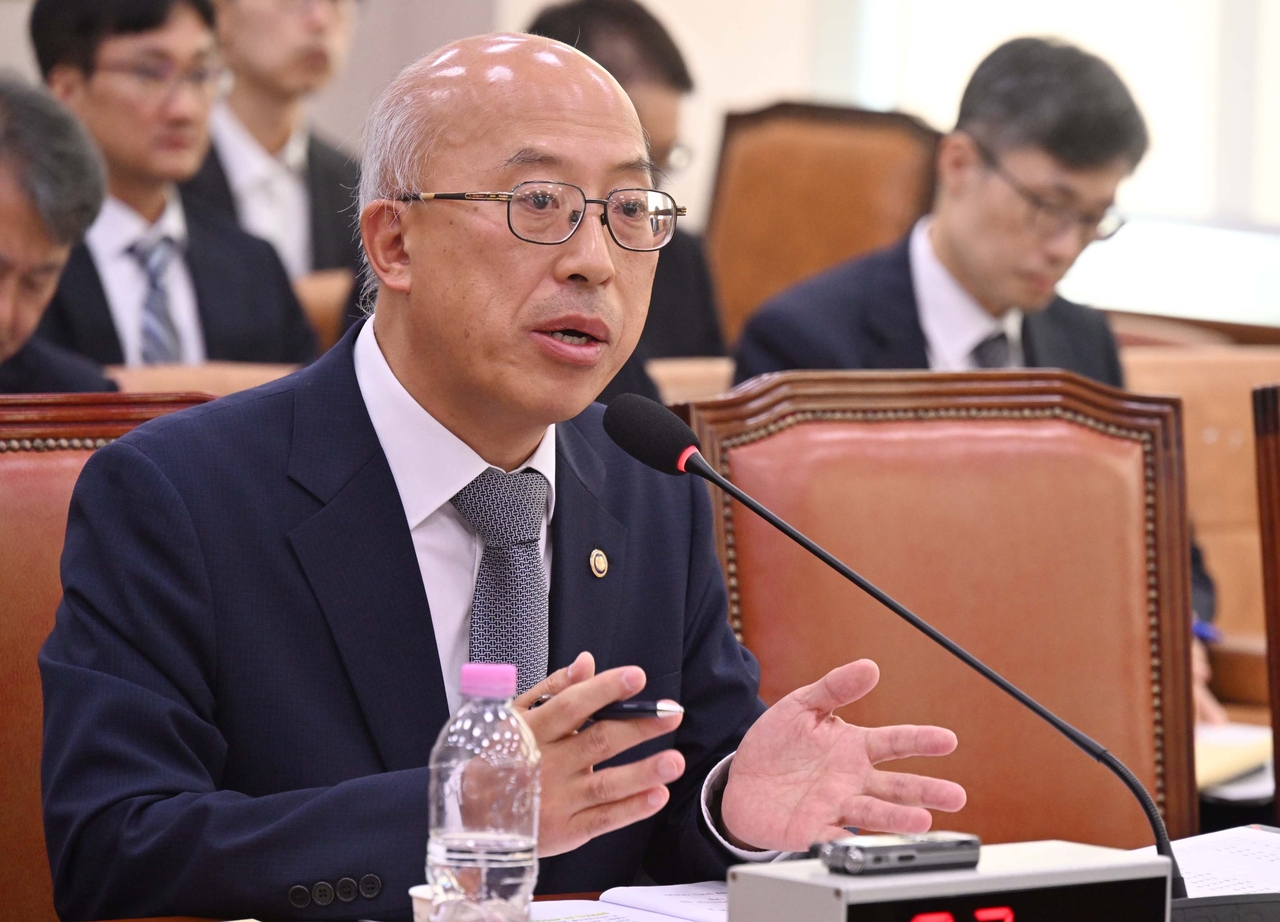
Ruling and opposition lawmakers clashed Thursday at the Legislation and Judiciary Committee's national audit of the Ministry of Government over Chief Justice Jo Hee-dae's refusal to re-nominate a Supreme Court justice candidate.
The ruling Democratic Party argued that Jo had failed to fulfill his constitutional duty by refusing Cheong Wa Dae's request to re-nominate a candidate, while the opposition People Power Party countered that the president had infringed on the National Assembly's confirmation authority.
Democratic Party lawmaker Kim Dong-a said the constitutional crisis caused by the Supreme Court vacancy stemmed from the chief justice's insistence on his nomination power, as if that power superseded the president's appointment authority. "If the president requested a re-nomination, a constitutional obligation to comply arose," Kim said. "Refusing to re-nominate amounts to dereliction of duty."
Kim added that if the president objected to a nominee, there was naturally no need to send a confirmation request to the National Assembly. "Yet the chief justice claims the president's request for a re-nomination is unconstitutional," he said.
Fellow Democratic Party lawmaker Lee Sung-yoon said Chief Justice Jo had stated at a national audit that the president's re-nomination request was unconstitutional. "A chief justice who has gone 225 days without nominating a Supreme Court justice — isn't that dereliction of duty?" Lee said.
Kim Eui-gyeom, who leads the Democratic Party's side on the Legislation and Judiciary Committee, said Jo had failed both his constitutional and criminal-law duties. "This could rise to the level of criminal dereliction of duty and connects to impeachment," Kim said. "Failing to fulfill a constitutional obligation is far more serious than ordinary dereliction of duty."
People Power Party lawmaker Yoon Sang-hyun pushed back, saying the president's appointment authority, the National Assembly's confirmation authority and the chief justice's nomination authority were equal powers. "The president refuses to consult on nominations and says something different — what is the chief justice supposed to do?" he said.
PPP lawmaker Kim Tae-gyu also criticized Minister Cho, saying he had never risen above the level of a "Daejang-dong lawyer" and was "the administration's blotting paper," simply absorbing and repeating whatever the administration claimed.
Park Hyung-su, who leads the PPP's side on the committee, said that if the president could keep rejecting nominees until someone to his liking was put forward, the chief justice's nomination power would be meaningless. "The minister's responses mirror President Lee Jae Myung's positions too closely," Park said.
Park questioned whether the minister was serving as the president's private attorney. "If you're just going to follow whatever the president says, quit as minister and go be his defense lawyer — he'll need one after leaving office," Park said.
The two sides also sparred Thursday over the effective suspension of President Lee Jae Myung's trials under Article 84 of the Constitution, which grants a sitting president immunity from criminal prosecution.
PPP lawmaker Kim Tae-gyu challenged Minister Cho's characterization of the suspension as reflecting a majority — or overwhelming majority — of legal opinion. "Among the many constitutional scholars, who exactly said that?" Kim demanded.
Cho said every court with a pending case involving President Lee had halted proceedings after concluding that the term "prosecution" in Article 84 covered not only indictment but also the continuation of a trial. "The view is that prosecution means both the filing and the conduct of a criminal case," Cho said.
Democratic Party lawmaker Kim Han-gyu said the courts had already ruled on the matter and it was settled. "Continuing to destabilize a sitting president in the National Assembly feels like a refusal to accept the outcome of the presidential election," Kim said.
bigroot@heraldcorp.com





