Foreign investors net sold 208.65 trillion won on Kospi this year
Hong Kong's CSOP Asset Management: Chinese chip impact 'limited'
JPMorgan calls for aggressive shareholder returns from Samsung, SK hynix
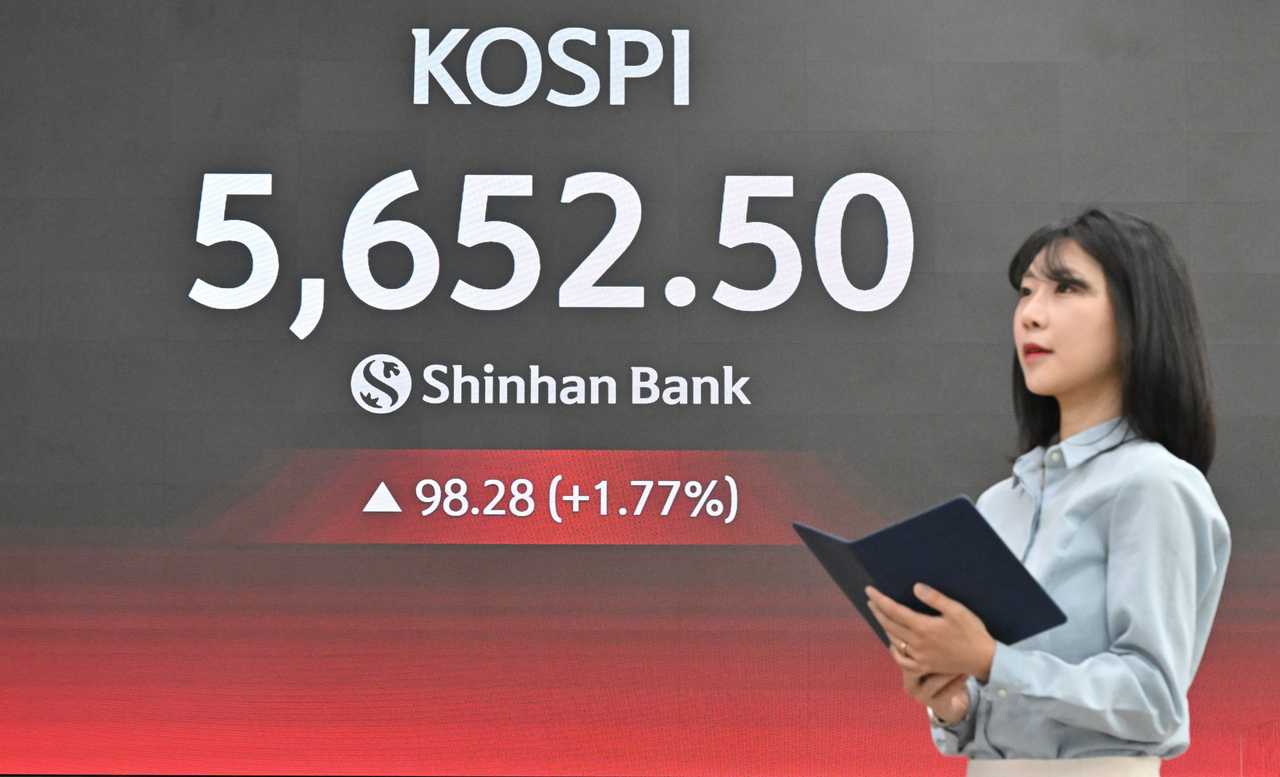
South Korea's stock market suffered a "Black Thursday" on Thursday, wiping out more than 400 trillion won ($297 billion) in market capitalization in a single session. As domestic brokerages identify the return of foreign capital as the key condition for a market rebound, overseas investors are pressing Samsung Electronics and SK hynix to step up shareholder returns.
According to Korea Exchange, foreign investors were net selling 356.9 billion won on the Kospi as of 10 a.m. Friday — their ninth consecutive session of net selling. The Kospi was up 155.30 points, or 2.80 percent, at 5,709.52 at that time, recovering the 5,700 level during trading. The index had opened up 99.77 points, or 1.80 percent, at 5,653.99. The Kosdaq was up 3.99 percent at 791.21 at the same time.
Despite the rebound, anxiety over the market persists as concerns about AI industry profitability, a prolonged high-interest-rate environment and continued foreign selling weigh on sentiment.
On Thursday, the Kospi and Kosdaq each tumbled more than 7 percent, erasing 410.9 trillion won in combined market capitalization in a single day. The Kospi's market cap fell to 4,581.18 trillion won from 4,957.11 trillion won the previous session — a drop of 375.94 trillion won. The Kosdaq shed an additional 34.96 trillion won in market cap on the day.
Heavy foreign selling drove the indexes lower. From the start of this year through Thursday, foreign investors net sold 208.65 trillion won worth of Kospi-listed shares. They unloaded roughly 90 trillion won of SK hynix and about 87 trillion won of Samsung Electronics — together accounting for 85 percent of total net foreign selling on the Kospi.
Interviews with global asset managers and investment banks point to two main drivers behind the foreign exodus: a global shift toward safe-haven assets and dissatisfaction with domestic companies' shareholder return policies.
Concerns about the competitiveness of Korean chipmakers have also grown after Chinese memory chip company CXMT recently announced plans to release server DDR5 chips based on a new, higher-density DRAM architecture before year-end. The worry is that increased Chinese memory chip supply could intensify price competition and erode profitability.
Lee Je-chung, head of the Korea branch of Hong Kong-based CSOP Asset Management, said in a written interview that "CXMT's announcement is merely the company's own claim — its actual mass production capability and technological level still need to be verified," adding that "the impact on Korean semiconductor companies is not significant."
CSOP Asset Management is Hong Kong's largest ETF manager and the first in the world to launch single-stock leveraged ETFs on Samsung Electronics and SK hynix. Its total assets under management stand at around 80 trillion won.
Lee said the selling triggered by CXMT-related news was "an overreaction" and argued that the foreign exodus from the Korean market was not driven by concerns about Samsung Electronics and SK hynix losing their grip on the memory market.
"The biggest reason for foreign selling is the flow of funds into bonds as US Treasury yields rise," he said. "Foreign investors have been taking profits from the Korean market, which had risen sharply since last year, and some of that money is moving into safe-haven assets."
Lee said foreign investors are shifting funds to Japan and Taiwan to avoid the high volatility of the Korean market, arguing that wide price swings in domestic stocks are blocking foreign capital inflows.
Thursday's session illustrated the point: while major Asian markets fell across the board, South Korea's decline stood out. The Kospi and Kosdaq tumbled 7.57 percent and 7.65 percent, respectively. Japan's Nikkei 225 fell 4.90 percent and Taiwan's Taiex dropped 3.41 percent on the same day. China's Shanghai Composite and Hong Kong's market declined 1.59 percent and 2.43 percent, respectively.
A strengthening won is another factor dampening foreign investors' appetite for Korean equities. When the won-dollar exchange rate falls, dollar-denominated returns shrink. This pushes emerging-market funds to reduce their exposure to won-denominated assets and redirect capital toward safe havens or equities in other markets.
A recent Bank of America survey of Asia-Pacific fund managers found that Japan and Taiwan were the most preferred investment markets in the region. South Korea ranked third, behind both.
Expanded shareholder returns from Samsung Electronics and SK hynix were cited as a key condition for foreign capital to return. Earnings improvement alone, analysts noted, is unlikely to restore overseas investor confidence.
"Shareholder returns were the single most common question and demand from overseas investors at Samsung Electronics and SK hynix IR sessions," Lee said. The comment underscores that foreign investors are evaluating not just chipmakers' earnings but also how much of those profits are being returned to shareholders.
Global investment bank JPMorgan also called for additional shareholder returns from the two memory chip giants. In a recent report, JPMorgan said that after meeting more than 100 investors in Singapore, Kuala Lumpur and Hong Kong over the past two weeks, "nearly all investors said aggressive shareholder returns from major memory chipmakers are needed to prevent further multiple de-rating."
The upcoming earnings releases from Samsung Electronics and SK hynix are seen as a potential turning point for the market. "There is no money in the market," Lee said. "Buying momentum has weakened sharply as foreign inflows have dried up and share buyback programs have ended. For foreign investors to return, external conditions such as interest rates and geopolitical conflicts need to improve — and there are no clear signs of that yet."
"It is worth paying close attention to what Samsung Electronics and SK hynix present at their earnings releases," he added.

moon@heraldcorp.com