Trading halts more frequent than during 9/11, pandemic
Kospi plunges nearly 40% from all-time high in just 3.5 months
Foreign investors dump 180 trillion won in Samsung Electronics, SK hynix
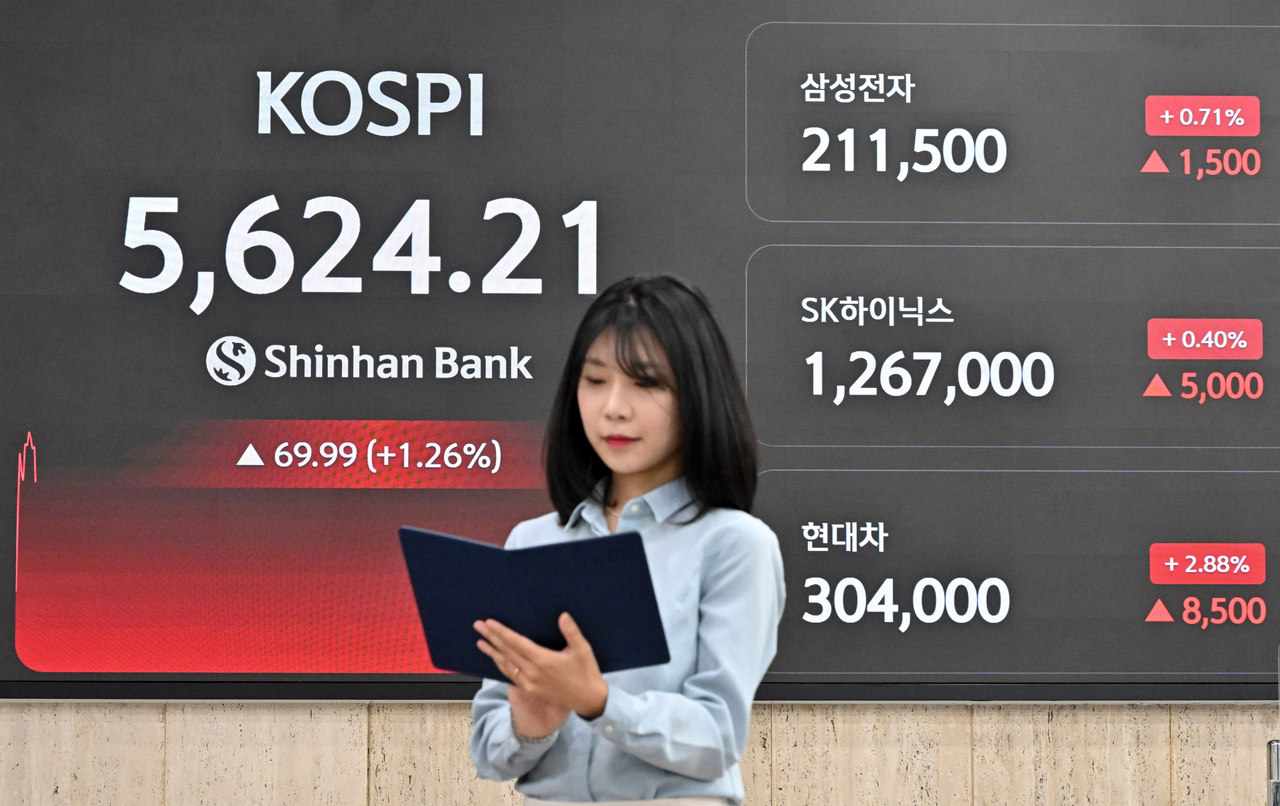
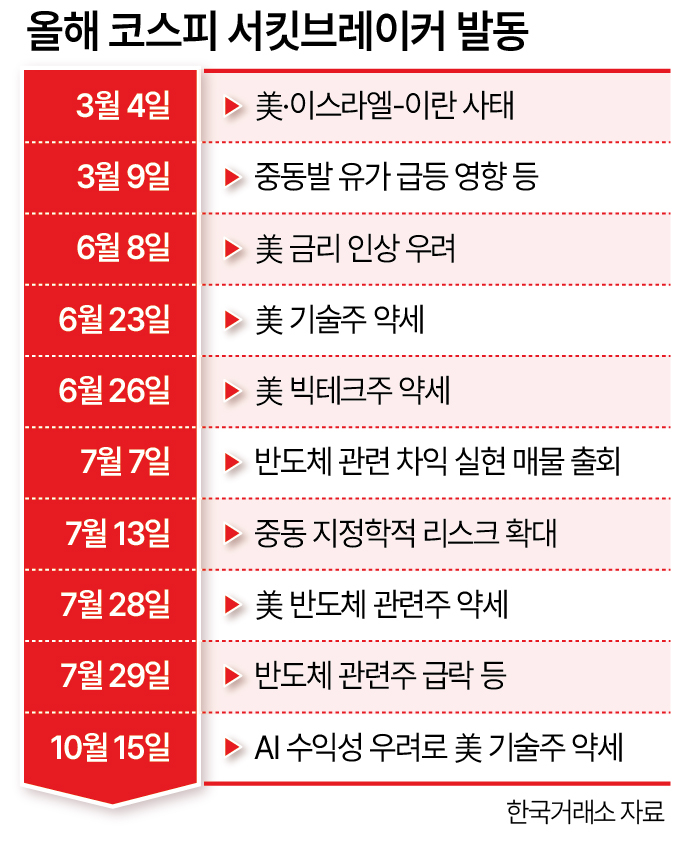
The Kospi is experiencing unprecedented volatility. Circuit breakers — the stock market's emergency brake — have been triggered 10 times on the benchmark index so far this year, accounting for 62.5 percent of the 16 total activations recorded in the index's entire history.
Circuit breakers have traditionally been associated with major national or global crises. During the Sept. 11, 2001 terrorist attacks in the United States, the mechanism was triggered just once. Even during the COVID-19 pandemic, when financial markets were severely shaken, it was activated only twice in 2020. This year, with no single large-scale crisis to point to, circuit breakers have been going off roughly once a month. Analysts say the market's heavy concentration in semiconductor stocks and massive foreign selling of those shares have been key drivers.
According to Korea Exchange, circuit breakers and sidecars were triggered simultaneously on both the Kospi and Kosdaq on Thursday — the first time both markets saw circuit breakers activated on the same day since July 29, and the fifth such occurrence this year.
Sidecars, a less severe measure than circuit breakers, have been even more frequent. The Kospi has seen sidecars triggered 51 times this year through Thursday, representing 45.9 percent of the 111 total activations in the index's history.
That level of activity on the Kospi surpasses even the Kosdaq, which has traditionally been considered the more volatile of the two markets. The Kosdaq has seen circuit breakers triggered five times this year — 33.3 percent of its all-time total of 15 — and sidecars 33 times, or 28.2 percent of its historical total of 117.
Not only in raw frequency but also as a share of all-time activations, the Kospi's volatility has outpaced the Kosdaq's. Analysts say the index's exceptional run-up earlier this year has made the subsequent downturn equally steep.
The Kospi opened 2026 at 4,309.63 on Jan. 2 (closing basis) and surged to an all-time high of 9,114.55 on June 22, driven by optimism over the semiconductor market. In just three and a half months, however, it had fallen to 5,554.22 on Thursday — a drop of 39.06 percent from that peak.
Global markets broadly were rattled during this period by concerns over a semiconductor cycle peak, high interest rates and geopolitical tensions. But the Kospi's decline was particularly steep compared with other major markets. From June 22, when the Kospi hit its yearly high, through Thursday, Japan's Nikkei 225 fell 10.96 percent and China's Shanghai Composite dropped 10.94 percent — both holding up relatively well. The NASDAQ, meanwhile, actually gained 2.09 percent over the same period.
Behind the domestic market's outsized volatility is a structural overconcentration in semiconductors. While markets in the United States, Japan and elsewhere are supported by companies across a wide range of industries, South Korea's stock market is effectively driven by the semiconductor sector alone.
Samsung Electronics and SK hynix together accounted for 46.92 percent of the Kospi's total market cap as of Thursday. That combined weighting stood at 34.04 percent at the end of last year, crossed 50 percent for the first time on May 27 and reached 55.67 percent when the index hit its all-time high on June 22.
The two stocks' combined share has since eased somewhat as global semiconductor names came under pressure from a wave of Chinese memory chip competition and concerns over AI profitability, but they still dominate the index by a wide margin. The combined weighting of the next tier of large-cap stocks — SK Square at 2.20 percent, LG Energy Solution at 2.06 percent, Samsung Electro-Mechanics at 1.90 percent and Hyundai Motor at 1.31 percent — still falls far short of Samsung Electronics alone.
Heavy foreign net selling has compounded the pressure. Foreign investors net sold 208.65 trillion won ($155 billion) worth of Kospi shares from the start of the year through Thursday. Of that total, 180.61 trillion won was concentrated in just two stocks: SK hynix, with net selling of 91.42 trillion won, and Samsung Electronics, with 89.19 trillion won.
Hwang San-hae, a researcher at LS Securities, said the accumulated supply-demand vacuum left by foreign selling and the end of share buyback programs at the two semiconductor companies has been amplifying the price impact of negative news. "With retail and institutional investors also unable to step up as consistent buyers, attempts at a rebound driven by perceptions of overselling during the week have failed to gain traction, and buying confidence has retreated," he said.
Hwang added that the key to a return to a long-term uptrend lies not in further capital expenditure by big tech companies, but in productivity gains and spending capacity at firms adopting AI — and the resulting recovery in cash flows at hyperscalers. He projected a weekly trading range for the Kospi of 5,200 to 6,000 next week.
jiyun@heraldcorp.com