
Pizza-topped rice cakes, fruit-filled chapssaltteok draw younger crowds
'Tteok open runs' and 'tteoketing' signal a dessert culture shift
Domestic tteok sales near 1 trillion won; exports hit record high
Neighborhood rice cake shops declining even as market grows
![Yeongdobridge Tteokbang's rice cakes — including its signature pizza-topped baeksulgi — are now available at pop-up stores in Seoul department stores and convenience stores. Shown here is a pop-up event at Lotte Department Store's Busan branch. [Provided by Modern Art]](https://wimg.heraldcorp.com/news/cms/2026/10/16/news-p.v1.20261016.c04a0bbd86444bab9299b9ec5fcd7fc9_P1.jpg)
Yeongdobridge Tteokbang opened in 1999 as a small neighborhood rice cake shop in Nam-hang Market in Busan's Yeongdo-gu. For more than two decades it served local residents, but it has recently reinvented itself as a nationally recognized destination. The turnaround came when its "pizza sulgi" — a baeksulgi rice cake topped with cheese, pepperoni and potato — went viral on social media.
Last April, more than 100 customers a day were lining up before the shop opened. Visitors from Seoul and across the country still make the trip every weekend. The shop's products are now also available through pop-up stores at department stores and convenience stores in Seoul.
Pizza sulgi was developed by Shin Woo-sol, who joined the family business five years ago. "Continuing what my parents had done for so long was important, but I also felt we needed to try new things to keep up with a changing market," Shin said. Noticing that existing tteok desserts leaned heavily sweet, she set out to create something savory. After more than six months of research and trial and error, she launched pizza sulgi in 2021.
The product's success transformed the shop's operations. Daily rice cake output, which once averaged 30 to 40 doe, has risen to 100 to 150 doe. Combined shop sales and delivery now move an average of about 5,000 pieces a day, roughly 70 percent of which are pizza sulgi products. Work typically begins at 3 or 4 a.m., and all-nighters are common when department store pop-ups or bulk orders pile up.
![Pizza sulgi products sold at the Yeongdobridge Tteokbang pop-up store. [Provided by Modern Art]](https://wimg.heraldcorp.com/news/cms/2026/10/16/news-p.v1.20261016.d837b263eee2495589189863013499f1_P1.jpg)
"The biggest challenge used to be just getting through each day while covering ingredient and labor costs," Shin said. "Pizza sulgi's success means more than just having a product that sells well — it means our family can dream about the future together." She added that rather than resting on the current wave of attention, she considers it more important to maintain the shop's quality and flavor across every distribution channel.
Modern Art, the distributor handling Yeongdobridge Tteokbang's products, was drawn to pizza sulgi's distinctive appeal. "Pizza sulgi blends the familiar taste of traditional tteok with a modern visual that younger consumers can enjoy without hesitation," said Park Jin-cheol, chief executive of Modern Art. "We decided to take it on because we saw potential for it to grow into a differentiated dessert product by grafting the universally familiar concept of pizza onto sulgi."
The company plans to move beyond pop-up events toward permanent retail distribution. "We are currently expanding our distribution channels while gauging consumer response through department store pop-ups," Park said. "Going forward, we plan to broaden our sales reach to major department stores, convenience stores and other channels, and to connect products proven through pop-ups to retail stores and regular distribution."
![A view of the "National Tteok Pilgrimage Season 2" pop-up store on the basement first floor of Lotte Department Store's Jamsil branch. [Provided by Lotte Department Store]](https://wimg.heraldcorp.com/news/cms/2026/10/16/news-p.v1.20261016.d27d5e3985f54d2a8c5f74600701c233_P1.jpg)
From 'tteok pilgrimages' to 'tteok open runs': rice cakes go viral
Beyond pizza sulgi, a range of reinvented traditional rice cakes — fruit-filled chapssaltteok and castella-coated injeolmi among them — are drawing crowds. The trend has given rise to what Koreans call "tteok pilgrimage" (tteokjisunrye), a portmanteau of "tteok" and the Korean word for pilgrimage, describing the practice of seeking out celebrated rice cake shops. Related coinages have followed: "tteok open run" (tteokpeurun), for lining up before a shop opens, and "tteoketing" (tteoketting), evoking the fierce competition of concert ticket sales.
Rice cakes have long been associated with middle-aged and older consumers. Data from the Korea Rural Economic Institute on processed food spending in 2025 showed that tteok ranked 25th among processed food expenditures for households headed by someone under 30, but seventh for households headed by someone 60 or older.
Among younger consumers, however, interest has been climbing rapidly through social media. According to big data analytics platform Some Trend, online posts describing tteok as a "dessert" rose 39.7 percent on blogs and 47.7 percent on online communities from January through Aug. 23 this year compared with the same period last year. Social media mentions of pizza sulgi alone jumped from fewer than 100 in April to about 2,000 in August and more than 10,000 in September.
![The Hanjeongseon store on the basement floor of Lotte Department Store's main branch in Jung-gu, Seoul. [Herald DB]](https://wimg.heraldcorp.com/news/cms/2026/10/16/news-p.v1.20261006.cfead8c7da824cd5895b8aae8440aa3a_P1.png)
Industry observers attribute the trend to curiosity about new flavors and textures layered onto a familiar traditional food. Yeongdobridge Tteokbang set itself apart by combining pizza toppings — cheese, pepperoni and more — with baeksulgi. Hanjeongseon, a brand specializing in fruit chapssaltteok, adds fresh strawberries, tangerines and kiwi inside the rice cake for a new taste and texture. Changeoktteok, from Gwangju in South Jeolla Province, has won fans with its pumpkin injeolmi coated in castella crumbs instead of the traditional soybean powder.
Tteok's signature chewy texture and its image as a healthier dessert are also cited as key draws. Some Trend found that online posts describing tteok as a dessert this year most frequently paired the word with keywords related to taste, texture and health. "Texture is the single strongest purchase driver for tteok," the platform said. "It occupies territory that flour-based bread cannot replicate — tteok's competitive edge lies in the chewing experience, not just the flavor."
"Experience consumption" — visiting a shop in person to taste something discovered online — is also fueling the tteok pilgrimage trend. "This craze has an element of experience consumption, where people want to taste for themselves the tteok they encountered on social media," said Lee Eun-hee, an emeritus professor of consumer studies at Inha University. "Once a trend catches fire through experience consumption, the consumer response is far more intense than in the past, and people then go looking for the next new thing to experience."
![Pizza sulgi on sale at Sodam Tteokjip in Namseong Sagye Market in Dongjak-gu, Seoul. [Herald photo by Jeong Dae-han]](https://wimg.heraldcorp.com/news/cms/2026/10/16/news-p.v1.20261016.208846a50e3545c9aaed53eba88b8e4c_P1.jpg)
The craze is spreading beyond famous shops to traditional markets and neighborhood rice cake stores. Sodam Tteokjip in Namseong Sagye Market in Seoul's Dongjak-gu began developing its own pizza sulgi recipe after the chuseok holiday, once the product's popularity became clear. It sells for 2,000 won per piece — relatively affordable compared with well-known brands.
"Since we started selling pizza sulgi, a lot of younger people have been coming to the shop," a Sodam Tteokjip representative said. "Customers who come for the pizza sulgi tend to pick up other rice cakes as well, so it has been good for overall sales." Young consumers drawn in by pizza sulgi are buying other products too, creating a new customer base for traditional neighborhood shops.
"Customers who come in for pizza sulgi often buy other tteok at the same time, which is helping sales at existing shops," said Lee Hyeong-guk, secretary general of the Korea Tteok and Food Processing Association. "Young entrepreneurs are also showing interest in developing products that match new trends and consumer tastes, and that is driving change across the tteok industry."
![Hanjeongseon yogurt and pistachio chapssaltteok sold at GS25. [Provided by GS25]](https://wimg.heraldcorp.com/news/cms/2026/10/16/news-p.v1.20261006.840a2b9056ed42da9a9e0a05766a63aa_P1.jpg)
From convenience stores to department stores: retailers ride the tteok wave
Retailers are joining the tteok boom. Convenience store chains have been rolling out new products developed in collaboration with well-known tteok brands or by incorporating new ingredients into existing rice cakes. GS25 last month launched a "Hanjeongseon yogurt chapssaltteok" developed with dessert brand Loromélo and Hanjeongseon. Cumulative sales have surpassed 1 million units since the product's release. A follow-up product, "Hanjeongseon pistachio chapssaltteok," sold out its entire pre-order allocation on the chain's app in six minutes Tuesday.
CU released a "pizza jeolpyeon" — a pizza-style version using jeolpyeon rice cake — to ride the pizza sulgi trend. About 30,000 units have sold since it launched Saturday. E-Mart 24 also held pop-up events last month at select specialty stores, selling popular products from Iksan Agricultural Cooperative Tteok Mill, known for its fresh cream chapssaltteok, and from Yeongdobridge Tteokbang.
The popularity has translated directly into sales. GS25's tteok sales from Oct. 1 through Tuesday were 56 times higher than in the same period last year. CU and Seven-Eleven posted increases of 351.5 percent and 254 percent, respectively.
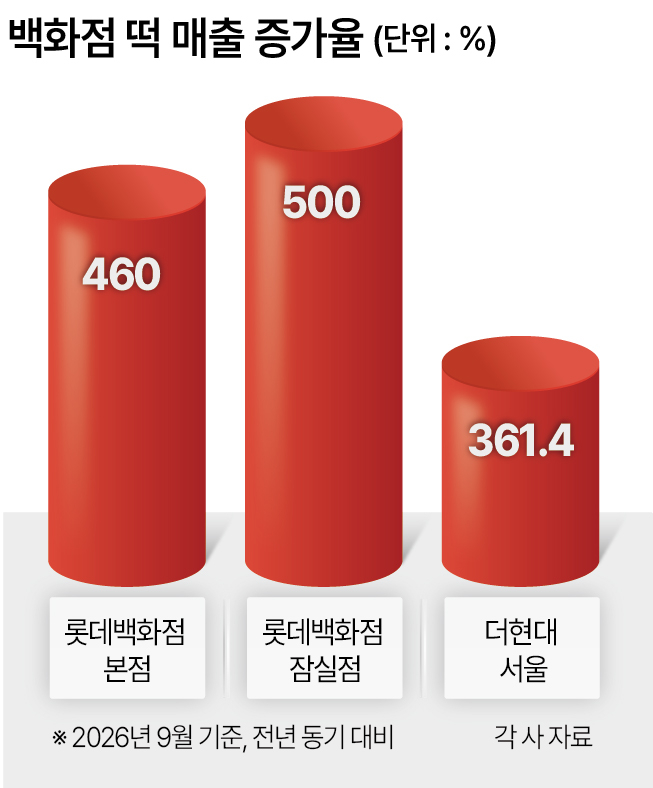
Department stores are also seeing sharp tteok sales gains, driven largely by pop-up events. Lotte Department Store's tteok sales in September rose 460 percent year on year at its main branch and 500 percent at its Jamsil branch. The main branch brought in Hanjeongseon as a permanent tenant, while the Jamsil branch ran a Hanjeongseon pop-up. From Monday through Thursday, the Jamsil branch also hosted a "National Tteok Pilgrimage 2" pop-up featuring eight tteok brands from across the country.
Over the same period, Hyundai Department Store's tteok brand sales rose 250.3 percent across all branches. The Hyundai Seoul store, which has hosted pop-ups by well-known tteok shops, posted a 361.4 percent increase. Last month, Hyundai Seoul featured pop-ups by prominent brands including Bangbae-dong's Gureum Tteokjip, Jaiso and Songwolhyang. A pop-up event in August that included Changeoktteok drew more than 10,000 visitors over one week — with lines forming as early as 6:30 a.m., before the store opened, and waitlist registrations topping 700 groups by opening time.
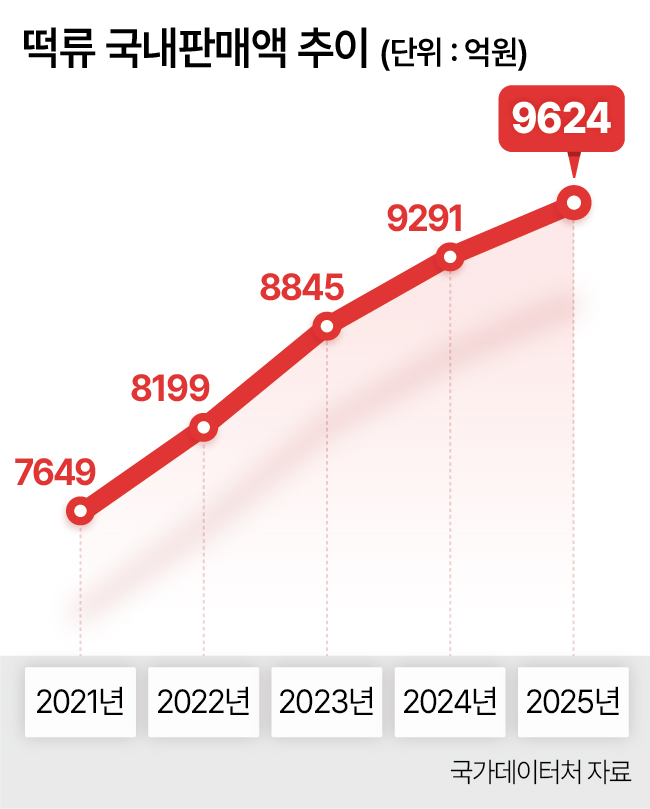
Domestic tteok sales near 1 trillion won; exports hit all-time high
The tteok industry has been growing steadily. According to food production statistics from the Ministry of Food and Drug Safety, domestic tteok sales last year reached approximately 962.4 billion won ($714 million), up 25.8 percent from 764.9 billion won in 2021. Rice consumption by tteok manufacturers has also surged. The Ministry of Statistics' 2025 Grain Consumption Survey showed that tteok manufacturers used 264,915 tons of rice last year, up 32.6 percent from 199,766 tons the year before. Tteok manufacturing accounted for 24.9 percent of all rice consumed across the food and beverage manufacturing sector last year — the highest share of any related industry.
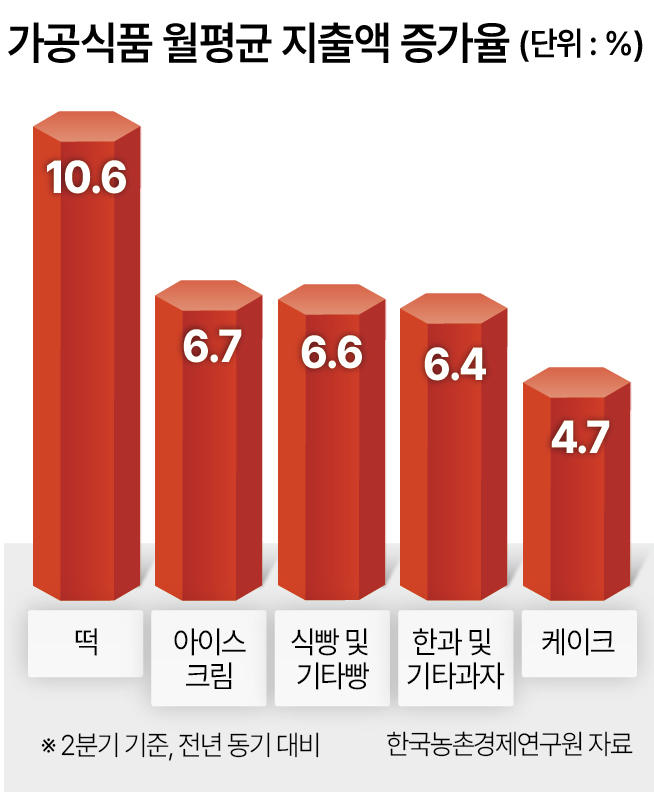
Consumer spending on tteok is also rising. A Korea Rural Economic Institute analysis of household expenditure data, published in a report on processed food spending trends for the second quarter of this year, found that households spent an average of 5,200 won per month on tteok in the second quarter, up 10.6 percent from the same period last year. That outpaced spending growth on other major dessert categories over the same period, including ice cream (6.7 percent), bread (6.6 percent), Korean confections and other snacks (6.4 percent) and cake (4.7 percent).
Overseas demand for Korean tteok is growing as well. According to Korea Customs Service trade statistics, tteok exports last year totaled $107.51 million, up 17.6 percent from the previous year and surpassing $100 million for the first time. That represents a 63.3 percent increase from $65.85 million in 2021. Cumulative exports from January through August this year reached $71.02 million, up 2.8 percent year on year, and are on track to set a new annual record.
![Visitors purchase rice cakes at a chuseok direct-trade market held at Gangnam District Office in Seoul. [Yonhap]](https://wimg.heraldcorp.com/news/cms/2026/10/16/rcv.YNA.20260916.PYH2026091613290001300_P1.jpg)
Market grows, but neighborhood shops shrink — sustaining the boom is the challenge
The central question is whether the current popularity will translate into lasting consumption rather than a passing fad. Even as the broader tteok industry grows, small neighborhood rice cake shops are declining — a tension that weighs on the industry. According to the Korea Tteok and Food Processing Association, the number of tteok shops nationwide fell from about 20,000 in 2024 to 19,100 in 2025 and 18,000 in 2026 — a loss of roughly 2,000 stores in two years. New demand for products like pizza sulgi and fruit chapssaltteok has emerged, but bulk orders tied to milestone celebrations such as first-birthday and hundredth-day ceremonies have declined.
The industry hopes the current craze will broaden tteok's consumer base. "Compared with bread, tteok has long been overlooked as something you only eat on holidays, and it is true that it has lagged behind other desserts in terms of innovation," said Shin of Yeongdobridge Tteokbang. "It needs to become a product that customers return to because of its taste and quality, not just because it is trendy." She added that she hoped the moment would serve as a springboard to develop tteok further and grow it into a K-dessert that Korea could proudly export to the world.
"I see this as more than a passing trend — it is a shift in which the traditional dessert market is meeting a new generation of consumers," said Park of Modern Art. "Tteok fits well with younger consumers' preference for visual appeal, fun and experience alongside taste." He added that he expected products combining traditional tteok with fresh ideas to grow into a significant pillar of the K-dessert market.
Industry voices also say the sector needs to strengthen its production and distribution capabilities to sustain growth. "Most tteok businesses are small-scale sole proprietors, so they are quite hesitant to expand," said Yoo Kyeong-bae, chairman of the Korea Traditional Tteok Food Industry Federation. "Even where legal support exists, actual assistance remains minimal." He added that as physical labor becomes harder to recruit, support for automation through AI and robotics would also be needed going forward.
korean@heraldcorp.com





