- KAIST study of 52 adults finds prefrontal cortex activity diverges during slouching and sighing based on depression level
- Higher depression symptoms linked to decreased brain activity, raising hopes for personalized mental health care
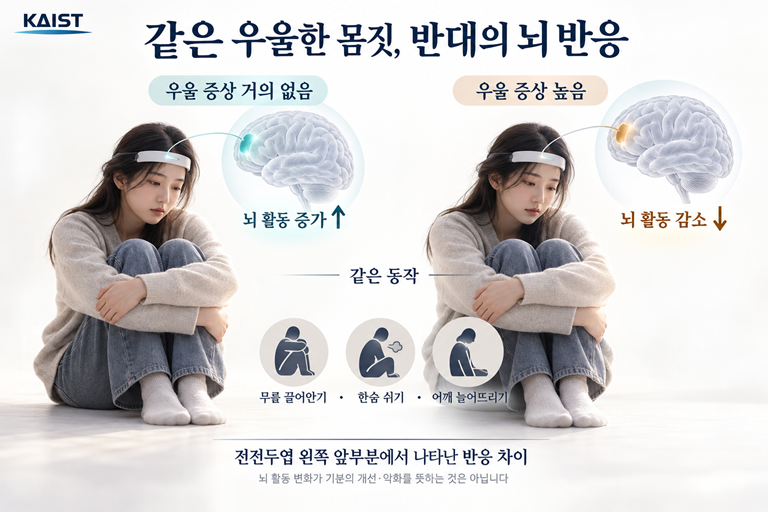
The same hunched posture and heavy sigh can trigger opposite brain responses depending on a person's level of depression symptoms, a new study has found.
KAIST announced Monday that a research team led by Professor Park Young-gyun of the Department of Bio and Brain Engineering used wireless brain-imaging equipment to measure brain activity during actual physical movement, confirming that brain responses vary with the severity of depression symptoms.
The team conducted experiments with 52 adults between the ages of 20 and 35. Through a depression symptom questionnaire and a mental health screening interview, participants were divided into two groups: 27 with minimal depression symptoms and 25 with elevated symptoms.
Participants were randomly assigned to one task — either a negative-emotion movement, such as hugging their knees to their chest, sighing deeply or drooping their shoulders, or a positive-emotion movement, such as a victory pose, jumping, or clapping and laughing. Each movement was performed for 30 seconds, followed by a 60-second rest, and the cycle was repeated four times.
The team measured changes in blood oxygen levels in the brain using a wireless functional near-infrared spectroscopy (fNIRS) device worn on the forehead. Unlike conventional functional MRI, the technology allows researchers to observe brain activity while a person is actually moving.
The results were unexpected. Although all participants performed the same negative-emotion movements — hugging their knees, sighing and drooping their shoulders — activity in the left anterior prefrontal cortex increased in the low-symptom group but decreased in the high-symptom group.
Notably, this divergence in brain response appeared consistently across all three negative-emotion movements in the same region. By contrast, no common pattern of brain activation emerged across the three positive-emotion movements.
The findings suggest that even when outward body movements are identical, the brain may process movement and emotion-related information differently depending on an individual's level of depression symptoms.

The research team expects the findings to serve as foundational data for developing personalized movement- and exercise-based mental health care technology. The team also sees potential for expanding the work into mental health monitoring using wearable brain-imaging devices and neurofeedback technology that tracks brain responses in real time.
However, the study did not establish that any specific movement has a therapeutic effect on depression. Whether increases or decreases in brain activity correspond to actual improvements or worsening of emotional states also requires further verification.
"This research is meaningful in that it confirmed, through measurement during actual movement, that the brain responds differently to the same body movements depending on a person's level of depression symptoms," Professor Park said. "It can serve as foundational data for future research into movement-based mental health care tailored to individual conditions."
The findings were published in the international academic journal Brain Research Bulletin.
nbgkoo@heraldcorp.com