Top 30 lenders hold 44 billion won in military loans; delinquency rate hits 7.93%
Han Min-su: 'Locally registered lenders fall outside FSS oversight — financial safety net must be redesigned'
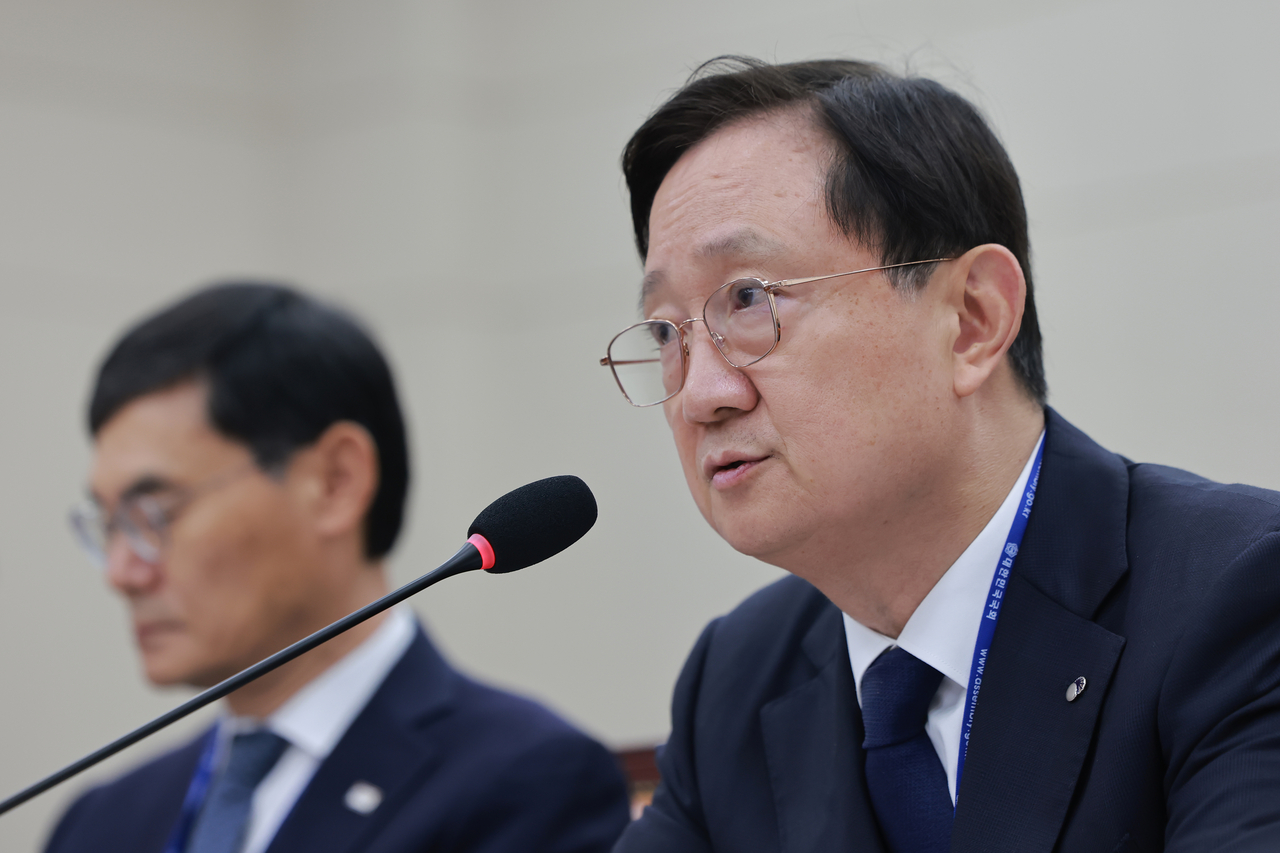
Financial Supervisory Service chief Lee Chan-jin said Monday he would consider directly banning loan companies from extending credit to active-duty soldiers, as rising military pay and widespread smartphone use inside barracks have fueled a surge in high-interest lending to troops — and a sharp jump in delinquencies.
Lee made the remarks at a national audit of the FSS held by the National Assembly's Political Affairs Committee, responding to questions from Democratic Party of Korea lawmaker Han Min-su. "I am considering whether we could pursue direct regulation under the Moneylenders Act — a form that would prohibit loans to school-age children and adolescents as well as soldiers serving their mandatory military duty," Lee said. He added that he planned to consult with the Financial Services Commission and, if an agreement is reached, to bring in the military authorities as well.
Han said that as monthly pay for soldiers at the rank of sergeant first class has risen to 1.5 million won ($1,120) and smartphone use has become routine, troops with limited financial experience are increasingly exposed to online gambling, high-risk virtual asset investment and debt-fueled speculation. Loan companies and brokers are actively marketing products under names such as "loyalty loan," "sergeant loan" and "active-duty soldier loan," offering up to 10 million won at annual interest rates of 15 to 20 percent, he said.
According to Han, the outstanding loan balance held by the top 30 lenders for military personnel exceeded 44 billion won at the end of last year, of which more than 24 billion won was owed by active-duty soldiers. As of the end of June, the active-duty balance alone had already surpassed 21 billion won, suggesting the full-year figure will far exceed last year's level.
Concerns about bad debt are also mounting. The delinquency rate on military loans stood at 7.93 percent as of the end of June. The overdue balance has ballooned from 22 million won in 2023 to about 1.7 billion won. The number of active-duty soldiers seeking debt restructuring has also risen sharply.
Han said the FSS's supervisory framework has clear limits. Of roughly 7,700 loan companies nationwide, about 6,600 — or 86.6 percent — are registered with local governments rather than the FSS, placing them in effect outside its oversight. The FSS conducts on-site inspections at only the top 30 firms, and its record of sanctions or examinations targeting illegal or irregular lending to military personnel stands at zero, Han said. He also noted that the FSS has been slow to introduce regulations it has been discussing to prevent active-duty soldiers from taking out loans.
The FSS announced in March that it would strengthen financial education for troops in cooperation with the Ministry of National Defense.
Han also warned of unintended consequences if policy focuses solely on blocking loans. "If we go down the road of cutting off lending, a balloon effect could push soldiers toward unregistered lenders or expose them to illegal private financing," he said. "The financial safety net for military personnel needs to be completely redesigned." He added that the FSS and the government must develop a comprehensive set of measures "so that the young people faithfully fulfilling their duty to defend the country can return to society as healthy economic participants."
won@heraldcorp.com