88 of 133 approved project sites have not started construction in past 5 years
Third-generation new towns including Wangsuk, Gyosan account for 27,772 units
Land compensation disputes, lawsuits put government's 'fast-track' pledge to the test
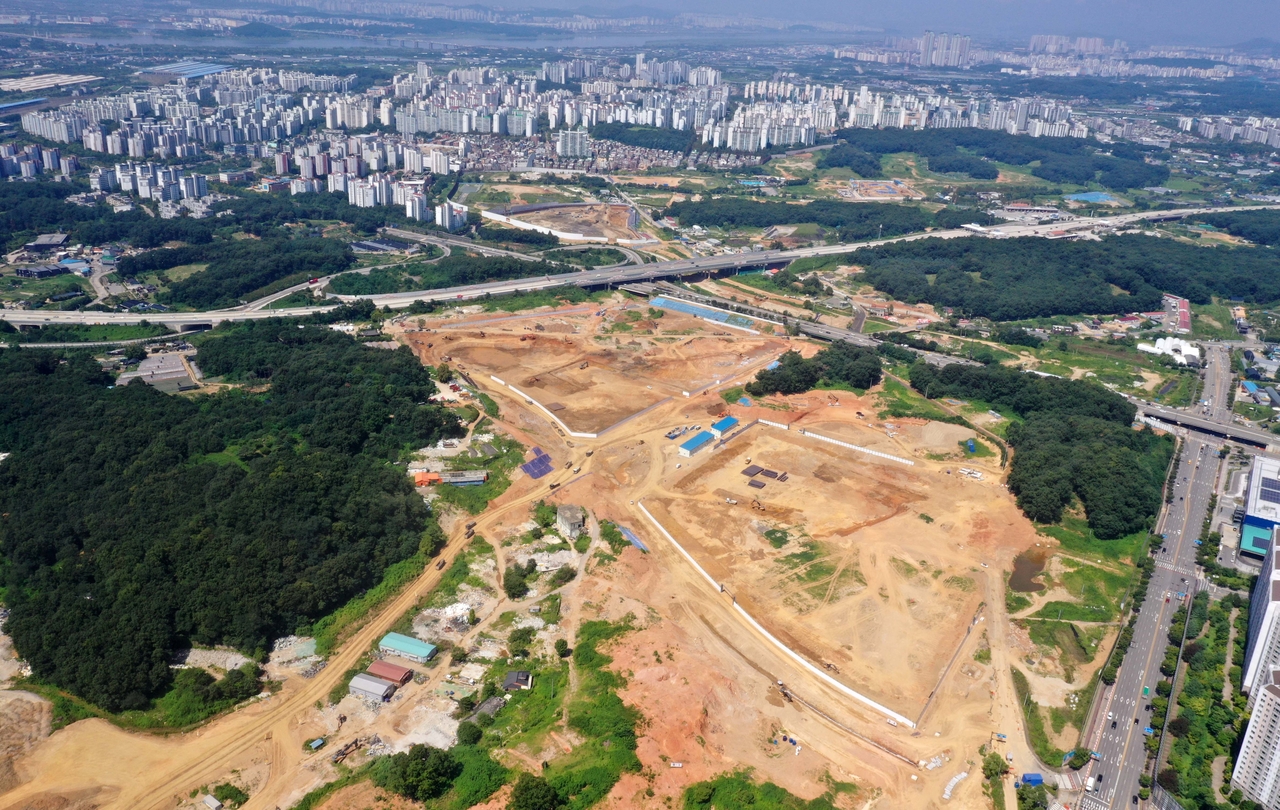
As the government pushes to accelerate housing supply to cool overheating home prices in the Greater Seoul area, 66 percent of public pre-sale apartment project sites approved over the past five years have yet to break ground, a new analysis shows. Experts attribute the delays primarily to protracted land compensation disputes and time-consuming site preparation work such as contaminated soil remediation. The stalled construction is feeding a vicious cycle of rising construction costs and higher pre-sale prices, prompting calls for more hands-on, site-level management.
Data obtained Tuesday by the National Assembly's Land and Infrastructure Committee show that 88 of the 133 Greater Seoul public pre-sale apartment project sites that received project plan approval — the key regulatory permit — between 2022 and August 2026 have not yet broken ground. In terms of units, 67,192 of the 94,766 public pre-sale apartments slated for supply remain unstarted.
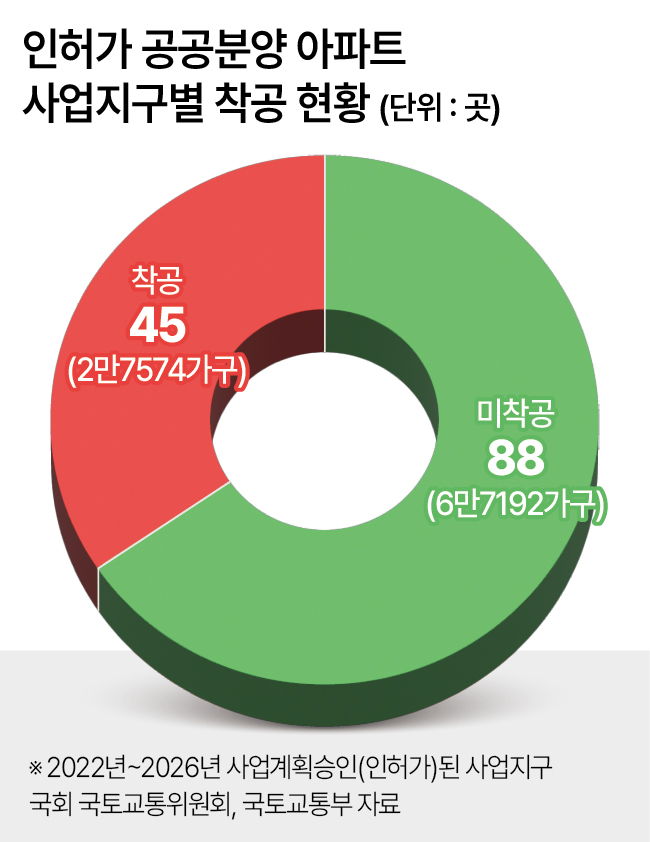
Among the stalled sites, the A182 block in the Pyeongtaek Godeok International Planning District (512 units) and the S11 block in Namyangju Wangsuk (546 units) received project plan approval in December 2022 but have gone more than three years without breaking ground. The unstarted sites include third-generation new town projects — Goyang Changneung, Namyangju Wangsuk 1 and 2, Bucheon Daejang, and Hanam Gyosan — accounting for 27,772 units, as well as Gwacheon Gwacheon, Gwangmyeong Siheung, Gwangmyeong Haan 2, the Namyangju Yangjeong transit-oriented area, Suwon Dangsu 2, the Uiwang-Gunpo-Ansan district, the Pyeongtaek Godeok International Planning District, and the Geomam transit-oriented area. Of the 133 approved public pre-sale apartment sites, only one is in Seoul — the A1 block in Seoul Daebang (858 units), which received project approval in December 2024 but has yet to start construction.
Of the 88 sites that have not broken ground despite receiving approval, 81 cite "immature land conditions" as the reason for the delay. On the ground, land compensation disputes are widely seen as the single most critical obstacle blocking construction starts. Negotiations over higher compensation with landowners, refusals to demolish structures or relocate, and legal battles arising from compulsory acquisition proceedings have left site preparation work frozen for years even after project approval. When cultural heritage surveys or soil contamination cleanup are added to the mix, the actual construction start date can be pushed back indefinitely.
The projected compensation for the five third-generation new towns stood at 12.14 trillion won ($9.12 billion), but the amount actually paid out reached 13.17 trillion won — more than 1 trillion won over budget. Eviction lawsuits, filed when occupants refuse to vacate land or buildings after compensation procedures are complete, numbered 2,718 cases.
The government has acknowledged the delays in land compensation and site preparation, and plans to build a "minimum-timeline groundbreaking model" that would cut the public housing development period from the current 68 months to 37 months — nearly half — by pursuing land designation and compensation procedures simultaneously. The Ministry of Land, Infrastructure and Transport announced Aug. 13 a rapid housing supply plan aimed at stabilizing both the jeonse and monthly rent and sales markets, pledging to run permitting, compensation, and site preparation in parallel and to shorten the compensation period from the current 12 months to nine.
Critics, however, warn that land compensation disputes are entangled with residents' livelihoods and complex legal proceedings, making them difficult to resolve simply by streamlining administrative procedures.
"Many landowners in project districts run greenhouse flower farms, factories, or small businesses — their entire livelihood and living environment are tied to that area," said Lee Eun-hyung, a research fellow at the Korea Construction Policy Research Institute. "That makes friction over relocation measures and compensation amounts particularly intense, and when compensation disputes and eviction lawsuits drag on, there is a limit to how much you can advance the physical construction start no matter how much you shorten the administrative timeline."
Lee added that the government's goal of cutting timelines while keeping existing compensation and negotiation procedures intact puts the cart before the horse. "What needs to come first is a precise and concrete action plan that can actually resolve on-the-ground compensation friction and genuinely shorten the compensation period," he said. "The longer construction is delayed, the heavier the cost burden becomes as inflation and rising raw material prices push project expenses well above initial estimates, making it increasingly difficult to move projects forward."
hwshin@heraldcorp.com