Navy pursues nuclear submarine readiness, unmanned carrier vessel
Marine Corps seeks operational command creation, transfer of 1st Division control by year-end
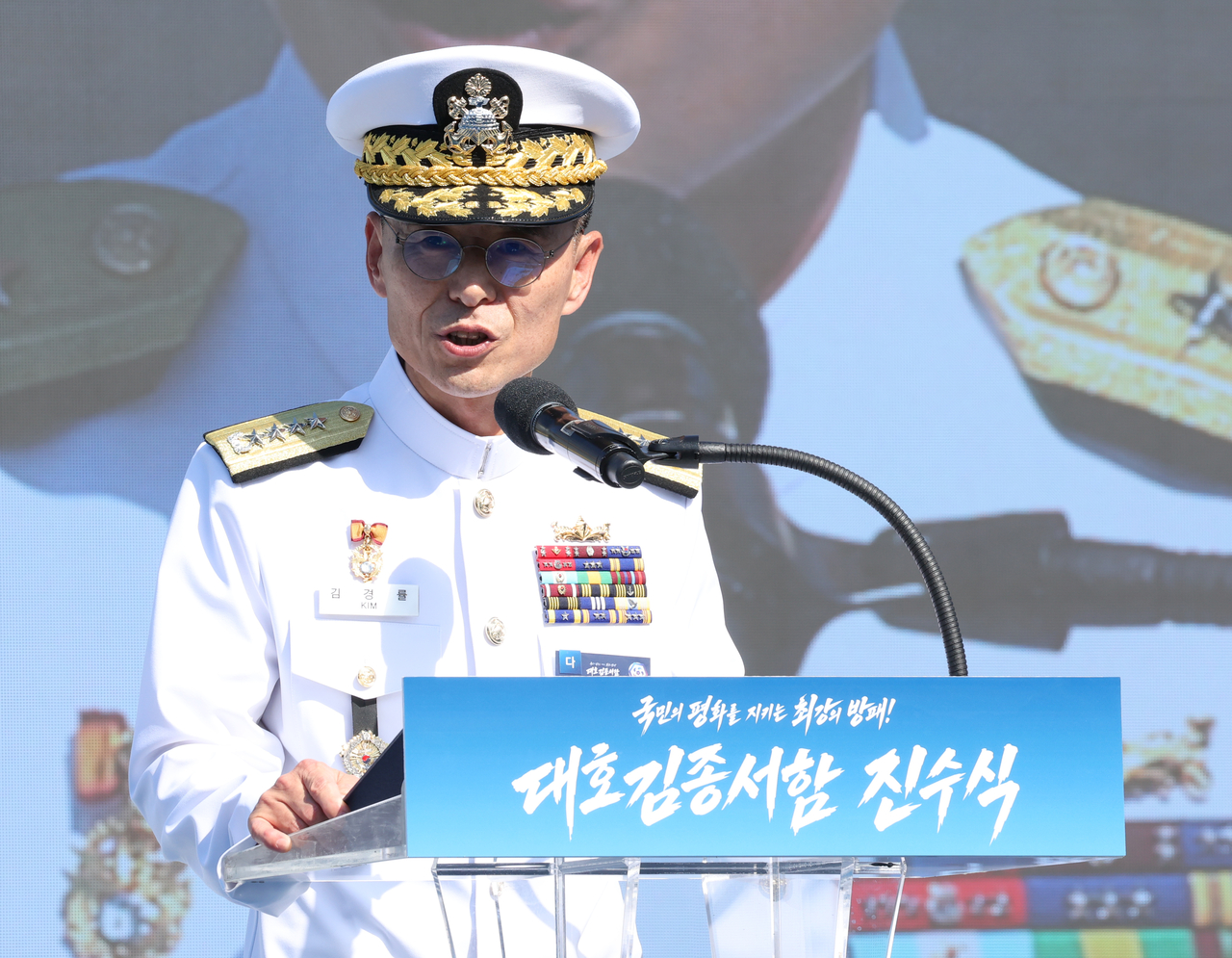
The Navy and Marine Corps presented plans Tuesday to strengthen combat capabilities and restructure their command systems in preparation for future battlefields, outlining their visions at the National Assembly's national audit.
The two services reported their key operational priorities at the Defense Committee's national audit held Tuesday morning at the main conference hall at Gyeryong base. Navy Chief of Staff Adm. Kim Kyung-ryul and Marine Corps Commandant Gen. Ju Il-seok attended, along with commanders and senior officials from the Naval Operations Command, Education Command and Logistics Command.
In his opening remarks, Kim said the importance of the sea in sustaining national survival and the future is growing amid uncertainty in the international order and shifts in the security environment surrounding the Korean Peninsula. "A strong naval force is the foundation for protecting our maritime domain and the core capability underpinning maritime sovereignty, as well as national peace and prosperity," he said.
The Navy presented three main policy priorities: ensuring readiness through enhanced existing capabilities, developing AI-based manned-unmanned combined combat capabilities, and building a trusted and proud naval force. It also said it would focus on naval force construction to counter evolving maritime threats, an AI transformation drive, stable personnel recruitment, and expanding ship maintenance, repair and overhaul operations through civil-military cooperation.
At the core of its naval buildup are the development of a maritime-based Korean three-axis system and preparations to operate nuclear-powered submarines. The Navy plans to gradually acquire the capability to monitor and strike sea-based launch points, in response to North Korea's efforts to extend its nuclear and missile operations into the maritime domain through submarines capable of carrying submarine-launched ballistic missiles and new destroyers.
To that end, the Navy plans to build the Korean Destroyer Experimental (KDDX) and a Maritime Intelligence Ship-III by the early-to-mid 2030s, and to acquire ship-to-ground ballistic missiles, long-range maritime suicide drones, and SM-3 and SM-6 missiles.
On nuclear-powered submarines, the Navy said it established a dedicated nuclear submarine task force — a temporary organization — on May 1. The task force is identifying the Navy's phased responsibilities from project preparation and launch through design, construction and test evaluation, with the goal of being ready for operational deployment without delay once the vessels enter service.
The Navy is also pursuing the acquisition of a manned-unmanned carrier vessel focused on carrying unmanned assets, replacing the earlier light aircraft carrier program. The Navy revised its requirement from a light aircraft carrier to a manned-unmanned carrier vessel in October last year, and the Joint Chiefs of Staff is currently reviewing the proposal. The target date for the vessel to enter service is the early 2040s.
The Marine Corps outlined five tasks for its restructuring into a quasi-fourth service branch: amending the Military Organization Act, transferring operational control of the 1st and 2nd divisions, reorganizing the command structure and organization, reinforcing advanced capabilities, and expanding opportunities for advancement to higher commands.
The Marine Corps plans to clarify its mission and role through amendments to the Military Organization Act and to enshrine the commandant's authority and status in law. It is also pursuing the creation of a Marine Operations Command to separate administrative and operational functions. The 1st Division is set to transfer operational control by the end of this year, with the 2nd Division targeting 2028, and both will be reinforced with the assets needed to carry out their missions.
Commandant Ju said all Marine Corps service members and civilian employees are working to align with the status and role of a national strategic maneuver force — including the restructuring into a quasi-fourth service branch — with a clear awareness of the changing security environment.
rimsclub@heraldcorp.com