Financial regulators' determination that SK hynix's US-based subsidiary Solidigm's planned stock market listing would violate South Korea's dual-listing rules has drawn fresh attention to domestic regulations governing overseas listings by foreign subsidiaries. Analysts say the rules — which since August have required parent company boards to fulfill shareholder protection obligations even when a subsidiary lists abroad — will have a significant bearing on Korean companies' overseas IPO plans.
Financial Supervisory Service Governor Lee Chan-jin told the National Assembly's Political Affairs Committee during a national audit Monday that both the Financial Services Commission and the FSS consider Solidigm's planned US listing to be in violation of dual-listing rules. The central question is how far domestic capital market regulations should extend to the local listing of a US-incorporated entity.
The market is paying close attention to the regulators' determination because a considerable number of affiliates of major Korean conglomerates are either pursuing or considering listings on overseas exchanges.
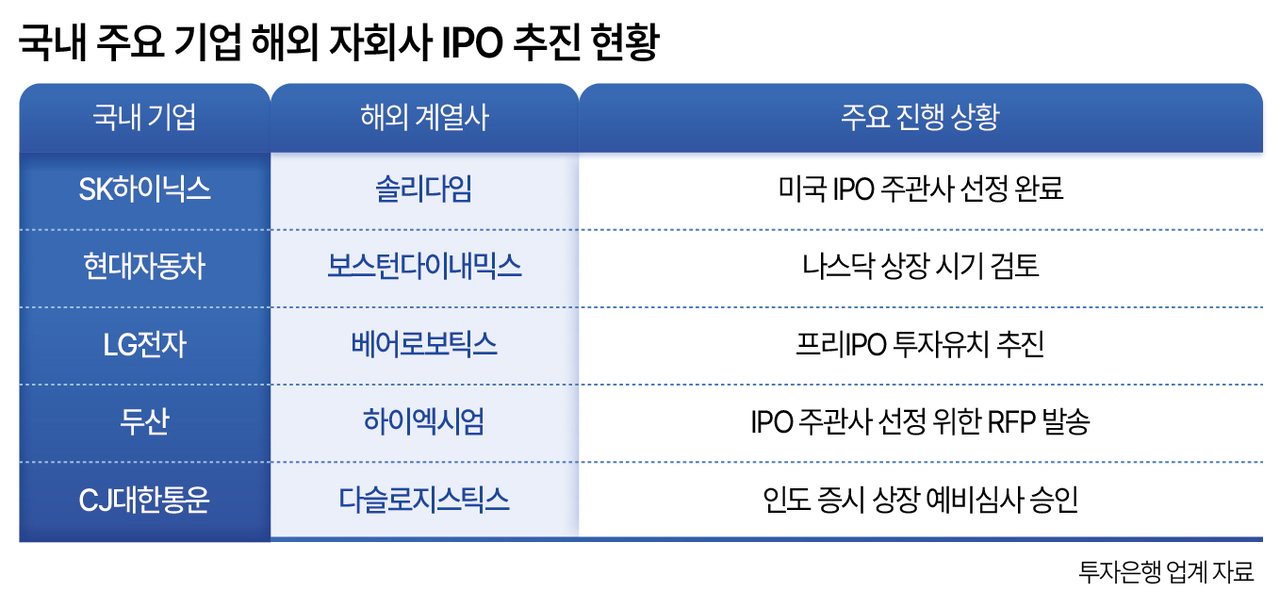
Hyundai Motor Group is currently reviewing a NASDAQ listing for its US robotics subsidiary Boston Dynamics, while LG Electronics' US robotics subsidiary Bear Robotics is pursuing a pre-IPO funding round. Doosan Group's US hydrogen and fuel cell subsidiary Hyaxiom sent requests for proposals to foreign securities firms last month to select an IPO underwriter. CJ Logistics' logistics subsidiary DAS Logistics is also pursuing a listing on India's stock exchange and has already received preliminary approval from local authorities.
The FSC and Korea Exchange have been enforcing an improved dual-listing regime since Aug. 3. Under the rules, even when a domestic listed company's subsidiary lists on an overseas exchange, the parent company's board must fulfill five obligations to protect ordinary shareholders: assessing the impact of the subsidiary's listing on shareholders, devising shareholder protection measures, confirming whether shareholders have been consulted or have given consent, passing a board resolution for or against the listing and notifying the subsidiary, and disclosing relevant information.
The parent company's board must also go through deliberation and a vote by a special committee of at least three members. The committee must be chaired by an independent director, or at least two-thirds of its members must be independent directors or outside experts who meet the qualifications for independent directors. If a shareholder consent vote was not held, the reason must also be disclosed.
The scope of regulatory requirements varies depending on each company's circumstances. Subsidiaries with sales, operating profit and assets each accounting for less than 10 percent of the parent company's are classified as low-weight subsidiaries and are exempt from the shareholder consent requirement. However, even if all three conditions are met, a subsidiary deemed significant based on its expected valuation may be excluded from the exemption. Boston Dynamics is considered a low-weight subsidiary of Hyundai Motor Group, raising the possibility that it could be exempt from the shareholder consent requirement.
Since the tightened rules took effect, there have already been cases where a parent company's board blocked a subsidiary's overseas listing over concerns about shareholder value dilution. Kakao Mobility confidentially submitted listing-related documents to the US Securities and Exchange Commission in July, but Kakao's board voted on Sept. 22 to oppose pursuing a US listing. The board concluded that because the primary purpose of the listing was to allow certain financial investors to exit their stakes, the benefits to Kakao's ordinary shareholders would be insufficient, and that the risk of conflicts of interest — including a widening discount to net asset value — was too great.
From a corporate perspective, concerns are also mounting over the tightened rules, given that overseas subsidiary listings serve as a key fundraising tool for expanding local operations. While a foreign exchange listing opens a channel to attract fresh capital from local investors, companies must now also navigate the parent board's shareholder protection procedures. If the listing timeline agreed upon with overseas investors is disrupted, it could derail not only fundraising plans but also financial investors' exit strategies.
The process of devising shareholder protection measures could also add to the burden on companies, analysts say. The measures proposed by financial regulators include cash dividends, share buybacks and cancellations, and in-kind dividends of subsidiary shares. Companies must secure the investment capital needed to expand their overseas operations while also accounting for the returns that should flow to the parent company's ordinary shareholders.
The pressure from the Donald Trump administration, which has been pushing Korean companies to invest locally through tariff policy and other measures, adds another layer of difficulty. As Korean companies move to expand production facilities and business operations in the United States, the tightening of domestic regulations on overseas subsidiary listings has made it harder to secure the funding needed for those local investments, analysts say.
Against this backdrop, attention is also turning to how Solidigm's potential US listing could affect SK hynix's capacity for investment. SK hynix is understood to be considering building a NAND factory in the United States through Solidigm. In a report Thursday, Masahiro Wakasugi, a senior industry analyst at Bloomberg Intelligence, said that if Solidigm raises its own funds through a US listing to finance its enterprise solid-state drive business for AI data centers, SK hynix would have more room to invest in its core businesses, including HBM and server DRAM.
Eom Su-jin, an analyst at Hanwha Investment & Securities, said that "an overseas listing of a subsidiary will only be justified when there is a clear conviction and basis that the subsidiary's core competencies can be meaningfully enhanced — through local factory construction, overseas mergers and acquisitions, securing top overseas talent, and expanding overseas supply chains and retail channels."

hajun825@heraldcorp.com