Foundation spends 16.34 billion won to support 260,000 people over two years
62 households receive low-interest deposit loans to escape substandard housing
Isolated youth reintegrated through counseling, internships
Over 21,000 seniors receive digital literacy training, including scam prevention
Management and labor agree to first additional contribution in 8 years
A single-parent family living in an unauthorized prefabricated panel house secured a low-interest deposit loan and moved into public rental housing. A young person who had cut ties with society after losing a sibling found a way back through counseling and an internship, eventually landing a job as a social worker. These are among the real-life stories of change made possible through the Financial Industry Public Interest Foundation.
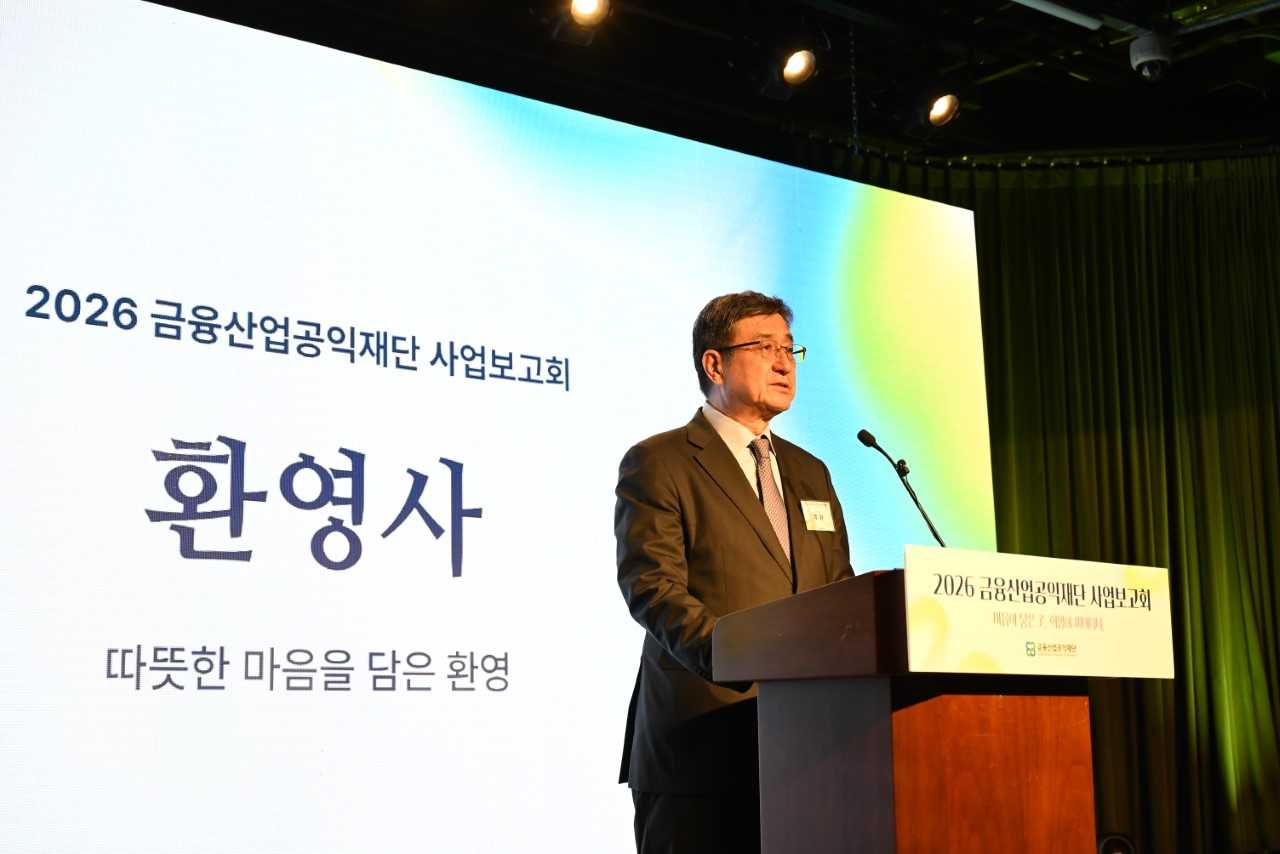
The foundation held its 2026 project report conference Tuesday at the Korea Federation of Banks building in Jung-gu, Seoul, presenting the results of its work. Over the past two years, it channeled 16.34 billion won ($12.3 million) into 35 projects across four areas — inclusive finance, employment, the next generation and regional coexistence — reaching 260,128 people. That is roughly 70,000 more beneficiaries than in the preceding two-year period.
Inclusive finance drew the largest share of spending, accounting for 54 percent of the total at 8.82 billion won. An additional 1.43 billion won went to social finance initiatives, including small loans, high-interest debt refinancing and interest subsidies.
One of the flagship programs highlighted at the conference was a housing welfare fund designed to ease the deposit burden on vulnerable residents. The implementing organization, Nanumgwa Mirae, lends rental deposits to young people and low-income households who cannot access conventional bank loans at annual interest rates of 1 to 2 percent, and refunds the full interest to borrowers who repay faithfully. To date, the program has extended about 301.85 million won in loans to 62 households, and all 18 households that had been living below the minimum housing standard have since improved their living conditions.
"We have filled gaps left by both the public and private sectors, and expanded opportunities for housing stability and asset building," said Han Bit-na, a deputy manager at Nanumgwa Mirae. "Going forward, we need to expand participating institutions nationwide and strengthen ties with similar support organizations."
Programs helping socially isolated young people regain independence were also featured. Gachiaenneunurim, based in Ansan, Gyeonggi Province, identifies reclusive and isolated youth and provides step-by-step support — psychological counseling, peer support groups, job experience and internships. The organization has identified more than 200 young people, and the implementing body said participants showed a 33 percent reduction in the degree of isolation and withdrawal after joining the program.
"What we see most clearly in the field is that many young people are at a critical turning point — moving from social isolation into full withdrawal," said Kang Seong-gyeong, secretary general of Gachiaenneunurim. "What they need is long-term support built on deep trust, and safe work experience within their local communities."
An overseas initiative that drew attention involved turning discarded waste into income for local residents. Good Neighbors Global Impact ran a project in Indonesia where community members collect and sell recyclable materials such as plastic, while food waste is processed through insect farming and converted into animal feed. The project handled 152 metric tons of waste, and the organization estimated its economic value — including carbon emission reductions — at about 30 million won.
"Waste can become a new source of income for residents," said Kim Ji-yeon, a senior manager at Good Neighbors Global Impact. "What matters is moving beyond simple aid to building a self-sustaining revenue model through production and sales."
Efforts to close the digital divide among older adults also showed results. The Korea Information Science Promotion Association visited senior centers and elderly community halls across five regions nationwide, offering training in smartphone use, kiosk navigation and generative AI tools. The program has cumulatively trained 21,761 people. Participants also received education on preventing voice phishing and smishing, and the initiative trained 304 digital literacy instructors.
"The core goal is not just teaching people how to use devices, but enabling older adults to apply digital tools on their own and keep learning within their communities," said Lee So-gyun, a division head at the Korea Information Science Promotion Association. "We plan to expand into AI education and professional training going forward."
Financial Services Commission Chairman Lee Eok-won, in a video address, called the foundation "a truly unique case that would be hard to find in any other industry," noting that it was jointly established by financial sector management and labor. "It carries great significance in that the entire financial sector shares in its social responsibility," he said.
The foundation plans to expand support with a focus on inclusive finance and employment programs. On Oct. 6, financial sector management and labor agreed that management would make an additional contribution to the foundation equivalent to 0.25 percent of total wages — the first since the foundation was established in 2018. Korea Federation of Banks Chairman Cho Yong-byung called it "a precious achievement eight years in the making," adding that he expected it to "make the foundation's roots deeper and stronger."
"We will focus on inclusive finance and employment, seek out the blind spots where public and private support has not reached, and ensure that meaningful help continues to flow to those who need it," said Ju Wan, chairman of the Financial Industry Public Interest Foundation.
snsd@heraldcorp.com