Jeongeup's Han Yeong-seok Fermentation Lab wins top prize as sales grow from 500 million to 2.2 billion won; Ministry of Agriculture, Food and Rural Affairs selects five rural businesses for excellence in value-added farming
A farm enterprise in Jeongeup, North Jeolla Province, that brews traditional liquor using locally grown rice has more than quadrupled its sales in four years while expanding its use of local rice 22-fold. In Gangneung, Gangwon Province, a bread made from locally sourced hardy crops has sold more than 1 million units and broken into overseas markets. The results highlight how rural businesses are generating new revenue by combining agricultural production with food processing, tourism and hands-on experiences.
The Ministry of Agriculture, Food and Rural Affairs announced Wednesday that it had selected five certified businesses for excellence at the 2026 Rural Convergence Industry Excellence Competition, recognizing their contributions to raising agricultural value and revitalizing the rural economy.
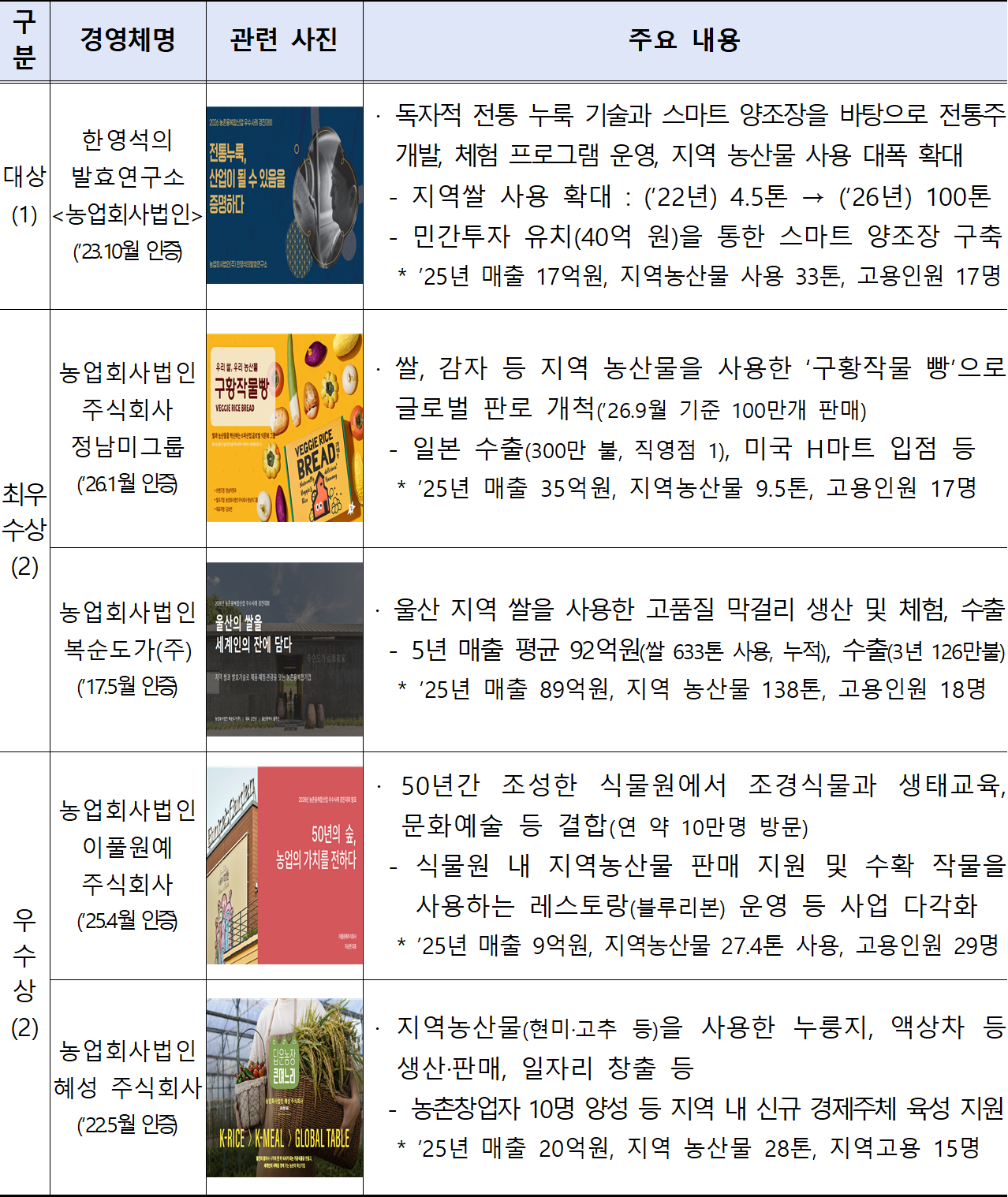
The rural convergence industry model combines primary agricultural production with secondary industries such as food processing and distribution, and tertiary sectors such as tourism and experiential programs, to create new added value. Fifteen companies that cleared regional screening across the country were nominated for this year's competition, and a panel of experts conducted written, on-site and presentation reviews before selecting one grand prize winner, two excellence award winners and two merit award winners.
The grand prize went to Han Yeong-seok Fermentation Lab, an agricultural corporation in Jeongeup, North Jeolla Province. The company develops traditional liquor using its own proprietary nuruk ("fermentation starter") technology and a smart brewery, and also runs hands-on experience programs.
The company's sales grew 4.4-fold, from 500 million won ($375,000) in 2022 to 2.2 billion won this year. Over the same period, its use of locally grown rice surged from 4.5 metric tons to 100 metric tons — a more than 22-fold increase. Its workforce expanded from five to 17 employees, and five of the current 13 young staff members relocated to the area specifically to join the company.
Judges praised the company for attracting private investment to build a smart brewery and scale up operations, while simultaneously boosting consumption of local agricultural produce and creating jobs in the region.
The two excellence awards went to Jeongnam-mi Group of Gangneung, Gangwon Province, and Boksundoga of Ulju-gun, Ulsan.
Jeongnam-mi Group developed a line of breads made from locally grown rice, potatoes and other hardy crops. Cumulative sales have surpassed 1 million units, and the company has made inroads overseas — recording $3 million in exports to Japan and securing a listing at H Mart stores in the United States.
Boksundoga produces premium makgeolli using rice grown in the Ulsan region. The company has maintained annual sales in the 9 billion to 10 billion won range since 2022 and has earned strong marks for its ties to local farming households, using about 100 metric tons of locally grown rice each year.
The two merit awards went to Ipul Horticulture of Ansan, Gyeonggi Province, and Hyeseong of Uljin, North Gyeongsang Province.
Ipul Horticulture operates a botanical garden built on roughly 50 years of accumulated plant assets, and has expanded into cultural arts, ecological education and experiential programs. The company was recognized for building a cooperative model that works in tandem with local farming households.
Hyeseong produces scorched-rice snacks and liquid teas from locally sourced agricultural produce. Beyond manufacturing and selling processed goods, the company has trained 10 local entrepreneurs and contributed to job creation for women who had left the workforce.
The ministry will present the five winning companies with ministerial citations and a combined purse of 15 million won ($11,300). It also plans to give them priority access to online and offline sales-channel support programs related to the rural convergence industry and to assist with promotional activities. The ministry will share the winning business models so other rural enterprises can draw on them.
The Rural Convergence Industry Excellence Competition has been held annually since 2013. The ministry said companies that combine agricultural production with processing, distribution and experiential offerings have been achieving results in areas such as brand recognition, sales growth and expanded market access.
Jeon Han-yeong, director general of the ministry's Rural Policy Bureau, said the rural convergence industry plays a vital role in raising agricultural value and injecting new energy into rural communities by drawing on the diverse tangible and intangible resources those areas have to offer. "We will continue to actively identify outstanding certified businesses and support them with expanded sales channels and promotional activities, so that the rural convergence industry can take root as a foundation for revitalizing local economies," he said.
adastra@heraldcorp.com