First public hearing since trial petition regime took effect in March
Case brought by lawyer who served as witness in late Sgt. Lee Ye-ram case
Ministry of Justice cites investigative secrecy; Korean Bar Association says rights protections fall short
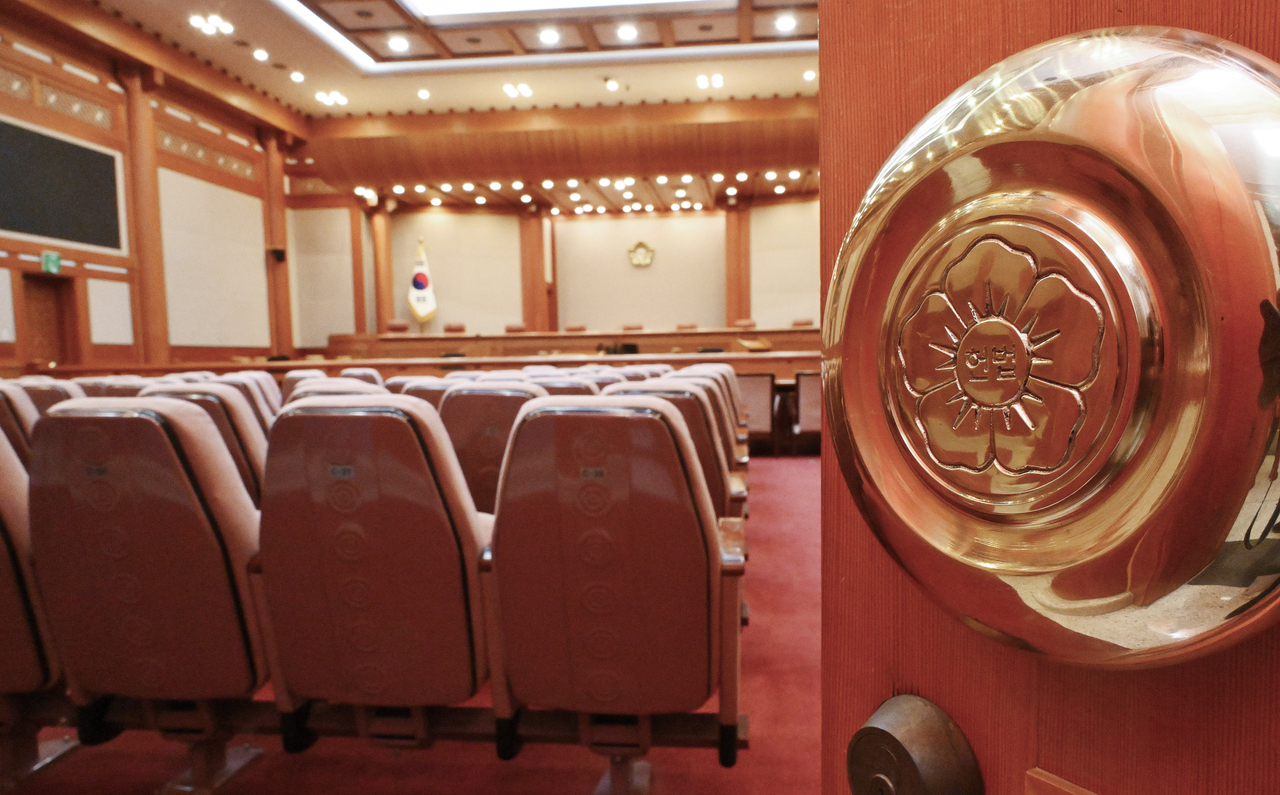
The Constitutional Court held its first public hearing Wednesday on a case brought under the newly introduced trial petition system, examining whether a Supreme Court ruling that investigators need not provide a copy of a search and seizure warrant to a witness — as opposed to a suspect — violates the Constitution.
The hearing took place Wednesday afternoon at the court's main courtroom in Jongno-gu, Seoul. The case was filed by Kim Young-su, a lawyer at the Daeryun law firm, who challenged the Supreme Court's ruling through a constitutional petition seeking to have the decision overturned. The trial petition system allows the Constitutional Court to review final court rulings for constitutional violations.
An amendment to the Constitutional Court Act that took effect in March allows parties to a lawsuit to file a constitutional petition with the court when a final ruling has violated the Constitution or statutes, failed to follow due process, or infringed on constitutionally guaranteed fundamental rights in contravention of a Constitutional Court decision. The previous version of the act had explicitly excluded court rulings from the scope of constitutional petitions.
The case stems from a search and seizure conducted by the special prosecution team — led by Special Prosecutor Ahn Mi-young — that was investigating the 2022 death of the late Sergeant Lee Ye-ram. The team raided Kim's residence and office, seizing his mobile phone and tablet computer while he was being questioned as a witness, not a suspect. When Kim asked for a copy of the warrant during the search, the team refused.
Kim then filed a quasi-appeal with the Seoul Central District Court, seeking to have both the search and seizure and the refusal to provide a warrant copy overturned. A quasi-appeal is a legal procedure through which a party may ask a court to cancel or modify a decision made by an investigative agency.
In May 2023, the Seoul Central District Court ruled that the search and seizure of Kim's phone and tablet had been unlawful and overturned that action. It dismissed his challenge to the refusal to provide a warrant copy, however, finding that investigators had no obligation to hand over a copy of a search and seizure warrant to a third party who was not a suspect.
Both Kim and the special prosecution team filed further appeals, but the Supreme Court dismissed both in February. Kim then filed a trial petition with the Constitutional Court in April, arguing that the Supreme Court's ruling had infringed on his right to equality and right to privacy.
The central issue is whether differentiating the obligation to provide a warrant copy based on whether the subject of a search is a suspect violates the constitutional right to equality. Article 118 of the Code of Criminal Procedure, which applied in this case, requires that a search and seizure warrant be shown to the person subject to the action and mandates that a copy be provided when that person is a defendant. Article 219 of the same code extends this requirement to searches conducted by investigative agencies.
Kim's side argues that withholding a warrant copy solely on the grounds that the subject is not a suspect violates the principle of due process. They contend that treating those subject to a search differently depending on whether they are a suspect — without reasonable justification — constitutes a violation of the right to equality.
The Ministry of Justice, an interested party in the case, took the opposing view in its written submission to the court. "From the standpoint of guaranteeing the right to defense, there is a fundamental difference between a person subject to a search who is a suspect and one who is not," the ministry said, and went on to say that providing a warrant copy to a non-suspect could alert the actual suspect that an investigation is underway, compromising investigative secrecy.
The Korean Bar Association, another interested party, rebuffed the ministry's position in its own written submission. "The need to maintain investigative secrecy diminishes significantly from the moment investigators begin executing a search warrant and present it to the subject," the association said, adding that merely showing the warrant is insufficient to protect the rights of a person subject to a search who is not a suspect.
Choi Ho-jin, a law professor at Dankook University appointed by the court as an amicus witness, also weighed in. "The legal provision at issue requires that a warrant copy be provided to the suspect — the party with the greatest incentive to destroy evidence," Choi said. "The effectiveness of an investigation cannot serve as a decisive basis for withholding a warrant copy from a person subject to a search who is not a suspect."
After hearing arguments from the parties, interested parties and the witness at Wednesday's hearing, the Constitutional Court will issue a ruling at a later date on whether the Supreme Court's decision infringed on the petitioner's fundamental rights. The court will also examine whether the provisions of the Code of Criminal Procedure applied in that ruling are unconstitutional.
The Constitutional Court is also scheduled to hold a public hearing Friday on a trial petition case involving GC Biopharma's fine for bid-rigging in a vaccine procurement tender. That case is the first to be referred to the full bench since the trial petition system was introduced.
yg@heraldcorp.com