Korea Defense Industry Association quarterly report
Estimated order backlog at end of Q3: 119.8 trillion won
Large export deals in Poland, Peru draw attention
Calls grow for greater transparency alongside order expansion
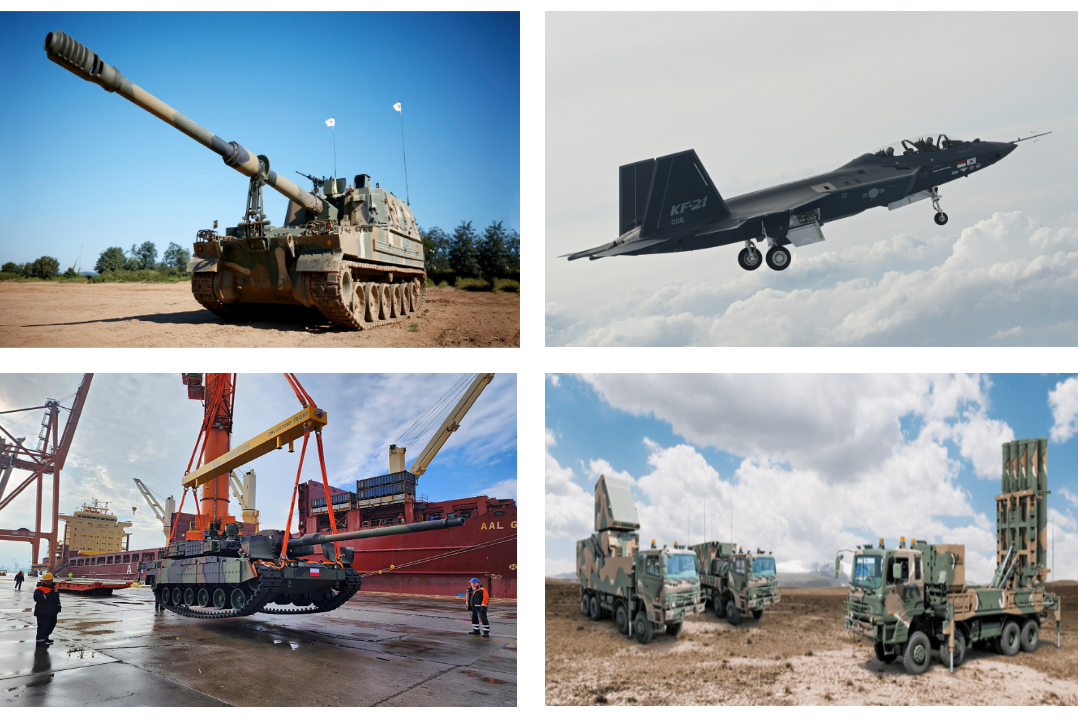
South Korea's four major defense companies are estimated to have held a combined order backlog exceeding 119 trillion won ($89.3 billion) at the end of the third quarter. Large export contracts in the pipeline from Poland and Peru are fueling expectations of further wins before year-end, making a breach of the 200 trillion won mark by December all but certain. At the same time, bidding irregularities, governance disputes and a drone test failure have kept the industry under scrutiny, putting transparency and credibility on the agenda alongside order growth.
According to the Korea Defense Industry Association's quarterly report released Wednesday — based on publicly disclosed contract data as of Sept. 18 — the four firms' combined estimated order backlog at the end of Q3 stood at 119.8 trillion won. By company, Hanwha Aerospace led with 60.92 trillion won (plus undisclosed amounts), followed by Korea Aerospace Industries (KAI) at 24.46 trillion won, LIG Defense & Aerospace (LIG D&A) at 23.46 trillion won and Hyundai Rotem at 10.95 trillion won.
The actual combined backlog is expected to exceed those estimates. Three new defense contracts were signed in the third quarter; the two that were publicly disclosed — an initial mass-production purchase contract for the L-SAM missile defense system and an export deal for Chunmoo multiple-launch rocket systems to Croatia — totaled about 761.2 billion won. A separate export execution contract that Hanwha Aerospace signed in August for K9 self-propelled howitzers to Spain was not disclosed, with the company citing business confidentiality.
Earnings growth is also expected to continue. Citing data from financial information provider FnGuide, the report estimated the four firms' combined third-quarter sales at 13.64 trillion won and operating profit at 1.72 trillion won — up roughly 38.4 percent and 34 percent, respectively, from the same period last year. Among the four, Hanwha Aerospace was projected to post the highest figures, with estimated sales of 9.29 trillion won and operating profit of 1.24 trillion won.
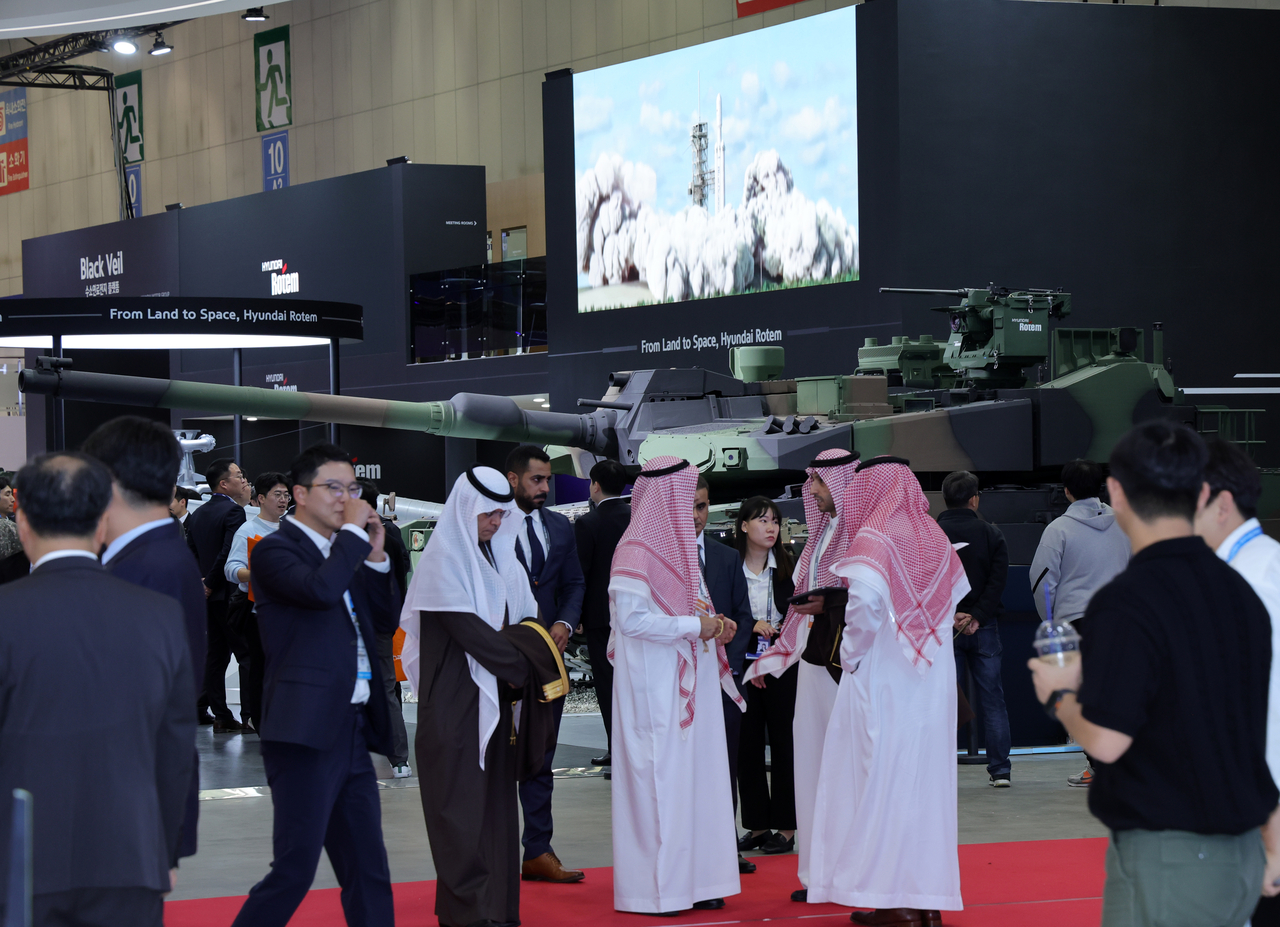
Whether additional large export contracts will be finalized before year-end is also drawing close attention. Hyundai Rotem is pursuing a third execution contract (EC3) with Poland for K2 tanks; if signed this year, it would cover the delivery of 210 K2PL units between 2026 and 2034. Hanwha Aerospace is in talks with Poland on a third execution contract for K9A2 howitzers. In Peru, formal contract procedures are under way following the selection of the K2 tank for a 150-unit procurement, while KAI is in the final stages of coordinating a deal with Egypt for 100 FA-50 light combat aircraft, with the first batch of 36 aircraft valued at around 1.3 trillion won.
Elsewhere, the K2 is competing against German tanks for a Romanian armor contract, and LIG D&A's L-SAM system remains in contention for a Swiss long-range air defense program. HD Hyundai Heavy Industries is pursuing a Philippine Navy submarine contract, while Hanwha Ocean has been announced as the preferred bidder for a Thai frigate program and is moving toward signing a formal contract.
Industry observers note that as large export programs multiply, contract execution capabilities — including localization and on-time delivery — will matter as much as the scale of orders won. Securing trust within the industry through greater business transparency and management stability is also seen as a pressing challenge alongside order expansion.
South Korea's Defense Acquisition Program Administration (DAPA) on Tuesday deliberated and voted to impose a two-year ban on LIG D&A's participation in defense procurement bids, over charges that the company bribed a DAPA employee during a weapons development tender process. The company said it would pursue legal countermeasures, including an application for a stay of execution. KAI, meanwhile, has been at the center of a governance restructuring debate following Hanwha Group's move to increase its stake and the Export-Import Bank of Korea's commissioning of a consulting study. Separately, a jet-powered drone developed by KAI crashed shortly after takeoff at a Ministry of National Defense-hosted event last month, raising questions about the company's technology verification processes.

keg@heraldcorp.com