UAM surrogate aircraft flies Yeongjongdo-Deokjeokdo maritime route
Flight seen as breakthrough for island residents' access to medical and daily services
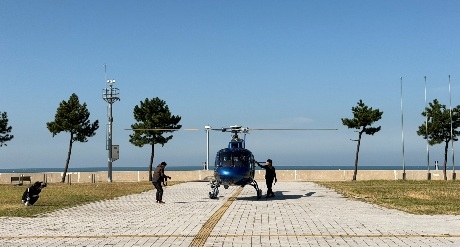
Incheon is moving closer to launching urban air mobility (UAM) public services that could ease the transportation difficulties faced by island residents seeking medical care and daily necessities.
The Incheon Metropolitan Government, working with the Aviation and Aerospace Industry-Academic Convergence Institute and the K-UAM One Team consortium, successfully completed a "public-demand-based UAM demonstration for island areas" on Tuesday, flying a maritime route between Yeongjongdo and Deokjeokdo.
The demonstration was a key milestone of the 2026 Incheon Island Area UAM Demonstration Support Project, which aims to address the poor transportation infrastructure on remote islands — including access to mainland medical facilities and emergency transport — and to build a UAM-based public mobility ecosystem.
The K-UAM One Team consortium — comprising KT Corp, Korean Air, Hyundai Engineering & Construction (Hyundai E&C), Hyundai Motor Company and Incheon International Airport Corp. — and the Aviation and Aerospace Industry-Academic Convergence Institute took part in the project, with support from the Ministry of Land, Infrastructure and Transport's UAM policy division and the Korea Aerospace Research Institute.
The actual flights used a helicopter as a UAM surrogate aircraft on the route between Yeongjongdo — specifically the Geojampo and Wangsan Marina sites — and Deokjeokdo.
Safety procedures were established in advance, taking into account the characteristics of the airspace around Incheon Airport, the maritime flight environment and existing aircraft traffic flows.
Particularly notable was the integration of Incheon city's UAM platform with a UAM traffic management system developed through a national research and development project. The combined system underwent a comprehensive operational review covering real-time location tracking, traffic management, vertiport operations and communications network connectivity.
It marks the first time in South Korea that a local government, private companies and a government agency have collaborated to complete the full cycle — from identifying public demand on island routes to designing flight paths and verifying operations. The demonstration is considered significant for proving that meaningful mobility rights for island residents can be guaranteed.
Building on the results, Incheon city plans to refine its route operations and safety management procedures and move ahead with vertiport construction centered on Geojampo in Yeongjongdo and Deokjeokdo.
The city also intends to develop a phased commercialization plan in coordination with the Ministry of Land, Infrastructure and Transport's efforts to designate UAM pilot operation zones.
"We have laid the groundwork for expanding UAM technology into a public service by connecting it to the actual mobility needs of island residents," said Park Gwang-geun, director of Incheon city's maritime and aviation bureau.
gilbert@heraldcorp.com