Hyundai Mobis targets 2029 to put domestic semiconductors in mass-production vehicles
'Short-term earnings contribution limited, but investment for the future'
Four to five years needed for development and vehicle verification
Domestic foundries to take priority; overseas fabs to play supplementary role
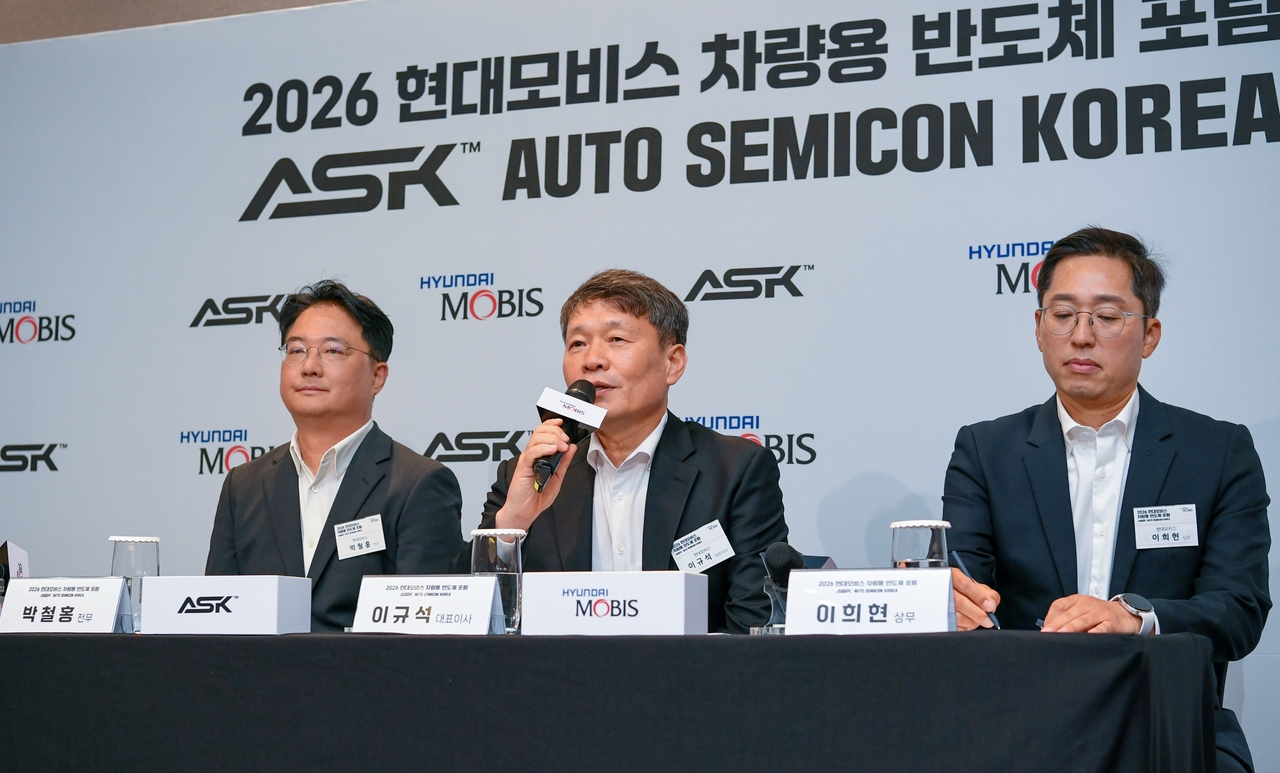
Hyundai Mobis has set a target of putting domestically developed semiconductors into Hyundai Motor and Kia vehicles as early as 2029, aiming to reshape a supply chain long dependent on overseas suppliers and secure long-term competitiveness — even if near-term financial returns remain limited.
Hyundai Mobis President Lee Kyu-seok announced the plan Wednesday at a press briefing held ahead of the second Auto Semicon Korea (ASK) automotive semiconductor forum at the DoubleTree by Hilton Seoul Pangyo in Seongnam, Gyeonggi Province.
"The target date for domestically co-developed automotive system semiconductors to be installed in Hyundai Motor and Kia mass-production vehicles for the first time is 2029," Lee said. "To that end, we plan to begin integrating the semiconductors under development into early-stage vehicle testing starting next year."
Since ASK launched last year, Hyundai Mobis has identified 19 collaboration projects with domestic chipmakers and begun developing 13 types of system semiconductors. Nine of those have already been matched to specific mass-production vehicle models in consultation with Hyundai Motor and Kia.
Still, getting a chip from development to an actual vehicle takes considerable time. Automotive semiconductors must operate reliably under harsh conditions — extreme temperatures, vibration and more — and therefore undergo far more rigorous verification than chips used in consumer electronics.
"Even after completing development and reliability verification, the chip must be integrated from the earliest stage of vehicle development, so it takes about four to five years to reach mass production," Lee said. Semiconductor development typically takes two to three years, with an additional one and a half to two and a half years required for vehicle-application verification.
Lee acknowledged that localizing automotive semiconductors would not translate quickly into improved earnings. "Chip unit prices are low, and after a chip is applied to the first vehicle model, it must go through further verification before being expanded to subsequent models," he said. "For now, it will be difficult for this to make a meaningful contribution to Hyundai Mobis's sales and profit."
"However, if we do not make these efforts and investments now, there could be serious difficulties ahead — not only for Hyundai Mobis's components business but also for Hyundai Motor and Kia's finished-vehicle operations," he said. "We are approaching this as a long-term investment, not something driven by immediate financial results."
The challenge reflects a broader profitability problem facing South Korea's automotive semiconductor industry. Domestic chipmakers have historically been reluctant to invest aggressively in automotive chips, given that they take longer to develop and verify than mobile or communications chips and that production volumes per model are relatively limited.
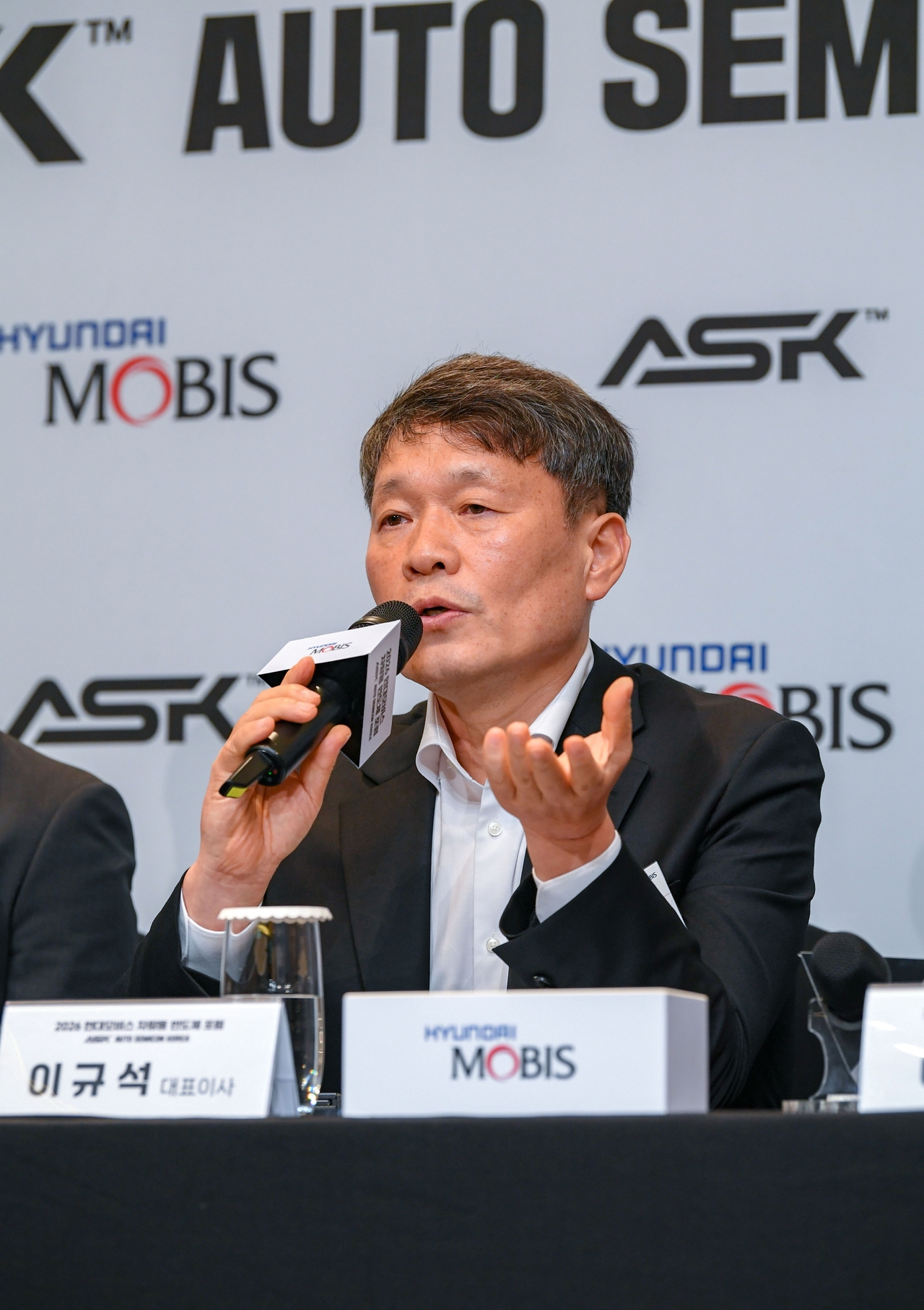
Lee acknowledged those limitations but pointed to the long-term business case for automotive semiconductors.
"Mobile and communications chips have short product replacement cycles, but automotive semiconductors, once developed, can be used for a long time," he said. "A single car model typically has a lifespan of four to five years, and a developed chip can be applied to up to two vehicle models, which means stable demand can be secured."
"The number of semiconductors needed per vehicle keeps growing, and automotive chips are accounting for a larger share of the overall semiconductor market," he added. "We expect domestic chipmakers' interest in this space to increase going forward."
Lee also outlined a domestic-first approach to production. Hyundai Mobis plans to build its supply chain around domestic foundries, turning to overseas manufacturers only for products that cannot be produced at home.
"We faced significant difficulties due to the global semiconductor shortage from 2021 to 2023, and we believe a similar problem could arise again at any time," Lee said. "While there will inevitably be cases where overseas foundries must be used, we think the right direction is to prioritize domestic foundries for products that can be made here."
He added that overseas foundries should serve a supplementary role, filling gaps that domestic manufacturers cannot cover — an approach he described as the right one for the medium to long term.
South Korea's domestic automotive semiconductor localization rate remains below 5 percent. Lee said the country's system semiconductor companies have built a reasonable technical foundation, but that the power semiconductor segment — critical for electric vehicles — lacks both the companies and the design capabilities needed.
In response, Hyundai Mobis is working with the government and SK Keyfoundry, among others, to secure the production infrastructure needed for power semiconductor research and development. The core aim is to help domestic chip design firms produce prototypes without bearing excessive costs.
"For system semiconductors, there are strong domestic design firms, and if we build a solid cooperation framework, we can gain competitiveness quickly," Lee said. "For power semiconductors, however, domestic design technology and production infrastructure are lacking, so we need to start by securing foundry infrastructure for research and development purposes."
Lee also left open the possibility of eventually expanding the application of domestically developed chips beyond Hyundai Motor and Kia to overseas automakers.
Hyundai Mobis Senior Vice President Lee Hee-hyeon said the immediate priority is getting the chips into Hyundai Motor and Kia mass-production vehicles. "If there is demand overseas for those products as well, we can increase production volumes to reduce unit costs, so we are also considering the possibility of overseas supply," he said.
Separately from the 13 existing collaboration projects, Hyundai Mobis is developing a communications system-on-chip with a domestic partner in preparation for the software-defined vehicle era. "Right now, we are focused primarily on adapting semiconductors already proven in other industries for automotive use," Lee said. "As SDV expands, we will need to broaden our cooperation into high-performance system semiconductors as well."
"South Korea's automotive industry has secured world-class competitiveness, but the foundation of its automotive semiconductor industry is still nascent," Lee said. "Hyundai Mobis will work to strengthen the domestic ecosystem by connecting automakers' demand with the technological capabilities of semiconductor companies."
kwater@heraldcorp.com