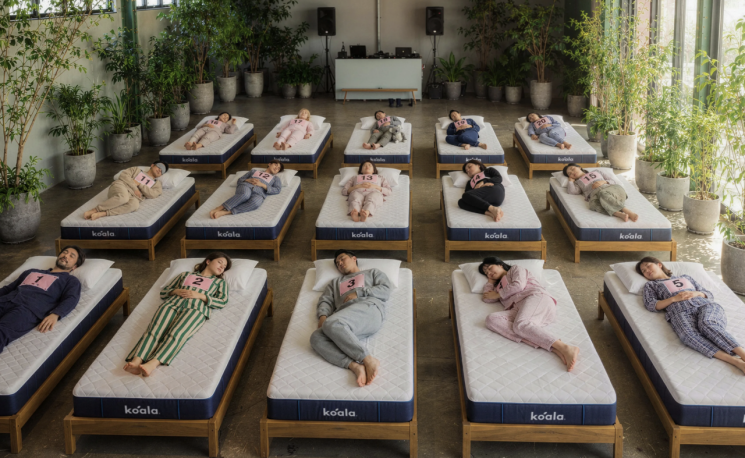
A competition offering about 19 million won ($14,300) to the best sleeper drew roughly 47,000 applications in Japan, with finalists competing to prove they could fall asleep the fastest and most deeply.
Australian bedding and furniture brand Koala held the event, called "Matt Race by Koala," on Oct. 5 in Minami-Aoyama, Minato-gu, Tokyo, according to Japan's Mainichi Shimbun and other outlets.
The top prize was set at 2.22 million yen — a figure inspired by the "Zzz" symbol commonly used to represent sleep.
Organizers said they planned the event to raise awareness about the importance of sleep and to turn the experience of getting a full night's rest into a competitive sport.
The contest attracted about 47,000 applications, with a competition ratio exceeding 700 to 1. Sixty-five finalists were selected to compete.
Participants took part in three rounds, each lasting 90 minutes. Competitors lay on mattresses set up at the venue and tried to fall asleep.
The judging criteria focused not on how long participants slept but on how quickly and deeply they fell asleep.
Each participant wore sleep-monitoring devices on their forehead and behind their ears. Organizers used brainwave data to measure the time it took to fall asleep, sleep depth and stability during sleep.
The readings were converted into sleep scores based on the competition's own criteria. The participant with the highest cumulative score across all three rounds was declared the winner.
Before each round began, participants warmed up together with light stretching exercises. They then arranged their pillows and blankets and tried to fall asleep on cue from the host.
Competitors wore a variety of sleepwear and adopted different sleeping positions — some curled up under their blankets while others sprawled out with arms and legs extended.
The second-place finisher received 222,000 yen, and top finishers also received mattresses as additional prizes.
Doorbell sounds, a delivery worker's voice and a mirror ball were among the disruptions introduced during the competition to test participants' ability to stay asleep.
Organizers rang a doorbell, staged a scenario involving a delivery worker's voice and shone light across the venue using a mirror ball.
Some participants woke up when the disruptions occurred, while others slept through the noise and light without reacting.
Each round ended after 90 minutes when the host announced it was time to wake up. Final standings were determined by combining participants' sleep scores.
The winner was a 24-year-old woman from Musashimurayama, Tokyo.
She said she generally sleeps well even in noisy environments, adding that she had once fallen asleep at a live concert with loud music playing.
She said she had worried about sleeping in the same space as strangers but that she barely noticed the three disruptions during the actual competition.
Special awards were also presented at the event, including a "Deep Dive Sleep" prize for the participant who achieved the greatest sleep depth and an "Acrobatic Tossing and Turning" award for the most unusual sleeping position.
The event was livestreamed on Japanese video platform Niconico and YouTube, with organizers presenting the proceedings and results in the style of a sports broadcast.
Afromance, the creator behind the event, told the Mainichi Shimbun that sleep is a deeply private act, which made turning it into a group competition all the more intriguing. He said he wanted the unusual experience of competing over sleep to prompt participants to think seriously about the importance of rest.
South Korea and Japan both struggle with sleep deprivation — and the number of South Koreans treated for sleep disorders has surpassed 1.28 million.
The buzz surrounding the Japanese competition reflects a broader problem: chronic sleep deprivation.
Japan ranks among OECD member countries with the shortest average sleep times. A 2021 OECD comparison of sleep duration found Japan had the shortest average among major developed nations. South Korea also ranked among countries with relatively short sleep times.
In South Korea, the number of patients seeking medical treatment for sleep disorders has been consistently rising.
According to data submitted to the National Assembly's Public Administration and Security Committee by Rebuilding Korea Party lawmaker Jeong Chun-saeng, the number of people treated for sleep disorders in South Korea last year reached 1,281,695.
That represents a 24.7 percent increase from 1,027,693 in 2021 — a rise of nearly a quarter in four years.
In the first half of this year alone, 954,078 people received treatment for sleep disorders.
Sleep disorders encompass a range of conditions, including insomnia, sleep apnea and circadian rhythm disorders. Persistent sleep deprivation or poor-quality sleep can affect daily functioning even when a person gets some rest.
Insufficient sleep can impair concentration and memory and increase fatigue, and prolonged sleep deprivation can also take a toll on physical health.
Adults are generally advised to sleep seven to nine hours a night, though the optimal amount varies depending on age and individual health conditions.
The Japanese competition was designed to frame sleep as a competitive event and draw public attention to the value of getting enough rest. Organizers said they structured the event to let participants experience sleeping as a sport and to spark broader social interest in sleep quality.
rainbow@heraldcorp.com