Korea Workers' Compensation and Welfare Service, Human Resources Development Service, Safety and Health Agency, Construction Workers Mutual Aid Association face audit Friday
Five AI glasses cheating cases caught in May–June; occupational disease claims take average 221 days
Qualifications of Jang Geon, Park Seung-heup as heads of their respective agencies also under scrutiny
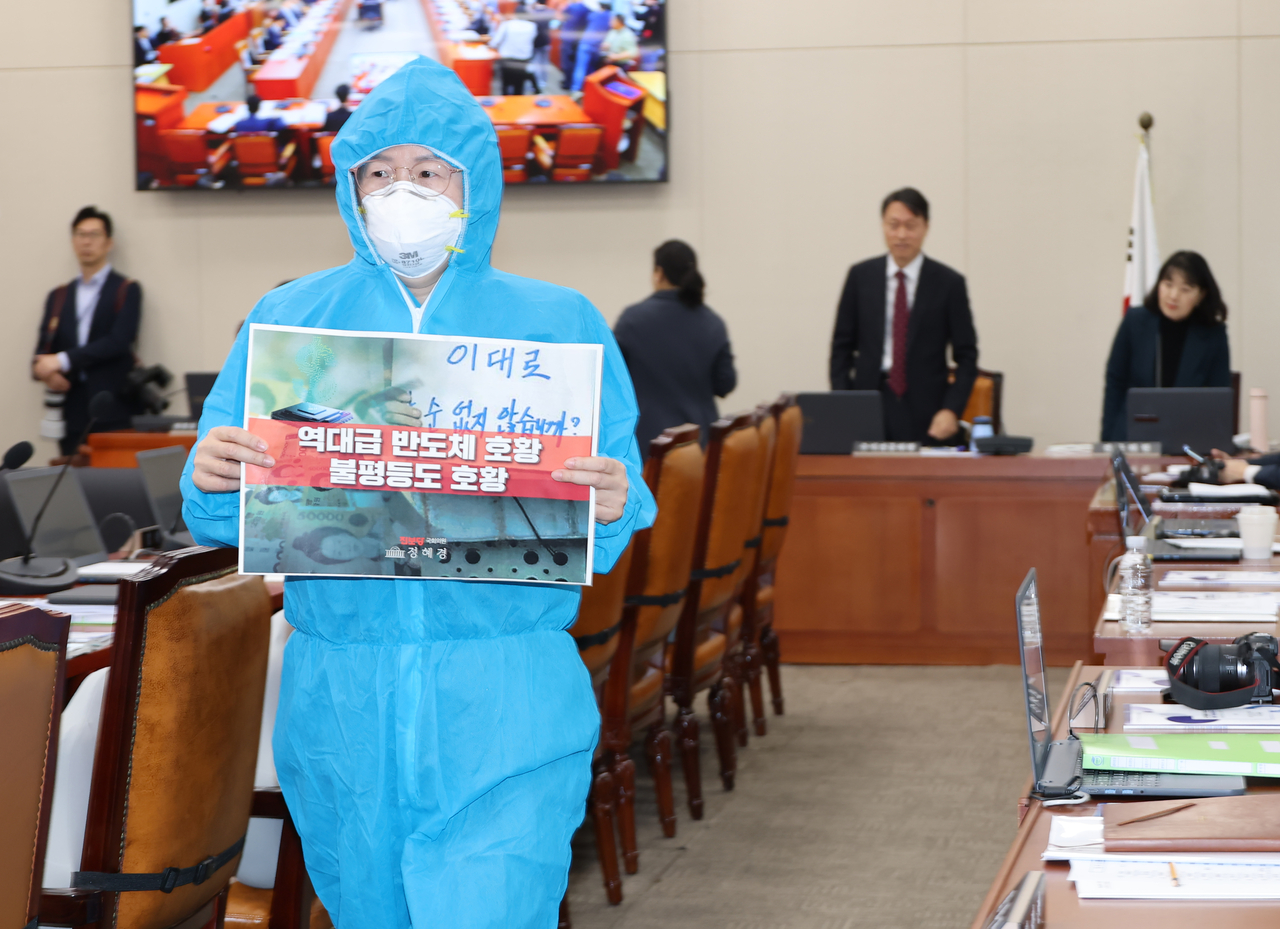
The National Assembly's Climate, Energy, Environment and Labor Committee will conduct a national audit of agencies under the Ministry of Employment and Labor on Friday. Key issues include delays in industrial accident rulings, lax management of national technical qualification exams, and problems with the industrial accident management system. The so-called "parachute appointment" controversy surrounding the head of the Construction Workers Mutual Aid Association is also expected to come up.
According to the National Assembly and the Ministry of Employment and Labor, the committee will audit the Korea Workers' Compensation and Welfare Service, the Human Resources Development Service of Korea, the Korea Occupational Safety and Health Agency, and the Construction Workers Mutual Aid Association, among other agencies under the ministry.
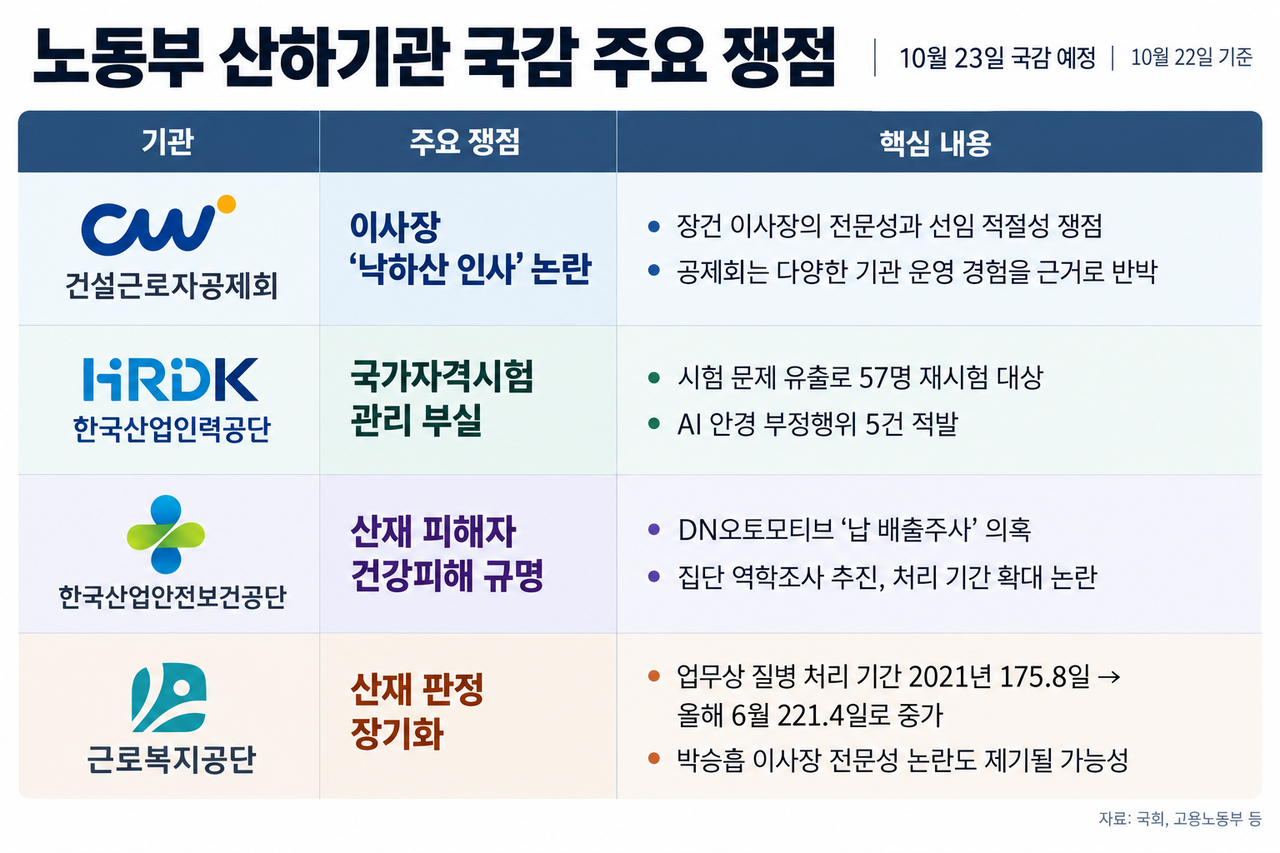
At the Construction Workers Mutual Aid Association, the qualifications and appropriateness of the appointment of Chairman Jang Geon are expected to be a central issue. Questions have been raised over whether Jang, who comes from a labor organization and regional foundation background, has sufficient expertise in finance and asset management to lead an institution that manages retirement benefit reserves for construction workers.
The association, however, maintains that "it is not appropriate to judge the chairman's expertise solely by his career in financial investment." Jang previously served as chairman of the Seongnam Iroun Foundation and the Korea Ceramic Foundation, and as head of the National University Workers' Union. The association said asset management is conducted systematically through internal specialist teams and external expert committees, and that since Jang took office, it has pursued an expansion of welfare programs for construction workers and the launch of specialized credit loan products.
At the audit of the Human Resources Development Service of Korea, a new form of cheating using AI-equipped glasses is expected to be a major issue. Five cases of cheating using AI glasses were caught during exams for fire protection engineer, information processing engineer, electrical industrial engineer, and gas technician certifications in May and June. Because the glasses use a built-in camera and display device, they are difficult to distinguish from ordinary eyewear, and visual checks by exam supervisors alone are insufficient to catch offenders. The agency has referred the cases to police for investigation and is working with the ministry to explicitly incorporate smart glasses and other new cheating tools into relevant regulations.
A test question leak is also expected to draw scrutiny. In July, a question set for the following day's practical skills exam for general mechanical engineer certification was accidentally released a day early due to errors by an exam official and an agency employee. The questions were also shared on an online community, and the agency determined that the integrity of the exam had been compromised, designating 57 examinees for a retake. The agency launched a special audit at the time and announced that those responsible would face strict disciplinary action. Lawmakers are expected to press the agency on the audit findings and the adequacy of follow-up measures.
At the Korea Occupational Safety and Health Agency, the central issue is allegations that workers at battery manufacturer DN Automotive received chelation injections to flush lead from their bodies ahead of special health checkups. The Ministry of Employment and Labor earlier found 68 violations of the Occupational Safety and Health Act during an inspection of DN Automotive, referring the cases for indictment and imposing a fine of 46.2 million won ($34,800). The allegations that workers received the injections to lower lead levels before mandatory health screenings were referred to police for investigation. President Lee Jae Myung has described the allegations as "a clear and serious criminal act" and ordered a thorough investigation and strict measures.
The agency plans to conduct a group epidemiological investigation covering all workers at the facility, including former employees. Lawmakers are expected to press hard on when the investigation will begin, how many people will be covered, and how health damage will be assessed. The role the agency will play in the ministry's planned expansion of inspections to about 150 workplaces at high risk of lead exposure is also expected to draw attention.
At the Korea Workers' Compensation and Welfare Service, the lengthening processing time for occupational disease claims is a key issue. The average processing time rose from 175.8 days in 2021 to 221.4 days as of June this year — an increase of 45.6 days — meaning workers who file a claim now wait more than seven months on average for a ruling.
The delays have been flagged by the National Assembly for several years. The need for additional staffing was raised at the 2021 audit, and the issue appeared in audit outcome reports for three consecutive years from 2023 through last year. Yet processing times have continued to grow. The agency established dedicated occupational disease teams at 64 branch offices nationwide this year, but a backlog of pending cases has kept delays from easing. Lawmakers are expected to question the effectiveness of the dedicated teams and what steps are being taken to clear the backlog.
With discussions ongoing over mandating the conversion of retirement pensions into a fund system, the agency's management of "Pureun Ssiat" — the retirement pension fund program for small and medium-sized enterprises — is also expected to come under questioning. Lawmakers are likely to raise issues including the agency's fund management capabilities, return rate oversight, and plans to expand enrollment. Questions about the qualifications and management capacity of Chairman Park Seung-heup, the first labor activist appointed to the post, are also anticipated.
fact0514@heraldcorp.com