About 133.24 million fresh eggs imported this year
Farm space unverified at 17 facilities in US, Thailand, Brazil
Lawmaker Shin Jang-sik calls for review of import verification system
The government spent more than 120 billion won ($90.4 million) importing eggs this year and labeled them with housing environment code "4" — the lowest tier — without verifying the actual floor space at any of the overseas farms. The discrepancy has sparked a fairness debate: domestic egg producers face mandatory requirements to expand their hen-housing space, yet the government secured no documentation to confirm that the imported eggs met the same standard.
According to data submitted to Rebuilding Korea Party lawmaker Shin Jang-sik of the National Assembly's Agriculture, Food, Rural Affairs, Oceans and Fisheries Committee, about 133.24 million fresh eggs were imported this year. The livestock development fund allocated for the fresh egg import project this year was 121.93 billion won, a figure that represents pre-settlement project costs.
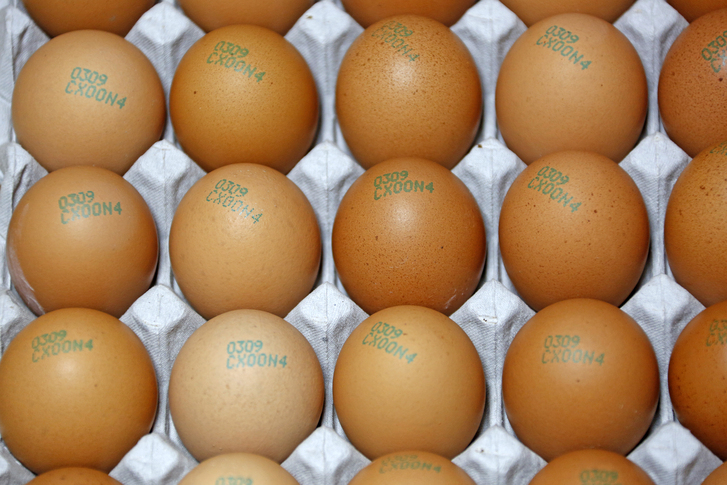
The Ministry of Food and Drug Safety listed 17 overseas facilities supplying the imported eggs — 15 in the United States and one each in Brazil and Thailand. All eggs from those facilities were labeled with housing environment code 4.
The housing environment code stamped on eggshells identifies the conditions in which hens were raised. Code 1 denotes free-range; code 2, barn-raised; code 3, enriched cages; and code 4, conventional cages. Under domestic standards, enriched cages require at least 0.075 square meters per hen, while conventional cages require at least 0.05 square meters.
The problem is that it is unclear whether the code 4 labels on the imported eggs actually reflect verified housing conditions. Under Ministry of Food and Drug Safety guidelines, code 4 applies when hens are kept in conventional cages meeting the domestic standard area while the stocking density remains below 0.075 square meters per bird.
The ministry said it did not collect separate supporting documents to verify the housing environment codes on imported eggs, explaining that importers are responsible for labeling under their own authority. Export health certificates issued by the governments of the United States, Thailand and Brazil also contained no fields for housing method or floor space per hen.
The Korea Agro-Fisheries and Food Trade Corporation said it likewise held no verification records, as housing method and floor space are not import requirements. The Ministry of Agriculture, Food and Rural Affairs said it had no review materials on exporting countries' housing conditions, no records of consultations with the Ministry of Food and Drug Safety, and had conducted no internal or legal review of whether the imported eggs met domestic labeling standards.
By contrast, other specifications were managed in detail in the purchase contracts. US eggs were required to weigh at least 56.7 grams each, Thai eggs at least 60 grams, and Brazilian eggs at least 61.42 grams. Laying date and storage temperature during transport were also written into the contracts — but housing space and rearing method were not.
A comparison with US industry standards sharpens the concern. The United Egg Producers' 2025 guidelines for caged hens set minimum usable floor space at about 0.043 square meters per bird for white-feathered hens and about 0.049 square meters for brown-feathered hens — both below South Korea's conventional-cage standard of 0.05 square meters.
Those are US industry certification benchmarks, not a confirmed description of conditions at the farms that actually exported eggs to South Korea. Whether the housing environment codes on the imported eggs were mislabeled has also not been established. The core issue is that the government never obtained the documentation needed to verify actual housing space.
Domestic producers, meanwhile, face tighter rules ahead. Following the 2017 pesticide-contaminated egg scandal, the government decided to raise the minimum housing space for laying hens from 0.05 to 0.075 square meters per bird. Existing farms are currently in a voluntary compliance period running through August 2027, after which code 4 is set to be abolished.
Production-stage safety oversight of imported eggs has also come under scrutiny. The EU removed Brazil from its list of approved egg exporters over concerns including the use of antimicrobial growth promoters, and Brazilian eggs have been barred from the EU market since last month. South Korea's shipment of Brazilian eggs, however, was loaded on June 28 — after the EU adopted the relevant regulation.
The EU import restriction does not prove a safety problem with the eggs imported into South Korea, nor does it mean South Korea was obligated to impose its own ban. The Ministry of Agriculture, Food and Rural Affairs said on Oct. 13 that the Brazilian egg imports were a pilot measure aimed at diversifying supply sources.
"The government is requiring domestic farms to transition to the 0.075-square-meter standard in the name of egg safety, yet it did not even verify the actual housing conditions of imported eggs paid for with public funds," Shin said. "Given that US industry certification standards allow for housing space below 0.05 square meters, the government should have first confirmed whether the actual farms supplying the imports met the code 4 threshold."
Shin added that while the EU's import restriction does not automatically justify a ban in South Korea, the government must clearly explain what verification, if any, was carried out at the production stage for the imported eggs.
adastra@heraldcorp.com