Price gap between two Gangnam districts and Han River belt shrinks from 1.5 billion to 1.1 billion won
Tighter taxes and loan curbs weigh on high-end areas
Jeonse shortage and supply crunch drive survival buying in mid-range zones
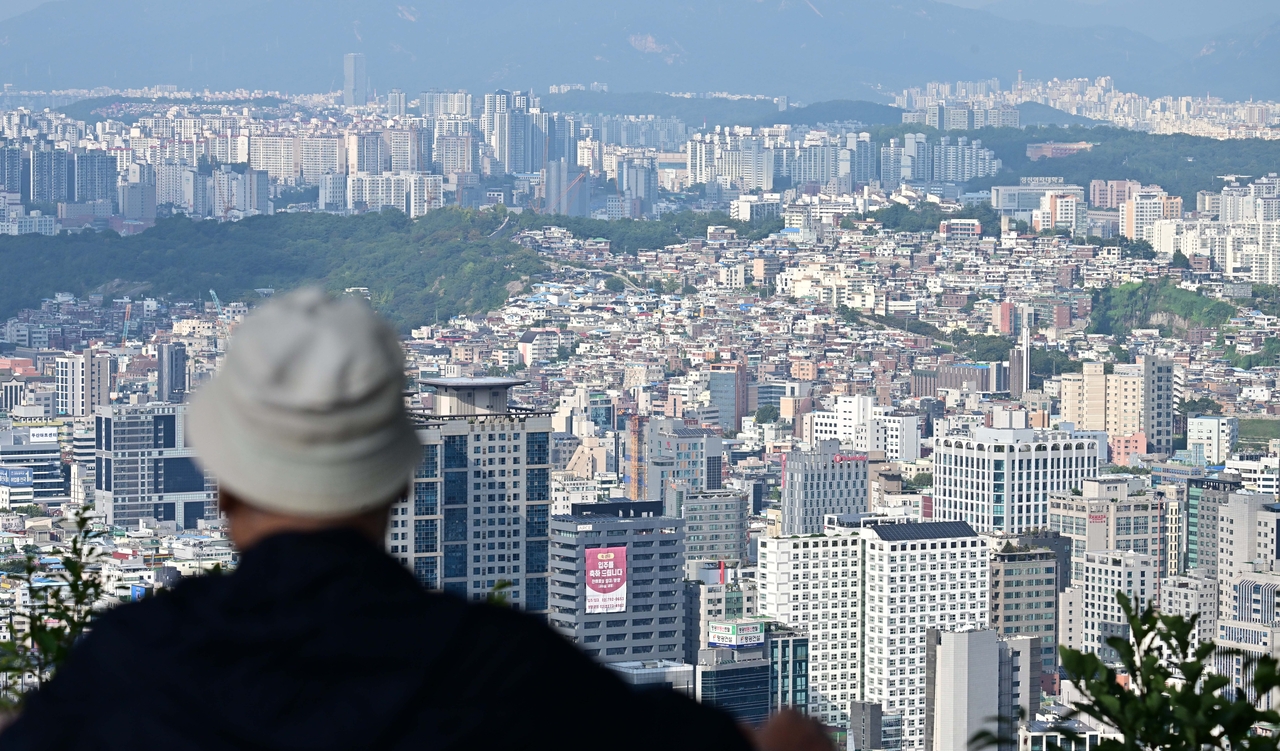
The price gap between Gangnam and non-Gangnam apartments in Seoul is narrowing at an accelerating pace. The average price difference between the two Gangnam districts — Gangnam-gu and Seocho-gu — and the Han River belt has shrunk by nearly 27% since the current administration took office.
Analysts attribute the trend to tighter tax and lending regulations targeting high-priced homes, which have pushed Gangnam prices lower, while upgrade demand and a severe jeonse shortage have funneled survival buying into the Han River belt and mid-range areas, sustaining price gains there. President Lee Jae-myung has described the trend as a "flattening process," but critics warn that rising prices in mid- and lower-priced neighborhoods with strong residential demand are making homeownership harder for ordinary households.
Gangnam 2 districts' average price falls from 2.99 billion to 2.65 billion won; gap with outer areas narrows 16%
An analysis of average apartment sale prices by district from the Seoul Real Estate Information Plaza shows that the average price in the two Gangnam districts fell 342.64 million won — from 2.99 billion won ($2.26 million) in June last year to 2.65 billion won in September. Meanwhile, the average price across the five Han River belt districts of Gangdong-gu, Gwangjin-gu, Dongjak-gu, Mapo-gu and Seongdong-gu rose from 1.49 billion won to 1.55 billion won over the same period, crossing the 1.5 billion won threshold. As a result, the average price gap between the two zones fell 26.5%, from 1.5 billion won in June last year to 1.1 billion won in September.
The narrowing is not limited to the Han River belt. In the Nodo-gang cluster — Nowon-gu, Dobong-gu and Gangbuk-gu — average apartment prices rose from 621.23 million won to 665.04 million won, shrinking the gap with the two Gangnam districts from 2.37 billion won to 1.99 billion won. In the Geumgwan-gu cluster of Geumcheon-gu, Gwanak-gu and Guro-gu, average prices edged up from 728.88 million won to 746.7 million won, narrowing the Gangnam gap from 2.26 billion won to 1.9 billion won.
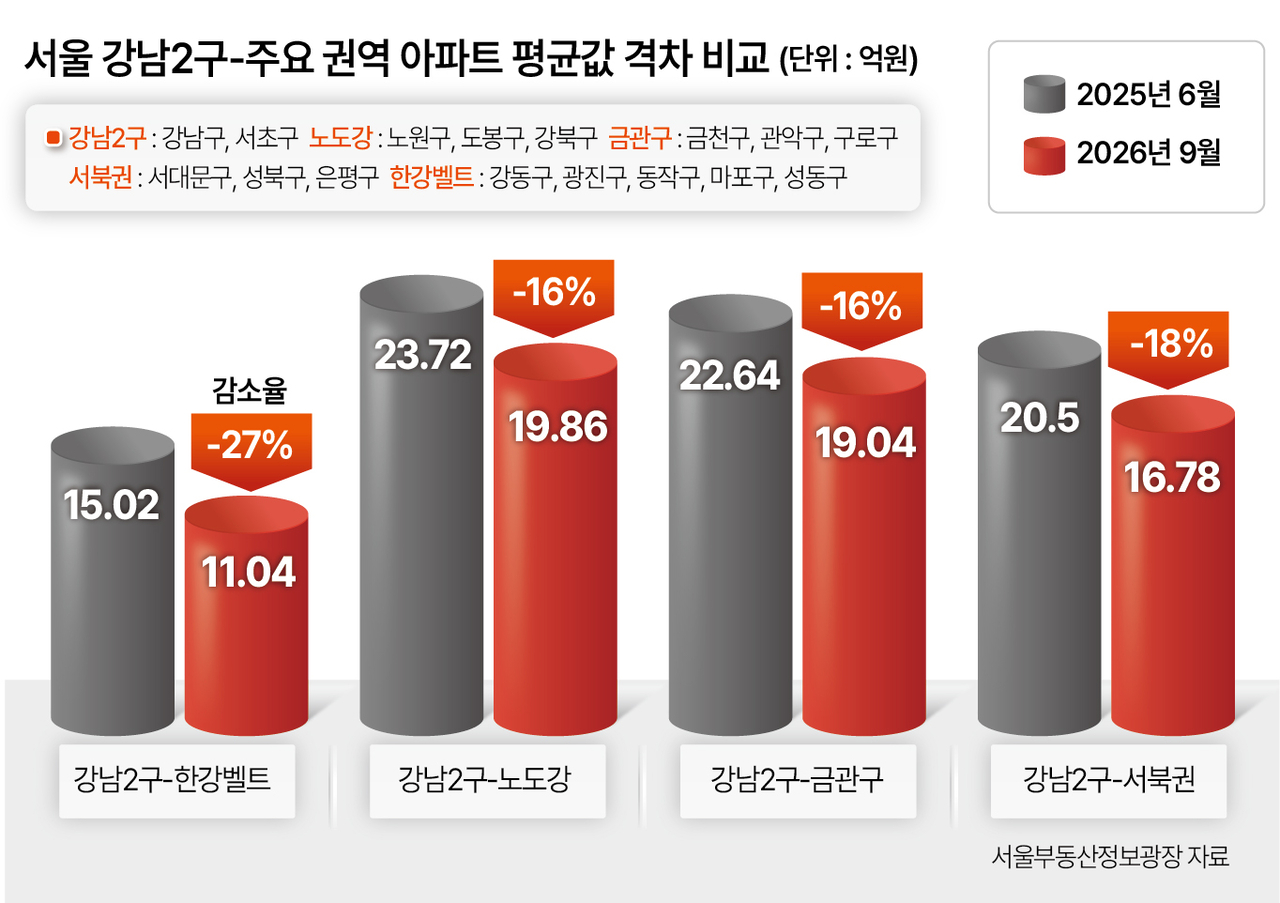
In the northwestern cluster — Seongbuk-gu, Seodaemun-gu and Eunpyeong-gu, which posted the highest cumulative apartment price gains in Seoul this year at 15.68% according to Korea Real Estate Board data — average prices rose from 942.96 million won in June last year to 972.45 million won in September. That narrowed the gap with the two Gangnam districts by 372.13 million won, or 18.1%, from 2.05 billion won to 1.68 billion won.
Tighter taxes and loan curbs dampen Gangnam buying sentiment; survival buying rises in mid-range areas
The across-the-board narrowing of price gaps with the two Gangnam districts reflects the combined effect of government lending and tax regulations concentrated on high-priced homes and a surge in end-user buying in mid- and lower-priced areas. Since taking office, the administration has rolled out a series of regulation-heavy real estate measures — including the June 27 lending rules capping mortgage loans at 600 million won, and the Oct. 15 package that introduced tiered loan limits by home value and designated all of Seoul and 12 Gyeonggi Province areas as land transaction permit zones and regulated zones. The Aug. 3 tax reform proposal, which raised property holding and capital gains tax burdens on high-priced homes, has also significantly dampened buying sentiment in Gangnam. A stream of distressed listings aimed at cutting tax exposure has kept apartment prices in Gangnam-gu and Seocho-gu on a downward trajectory.
Korea Real Estate Board weekly apartment price data show that Gangnam-gu prices turned negative in the second week of August, falling 0.02%, and have declined for 10 consecutive weeks since. Seocho-gu also turned lower that same week, dropping 0.04%, and has posted 10 straight weeks of declines.
The Han River belt and mid-range areas, by contrast, face relatively lower lending barriers than Gangnam and are more accessible to end-users, drawing concentrated buying interest. A deepening preference for a single, moderately priced home — one less exposed to the expanded tax burden — has also contributed to the shift.
Compounding the trend, a severe jeonse and monthly rent shortage driven by tighter owner-occupancy requirements and a supply crunch is pushing end-users into the purchase market, lifting price floors in mid-range areas. As of Thursday, available jeonse listings for Seoul apartments stood at 20,945 — down about 20% from roughly 25,943 in early June last year. A vicious cycle has taken hold: shrinking supply pushes jeonse prices higher, which drives renters into the purchase market and in turn pushes up sale prices for mid- and lower-priced apartments.
As the trend persisted, President Lee described it as a "flattening process." At a press conference on Sept. 18, he said: "The encouraging thing is that prices have started falling in areas including Gangnam, which had been rising, and the decline is continuing to spread to other areas. Before, Gangnam was at the top and everywhere else was lower — now Gangnam is coming down and other areas are rising slightly. It seems like a kind of flattening is underway."
Some experts, however, argue that the narrowing gap is a byproduct of policy distortions and call for easing certain regulations, including land transaction permit requirements.
Song Seung-hyun, chief executive of Urban Economy, said the shrinking price gaps between Gangnam, the Han River belt and outer areas "are not the result of changes in real estate market fundamentals, but the outcome of various regulations including lending restrictions and jeonse market instability." He added that easing regulations such as land transaction permits "could actually calm some of the urgent buying demand and, as jeonse listings return to the market, produce a market-stabilizing effect."
hwshin@heraldcorp.com