Five years of the Stalking Punishment Act

Acting Korean National Police Agency Commissioner Kim Jong-cheol visited a police station Thursday to review the response to relationship-based crimes, as a string of stalking cases across the country have escalated into killings and other violent offenses.
Kim visited the Mapo Police Station in Seoul that morning to inspect how officers are handling relationship-based crimes, the Korean National Police Agency said. He received a briefing on victim protection measures and checked the operational status of emergency smartwatches issued to stalking victims.
At a meeting with victim-support officers and abuse-prevention police, Kim said officers must "carefully ensure that all safety measures directly tied to the lives of relationship-crime victims are functioning properly, and do their utmost so that victims do not have to bear the pain of their ordeal alone."

Kim's visit came amid repeated calls from President Lee Jae Myung for a firm crackdown on relationship-based crimes.
Speaking at a Police Day ceremony held Wednesday at the Korean National Police Agency headquarters in Seodaemun-gu, Seoul, Lee said the police must "take seriously the reality that a series of recent relationship-based crimes has shaken public trust in the police and deepened public anxiety." He urged officers to make "a fundamental shift from reactive response to proactive prevention" on stalking and other relationship crimes, and to "devise extraordinary measures and spare no effort."
Earlier, at a Cabinet meeting he chaired at Cheong Wa Dae on Oct. 13, Lee said relationship-based crimes "carry a high risk of reoccurrence and a strong likelihood of escalating into more serious offenses, making strict early intervention above all necessary." He added: "We must change this absurd reality in which victims are forced to abandon their daily lives and go into hiding because of their perpetrators."
Killings follow stalking reports
'The law exists, yet victims still die'
Korea Women's Hotline, a support organization for victims of gender-based violence, held a press conference Thursday morning in front of Cheong Wa Dae in Jongno-gu, Seoul, condemning the situation. "Five years have passed since the Stalking Punishment Act took effect, yet tragic incidents in which victims lose their lives — even after reporting to police — continue without end," the group said.
In the early hours of Sunday, a man in his 60s surnamed Kang (61) attempted to force a woman in her 40s into a vehicle as she was returning home in Yeon-dong, Jeju. When she resisted, he stabbed her multiple times with a bladed weapon, killing her. The victim had been wearing a police-issued emergency smartwatch at the time. Kang later told investigators that he had torn the smartwatch from her wrist before carrying out the attack.
The first report to police had come more than a year earlier. The victim filed a complaint on Oct. 18 last year, telling police that "a man she knew had come to her home." Officers who responded separated Kang from the victim and closed the case. On Oct. 25 of the same month, she filed another report saying she was "receiving repeated contact from a man she used to know." She subsequently reported Kang to police on stalking charges on additional occasions. However, because the victim was reluctant to pursue a formal investigation, police issued Kang a warning and did not proceed further.
A man who killed his mother-in-law and was transferred to prosecutors in custody Tuesday had also been reported to police for stalking before committing the crime. Kim Seong-u (26) stabbed and killed his wife's mother, a woman in her 50s, on Sunday in Songpa-gu, Seoul, after she intervened as he tried to forcibly drag away his wife — who had filed a lawsuit to nullify their marriage and reported him for stalking.
On Thursday, a man in his 70s in Jeonju, North Jeolla Province, was arrested on suspicion of killing a woman in her 60s he had been living apart from, after having previously been separated from her under a stalking intervention order. On Monday, a woman in her 50s who had been a stalking victim was found dead in the passenger seat of a vehicle parked on a roadside in Asan, South Chungcheong Province. Police arrested a man in his 60s who was in the driver's seat, believing he had killed her. The deceased woman had previously reported the man to police for stalking on two separate occasions.
Korea Women's Hotline said "it remains a reality that sanctions against perpetrators are not properly enforced, leaving victims with no choice but to abandon their daily lives to secure their own safety." The group also said that "perpetrators retaliating by filing counter-complaints against victims who have reported them is a problem that occurs frequently."
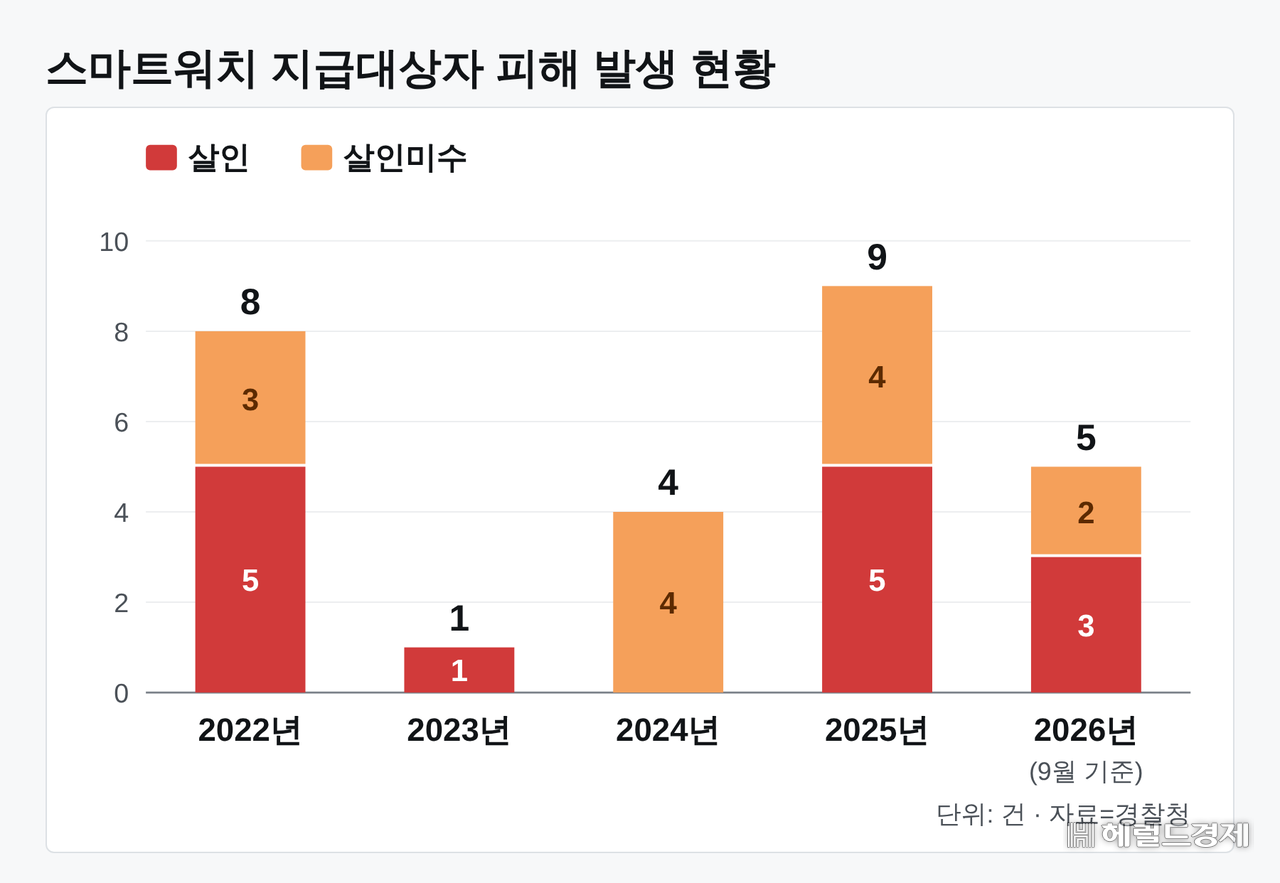
Police say they are moving toward more proactive enforcement of safety measures for relationship-crime victims. The number of smartwatches issued by police to crime victims has risen every year, from 14,208 in 2022 to 16,690 in 2023, 17,508 in 2024, 21,974 in 2025, and 19,223 through September this year, according to the Korean National Police Agency. The devices allow victims to quickly contact emergency services and automatically record ambient sound in crisis situations, and officers may issue them at their own discretion.
Even so, killings and attempted killings involving smartwatch recipients have continued. This year alone, three victims wearing the devices were murdered and two attempted murders occurred through last month. Year-by-year figures over the past five years show five murders and four attempted murders in 2025, four attempted murders in 2024, one murder in 2023, and five murders and three attempted murders in 2022.
Shin Jin-hee, a public defender who has represented sex crime victims, said "stalking is a powerful warning sign of extreme violence such as murder," adding that "investigative and judicial authorities must not treat it lightly simply because it occurs within an intimate relationship such as marriage or dating."
While the importance of prevention is widely acknowledged, some voices point to practical limits on police ability to intervene preemptively — for instance by physically separating perpetrators at the reporting stage. One police official said that "if an officer exercises strong physical force such as arrest for preventive purposes, the perpetrator can file a complaint against the officer for abuse of authority, which makes it a difficult call on the ground," and that "legislation granting police the authority to enforce preemptive mandatory separation is needed."
The Stalking Punishment Act, which took effect in October 2021, provides for a prison sentence of up to three years or a fine of up to 30 million won ($22,600) for stalking offenses. In July 2023, a provision that had allowed prosecution to proceed only with the victim's consent was abolished, enabling criminal proceedings to continue even when a victim does not wish to press charges.
arin@heraldcorp.com