Naver, Kakao Mobility among 6 participants
MOU to form traffic safety data sharing consortium
Real-time hazard alerts to help prevent secondary crashes
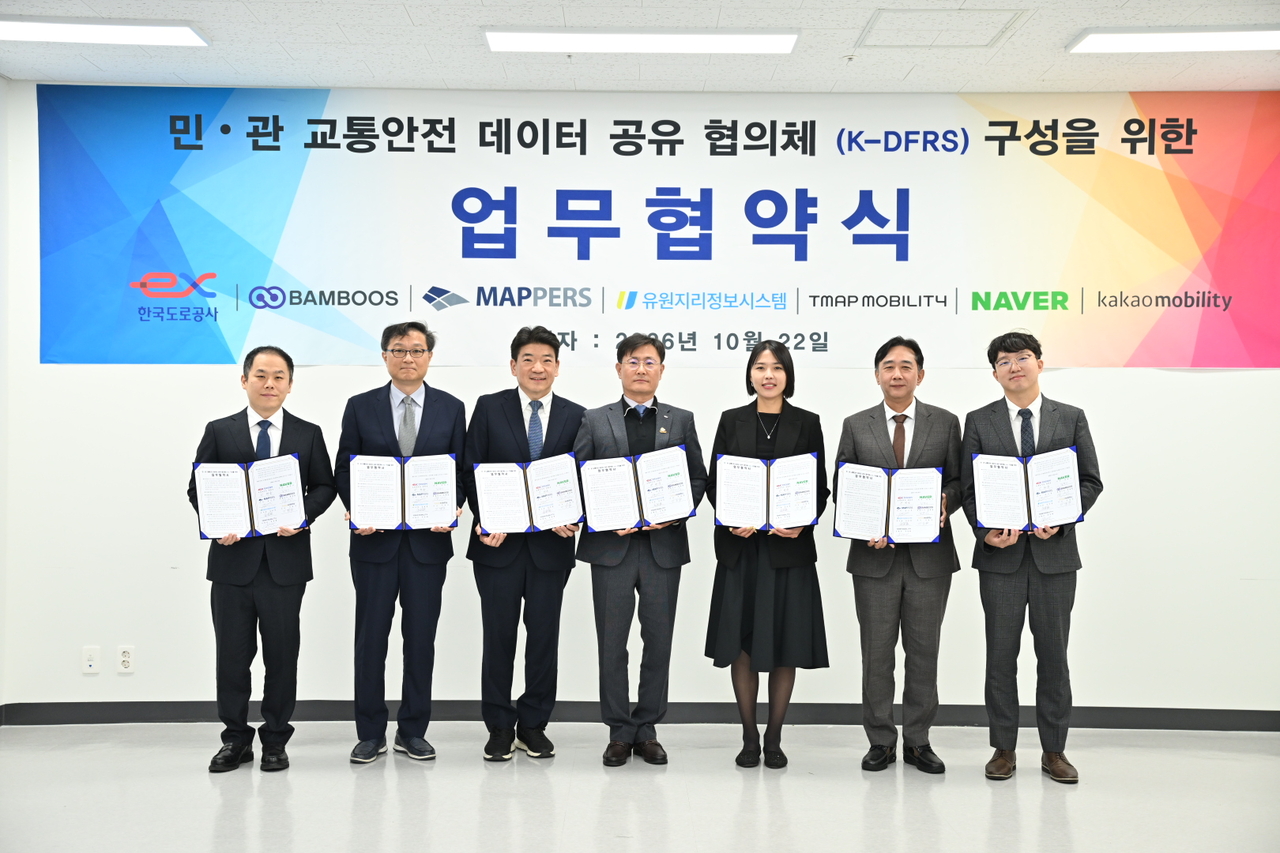
Korea Expressway Corporation is joining forces with leading domestic IT and mobility companies — including Naver, Kakao Mobility and T Map Mobility — to build a public-private framework for sharing expressway traffic safety big data.
The corporation signed an MOU Thursday at the Gangneung Convention Center with six private IT and mobility firms — Naver, Mappers, Bambus, Uwon Geographic Information System, Kakao Mobility and T Map Mobility — to establish K-DFRS (Data for Road Safety), a public-private traffic safety data sharing consortium.
The agreement was designed to introduce and adapt an advanced traffic safety data sharing system modeled on an EU initiative. The EU legally mandated the free sharing of traffic safety information in 2013, and has operated a public-private connected vehicle data sharing consortium called DFRS since 2020, targeting zero road traffic fatalities by 2050.
The participating organizations agreed to cooperate across multiple areas: sharing data on hazardous road conditions, standardizing traffic safety data and building interoperability systems, establishing a regular K-DFRS consultative body, and jointly proposing policies, conducting technology demonstrations and expanding services to drive traffic safety innovation.
The public-private big data collected and shared through the MOU will serve as a key resource for a project to build an AI agent-based automated traffic incident response system, led by the Ministry of Land, Infrastructure and Transport and the Korea Intelligent Transport Systems Association.
Running from July this year through December 2027, the system is designed to let AI automatically detect and handle the full sequence of unexpected incidents on expressways. Once complete, it is expected to prevent secondary crashes — which carry a high fatality rate on expressways — and enable real-time responses to sudden hazards, significantly improving road safety and driving convenience for the public.
"This MOU is a meaningful first step in which the public and private sectors join hands to build a highway traffic safety ecosystem together," a Korea Expressway Corporation official said. "We will work to successfully establish K-DFRS and lead the way in digital innovation on expressways and traffic accident prevention."
Meanwhile, Korea Expressway Corporation signed a separate MOU on Tuesday with Malaysia's Lembaga Lebuhraya Malaysia at the Gangneung Convention Center in Gangwon Province, covering cooperation in roads and transportation.
hwshin@heraldcorp.com