Regulations lifted for driverless taxis and apartment delivery robots
New accident liability guidelines and coexistence plan for taxi industry
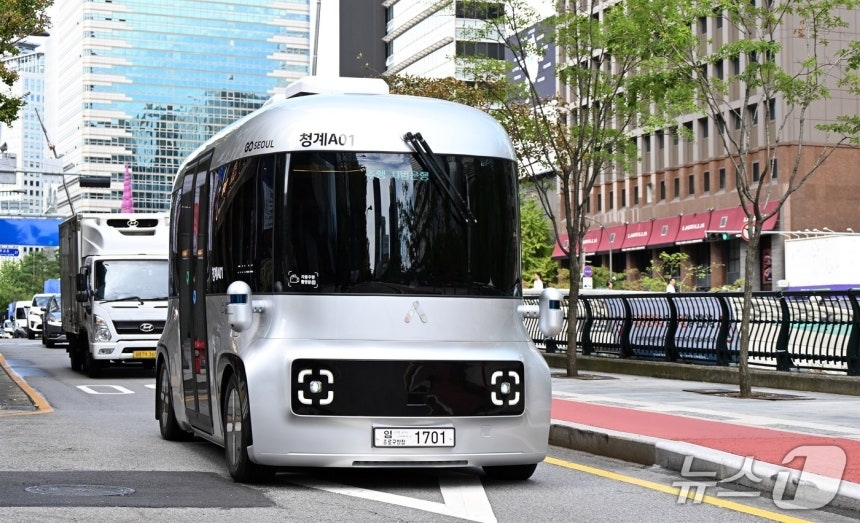
Driverless autonomous taxis will begin commercial service in Gwangju in 2028. As physical AI comes to play a growing role in everyday life, the government is also preparing measures to help the existing transportation industry — including taxi drivers facing a sharp drop in demand — adapt to the shift.
In addition, the government will introduce regulatory exemptions to further promote the use of mobile robots, which are increasingly being deployed in apartment complexes and construction sites. Incentives will include excluding robot waiting and charging areas from floor area ratio calculations.
The Ministry of Land, Infrastructure and Transport presented its plans for regulatory reform to support the commercialization of autonomous vehicles and mobile robots at the Regulatory Rationalization Committee, held Friday afternoon at Cheong Wa Dae.
3,000 driverless autonomous vehicles to enter trials next year
The ministry said it would push ahead rapidly with commercialization, describing autonomous driving as a core technology of physical AI and a national strategic technology that can guarantee universal mobility for an aging society while improving road safety.
To that end, the government plans to formalize autonomous driving service operators and prepare Gwangju — where a pilot program with 200 vehicles is already under way — to be the first city to launch commercial service. An additional 800 vehicles are set to be deployed in Gwangju next year, and when combined with other pilot cities, the total number of driverless autonomous vehicles in trials will grow to around 3,000.
Data gathered from these pilots will form the basis for formalizing driverless autonomous driving service operators. Operators will be required to have capabilities covering remote monitoring of vehicle operations, passenger safety management, emergency on-site response, accident handling and cybersecurity. The government will also present a commercialization model for driverless autonomous vehicles — including a fare structure — while working with the existing transportation industry, including taxi operators, to develop a coexistence plan. Both the commercialization model and the coexistence plan are set to be piloted first in Gwangju starting in 2028.
Recognizing that leaks of sensitive data collected by driverless autonomous vehicles could raise concerns about privacy violations and security threats, the government will require operators to store data domestically, implement security and protection measures, and obtain separate approval before transferring data overseas.
Cybersecurity management systems for vehicle manufacturers will be strengthened, and a framework for proactive investigation, management and response will be established to guard against hacking and backdoor risks.
The ministry will also work with related ministries, including South Korea's Ministry of National Defense and the National Intelligence Service, to develop additional measures governing connected vehicles' access to critical facilities, as part of a broader push to assert data sovereignty.
The government will also develop guidelines to address the growing risk of civil disputes over liability when autonomous vehicle accidents occur — cases where pinpointing the exact cause is difficult and responsibility is unclear among multiple parties such as manufacturers, autonomous driving companies and service operators. A task force on accident liability, bringing together the autonomous driving industry, insurers and experts, will be set up to create "accident liability guidelines" that systematically define how civil liability is shared depending on the type of autonomous vehicle accident.
Business-to-business transactions involving autonomous vehicles will be permitted, and safety standards for the commercial sale of autonomous vehicles developed by the United Nations Economic Commission for Europe will be incorporated into domestic law next year. A performance certification system for business-to-business transactions involving driverless autonomous vehicles will begin operating by the end of this year.
Licensing procedures will also be streamlined during the pilot phase to ease the burden on companies. Legislation will be amended to allow autonomous vehicles without a driver's seat to operate outside designated pilot zones in exceptional cases, such as moving to a garage or charging station. The current requirement to physically inspect each individual vehicle before issuing a temporary operating permit will also be scrapped — vehicles of the same model whose safety has already been verified will no longer need to undergo the on-site inspection step.
The ministry said these regulatory reforms would allow the existing special exemptions for research and development purposes to evolve into a framework that enables driverless robotaxi operations and paid transportation services, adding that the changes lay the groundwork for South Korea to become one of the world's top three autonomous driving powers.
Mobile robots to see expanded use in apartments and everyday spaces
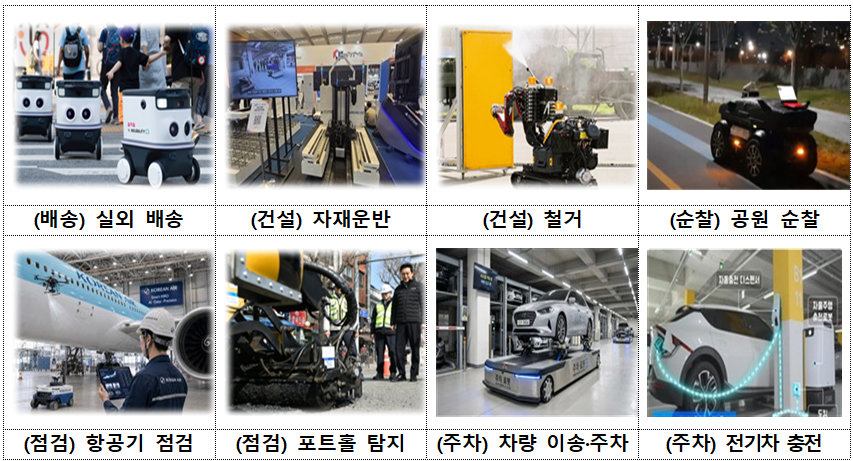
The other area presented to the Regulatory Rationalization Committee was a plan to advance the commercialization of mobile robots. The ministry said a shift to robot-friendly urban space regulations is needed to reflect the reality that mobile robots are moving beyond manufacturing into service roles — including parking, delivery, patrol and inspection.
Sector-specific regulatory exemptions will be introduced for buildings, aviation, railways and other areas to remove barriers to robot adoption. In the construction sector, floor space used for robot waiting, charging and maintenance facilities will be excluded from floor area ratio calculations.
The government will also develop a robot-friendly architectural design and certification system, under which certified buildings would receive benefits such as relaxed floor area ratio limits and height restrictions. Standardized design guidelines covering robot traffic flow, waiting and charging spaces, automated delivery facilities, and integration with building systems will be drawn up to support the indoor use of mobile robots.
Even where robots can be deployed on site, the absence of clear operating standards has made it difficult to move projects forward. The government will address this uncertainty by establishing sector-specific "robot operating standards" for construction sites, parking facilities and last-mile logistics facilities.
A "mobility pedestrian map" will be built to help robots accurately identify crosswalks, obstacles and building entrances and navigate safely. A joint public-private platform will also be developed so the map can serve as a public resource for the mobile robot industry.
The ministry said a special act to promote the safe use and commercialization of mobile robots has already been proposed in the National Assembly, and that once the law is enacted, a dedicated organization will be established to pursue robot industry policy more actively.
The ministry also said it had cut the number of administrative documents required from startups in the sector from 331 to 175, an improvement expected to save companies a combined 36,512 hours of paperwork annually. Examples of the streamlining include replacing six separate documents with a single self-assessment form when applying for smart logistics center certification, and adjusting the deadline for submitting local government support letters during applications for regulatory exemptions to before the committee review stage.
smh@heraldcorp.com