The two-tier system dividing workplace and regional subscribers creates deep inequities
The 'tax where income exists' principle rings hollow as calls grow for an income-centered overhaul
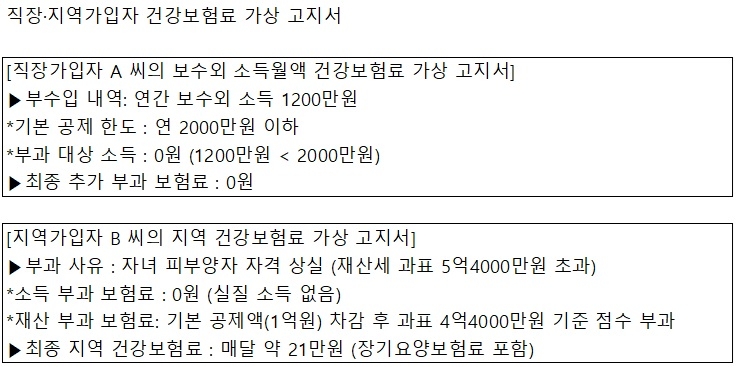
Worker A earns an annual salary of 40 million won ($30,200) and supplements it with weekend part-time work that brings in an additional 1 million won a month — yet pays nothing extra in national health insurance premiums. Because the side income falls below the 20 million won annual deduction threshold for non-wage income, the additional premium is assessed at zero. That may soon change: the Ministry of Health and Welfare is considering cutting the deduction threshold in half, to 10 million won a year, and workers like A are anxious.
Retiree B, who had been listed as a dependent under a child's workplace insurance plan, now has no meaningful cash income. But a single apartment — assessed at a public price of 900 million won, with a property-tax base of 540 million won — was enough to strip B of dependent status. Reclassified as a regional subscriber, B now receives a monthly bill of about 210,000 won, including long-term care insurance, based solely on that property.
The monthly health insurance bill issued by the National Health Insurance Service tells a starkly different story depending on a subscriber's economic status. The system is lenient toward salaried workers who earn side income on top of their regular pay, yet punishes retirees whose only asset is a home they spent a lifetime saving for. The contradiction is a direct product of the binary premium structure — workplace subscribers versus regional subscribers — embedded in the National Health Insurance Act.
The gap between those two bills stems from three structural blind spots in the current premium assessment system.
The first is the system's limited ability to reflect actual income — a leniency that effectively exempts workplace subscribers' side earnings from meaningful contribution.
Under the current framework, non-wage income for workplace subscribers — including dividends, interest, rental income and business earnings — is subject to a generous annual deduction of 20 million won. As a result, a subscriber like A, who earns an additional 12 million won a year and has a clear capacity to pay more, falls into a contribution-free blind spot and makes no additional fiscal contribution to the system.
The second blind spot is a punitive property-based premium that targets the assets of retirees and effectively creates a class of house-poor subscribers.
The moment a person is reclassified as a regional subscriber, heavy premiums are levied on their property regardless of whether they have any income at all. As B's case illustrates, a retiree with no cash income can be forced to pay a substantial premium calculated against the tax base of an "unrealized gain" — the home they live in. This directly threatens the housing stability of elderly retirees.
A third burden compounds the problem: an "income cliff" created by the lag between when income is earned and when it is reflected in premium assessments.
The system for tracking and adjusting regional subscribers' income operates with a built-in delay. Because premiums are calculated on the previous year's confirmed income, a subscriber who loses their job or closes a business this month may still be required to pay premiums based on their former high income for months to come.
"The only path to plugging the fiscal leaks in national health insurance and restoring public trust is a unified reform that taxes workplace subscribers' side income more rigorously while boldly reducing the property burden on retired subscribers with no income," said Kim Su-jin, a research fellow at the Korea Institute for Health and Social Affairs.
The government is now working on a response.
The Ministry of Health and Welfare is pursuing a restructuring centered on gradually reducing and eventually eliminating property-based premiums while shifting to a comprehensive income-based system that applies uniformly to all sources of earnings.
The most concrete measure under consideration is halving the non-wage income deduction for workplace subscribers — cutting the current 20 million won annual threshold to 10 million won — to bring parity with regional subscribers, whose total comprehensive income is already subject to premiums without a comparable deduction. Under the proposed change, subscriber A, who earns 12 million won in side income, would have 2 million won added to the assessment base after the 10 million won deduction, resulting in an additional monthly premium of about 12,000 won at the current contribution rate of 7.19 percent.
For regional subscribers, the government plans to expand the basic property deduction and ease the overall burden. It is also moving to abolish or reduce the premium levied on vehicles. Retirees like B, who lost dependent status solely because their property crossed a tax-base threshold, are expected to see their monthly bills lighten as a result.
The government also plans to strengthen the income-adjustment system so that subscribers who experience a sudden drop in earnings due to business closure or job loss can have their premium bills revised promptly, rather than continuing to pay based on outdated income figures.
However, when recent reports that the government was considering an across-the-board income reconciliation scheme — covering regional subscribers as well — sparked controversy, authorities moved quickly to tamp down expectations. Health and Welfare Minister Jeong Eun-kyeong said on Facebook that a nationwide income reconciliation program "is a matter that can only be pursued after comprehensive consideration of the burden on the public, sufficient discussion, deliberation by the Health Insurance Policy Deliberation Committee, and the necessary legislative process," signaling a cautious approach.
thlee@heraldcorp.com