Analysis of Power Statistics Information System data
Annual revenue loss estimated at 611.6 billion won if wholesale price cut by 10 won per kWh
Structure funnels savings from wholesale price cuts into retail discount funding
State-owned generators offset losses within Korea Electric Power's consolidated accounts; private firms take direct revenue hit
'Discounts for the regions come at private power firms' expense'
Concerns over harm to existing investors and financial strain; experts call for transitional safeguards
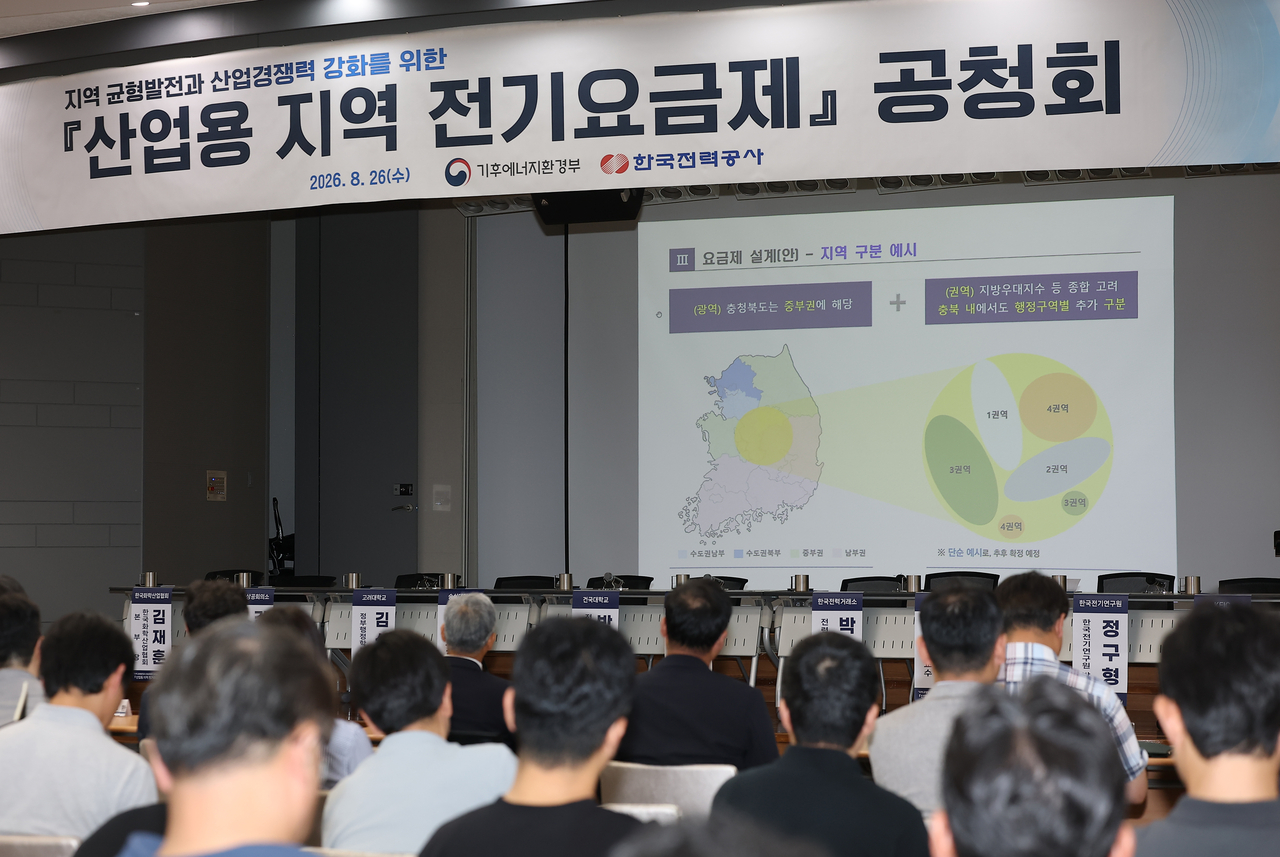
If the government's proposed regional industrial electricity pricing scheme takes effect, the 17 private power generators operating outside the greater Seoul metropolitan area are estimated to suffer combined annual revenue losses of 611.6 billion won ($461 million). The structure — which funds retail electricity discounts for non-metropolitan industrial users by cutting the locational marginal price paid to non-metropolitan generators — has drawn criticism for placing the policy burden disproportionately on the private sector.
According to an analysis of data from the Korea Power Exchange's Power Statistics Information System released Friday, a 10-won-per-kilowatt-hour reduction in the non-metropolitan system marginal price under a locational marginal pricing regime would reduce the 17 private generators' combined annual revenue by 611.58 billion won — an average of 36 billion won per operator.
Korea Electric Power Corporation held a public hearing on the regional industrial electricity pricing scheme in August, announcing a plan to divide the country into four zones — southern greater Seoul, northern greater Seoul, the central region and the southern region — and offer progressively steeper industrial rate discounts the farther a zone is from the capital, with a maximum discount of 10 percent. The corporation said at the time that funding the retail discounts would require about 2.8 trillion won ($2.11 billion) a year, and that it planned to raise those funds by cutting the wholesale prices it pays to non-metropolitan generators.
In other words, the scheme lowers the wholesale prices paid to non-metropolitan generators and redirects the resulting savings toward industrial electricity discounts in those same regions. The critical issue is that the impact of the wholesale price cut falls very differently depending on the type of generator. State-owned generators are consolidated subsidiaries of Korea Electric Power Corporation, meaning a reduction in the wholesale price the corporation pays them is ultimately offset within the parent company's consolidated financial statements.
Private generators, by contrast, see the wholesale price cut translate directly into lower revenue. Most of the 17 affected companies are structured around private capital combined with project financing, meaning a drop in sales immediately threatens their financial health. Estimated losses by fuel type are: 229 billion won for four LNG power plants, 237.6 billion won for four coal-fired plants, and 145 billion won for nine LNG combined heat and power operators. The actual impact on each operator's bottom line will also depend on individual settlement structures and cost-recovery terms. Notably, a significant number of the private generators are relatively new companies that began commercial operations within the past three years or so and have limited capacity to absorb losses.
Policy credibility is also at issue. Many private power developers invested in non-metropolitan locations in response to government policy signals. By the time locational marginal pricing rules were announced, most had already obtained operating licenses and broken ground, leaving them no opportunity to reconsider their siting decisions. Power generation projects require large upfront capital outlays that are recouped over long operating periods. Operators that locked in their locations and equipment based on government approvals and existing market rules cannot simply relocate a power plant if wholesale prices fall. What amounts to a price signal designed to guide new entrants toward certain locations becomes, for existing operators, a harm they have no practical way to avoid.
If the resulting financing pressures and delayed investment decisions prevent generating capacity included in the national power supply plan from coming online when needed, the country's electricity supply could be at risk. "The retail rate discount and the wholesale price reform need to be examined separately, and transitional measures for existing operators along with a fuel-type impact analysis must be prepared," an industry official said. "The difference in burden between state-owned and private generators, as well as the timeline for transmission network expansion, also need to be factored into the policy design."
keg@heraldcorp.com