Over 80 attend, including Ministry of Land officials and aviation safety experts
Participants discuss AI analysis standards, just culture
Working group to be formed for ongoing collaboration
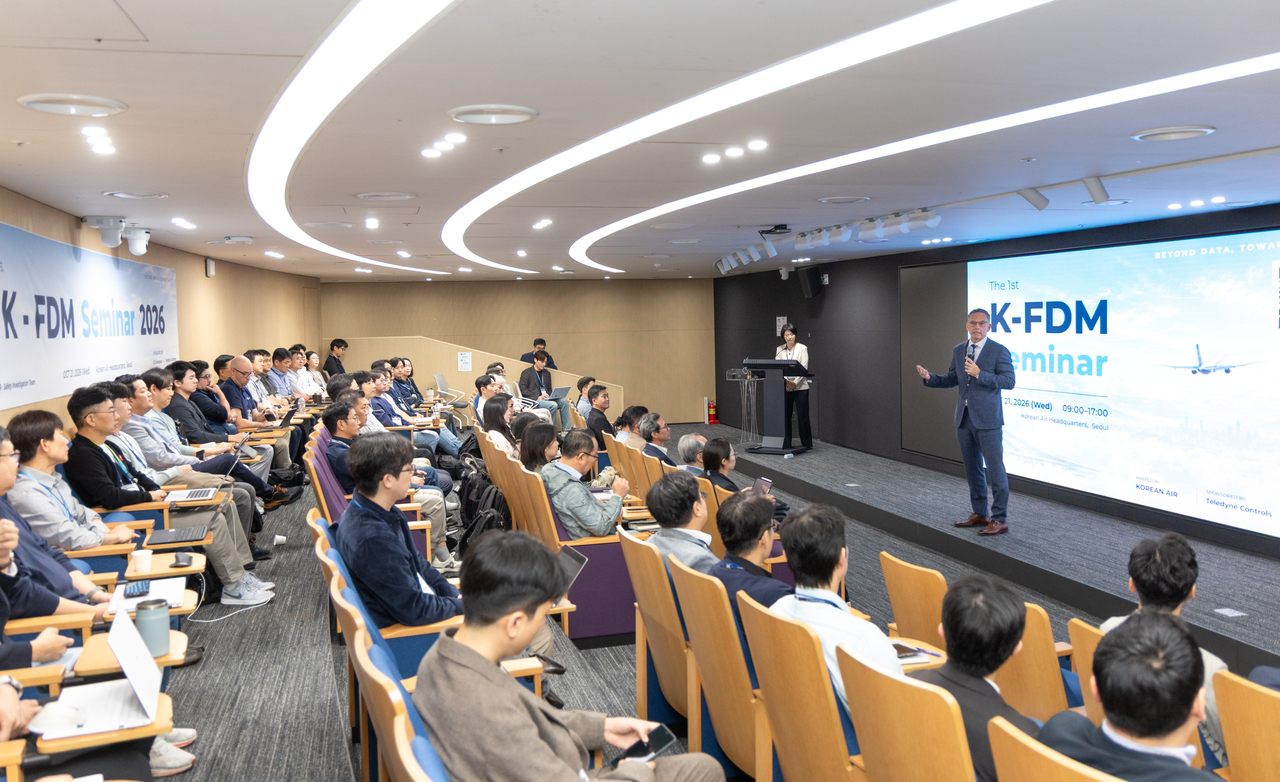
Korean Air hosted the inaugural K-FDM Seminar at its headquarters in Gangseo-gu, Seoul, bringing together the Ministry of Land, Infrastructure and Transport, the Korea Institute of Aviation Safety Technology and 13 domestic airlines, the company announced Friday.
Held under the slogan "Beyond Data, Toward Safety," the seminar drew more than 80 participants, including flight data monitoring (FDM) officers from the 13 carriers and experts from the Ministry of Land, Infrastructure and Transport and the Korea Institute of Aviation Safety Technology (KIAST).
Korean Air organized the event to share flight data analysis technology and expertise across the domestic aviation industry ahead of the launch of the integrated airline in December. The company noted that FDM officers from individual carriers — who had previously had little contact with their counterparts at other airlines — and specialists from related institutions were gathered in one place for the first time.
FDM is a management framework that collects and analyzes the vast amounts of data generated during flight to identify potential risk factors in advance and improve flight safety. Flight data encompasses pilot control inputs, wind direction and speed, terrain information and other variables.
Bennett Alan Walsh, head of aviation safety and security at Korean Air, said in his welcome address that the seminar was "very encouraging as the first of its kind to bring every domestic airline together in one place." He added that it would serve as "the first step toward linking data scattered across individual carriers into a safety network covering all of Korea, and ultimately expanding that into a global cooperation network connecting airlines around the world."
The main sessions featured case studies on applying flight data to operational infrastructure improvements and on-site practice. Participants also exchanged views on the need for analysts to establish clear standards and rigorous validation processes when integrating AI into data analysis. The seminar additionally covered strategies for fostering a "just culture" that encourages voluntary pilot reporting, as well as proposals for joint industry-academia-research flight data studies.
Attendees agreed to form a working group to sustain practical cooperation going forward. The plan calls for building a flight data-sharing framework and establishing the seminar as a regular forum to drive a stronger safety culture across the domestic aviation industry.
GE Aerospace and Teledyne Controls participated as sponsors, presenting their flight data-related solutions at the event.
Meanwhile, Korean Air recently completed a successful urban air mobility (UAM) demonstration flight over island areas off Incheon as a member of K-UAM One Team, a consortium it formed with Incheon International Airport Corp., KT Corp., Hyundai Motor Company and Hyundai Engineering & Construction.
The demonstration is being recognized as the first local-government-linked UAM pilot in South Korea in which the central government, local authorities and private companies collaborated across the full process — from identifying public-service applications and designing flight routes to conducting on-site flight verification.
eyre@heraldcorp.com