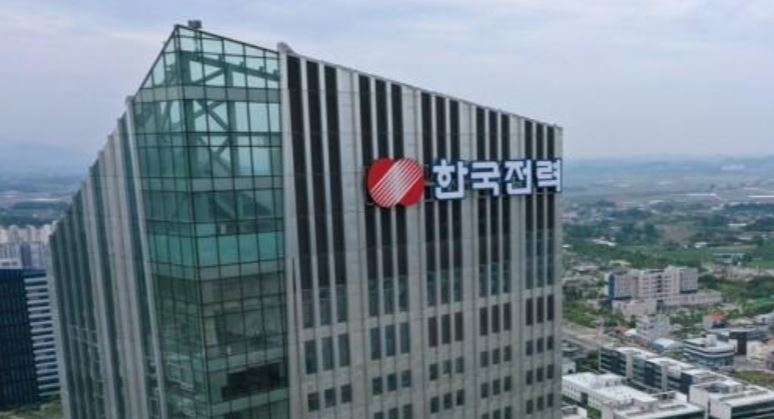
Korea Electric Power Corporation is facing a crisis that could push its corporate bond issuance beyond its legal limit by 19 trillion won ($14.3 billion), as a temporary exemption allowing expanded borrowing is set to expire at the end of next year. The state utility has struggled so severely to raise funds that it asked major conglomerates to prepay five years' worth of electricity bills, while the cost of building power grids for the semiconductor and AI industries is expected to exceed 70 trillion won — adding pressure for an electricity rate increase.
According to Korea Electric Power Corporation and the National Assembly Budget Office, if the utility maintains its current pace of bond issuance, its outstanding corporate bonds are projected to exceed 76 trillion won by the end of 2027 — more than 19 trillion won above the statutory limit that takes effect the following year.
Korea Electric Power is reviewing options including electricity rate increases, additional borrowing and financial restructuring to address a funding shortfall caused by deteriorating profitability and large-scale capital investment.
The biggest constraint on Korea Electric Power's financing is the expiration of a temporary exemption that raised the ceiling on corporate bond issuance. That exemption expires at the end of 2027.
The government amended the Korea Electric Power Corporation Act in 2022 after Russia's invasion of Ukraine sent international energy prices surging. At the time, Korea Electric Power was recording massive losses because it could not fully pass rising fuel costs on to consumers through electricity rates.
The amendment raised the bond issuance ceiling from twice the sum of the utility's paid-in capital and reserves to as much as five times that amount, giving it room to raise funds.
The problem emerged when that temporarily expanded ceiling reverts to twice the capital-and-reserves sum starting in 2028.
An analysis by the National Assembly Budget Office of Korea Electric Power's medium-term financial management plan for 2026–2030 estimated that the utility's combined paid-in capital and reserves will stand at 28.42 trillion won at the end of next year.
Applying the original two-times limit, the maximum allowable bond issuance would be 56.84 trillion won. Yet the projected outstanding balance at that point is 76.05 trillion won — exceeding the statutory ceiling by 19.21 trillion won.
As of the first half of this year, Korea Electric Power's outstanding corporate bonds had already reached 71.5 trillion won.
To prepare for the end of the exemption, the utility must either repay debt or accumulate profits to expand its capital base. Exceeding the issuance limit could also restrict its ability to raise new funds through additional bond sales.
Analysts say the utility's reliance on borrowing to cover deficits — without adjusting electricity rates — has reached its limits as the exemption's expiration approaches.
Korea Electric Power's earnings outlook is also gloomy. Conflicts in the Middle East have pushed up international fuel prices, including LNG, increasing the cost burden of power generation.
A consensus forecast compiled by Yonhap Infomax from securities firms projected Korea Electric Power's operating profit for the third quarter of this year at 2.7 trillion won, a 52.29 percent drop from the same period last year.
Revenue for the same period is expected to reach 27.61 trillion won, up just 0.12 percent year on year.
Profitability is expected to deteriorate further in the fourth quarter. Analysts forecast operating profit of 82.3 billion won — a 95.78 percent decline from a year earlier — and a net loss of 493 billion won.
Even when the utility generates operating profit, interest payments on accumulated debt are eating into net income.
Electricity pricing policy has also emerged as a variable. Under a regional differentiated rate system the government is pursuing, industrial electricity rates in some non-metropolitan areas could fall, reducing Korea Electric Power's power sales revenue.
A plan to raise funds by having large conglomerates prepay electricity bills also fell through.
Korea Electric Power had asked Samsung Electronics and SK hynix to prepay about 25 trillion won in electricity charges covering the five years from 2027 to 2031, with the aim of securing future power sales revenue in advance to fund grid construction and other investments.
Both companies declined, and the plan was abandoned.
Korea Electric Power President Kim Dong-chul told the National Assembly's climate, energy, environment and labor committee during a national audit Monday that the prepayment request was intended to "diversify funding sources."
Korea Electric Power is also reviewing self-help measures such as additional borrowing and cost cuts, but faces the dual challenge of reducing its debt burden while securing new investment capital.
Even as its financial pressures mount, the scale of investment required for grid expansion is growing rapidly.
Under Korea Electric Power's 11th long-term transmission and substation facility plan, the amount to be invested in grid expansion through 2038 stands at 72.8 trillion won — an increase of 16.3 trillion won from the plan drawn up two years ago.
The increase reflects the need to build new transmission lines and substations in areas of concentrated power demand as large semiconductor industrial complexes and AI data centers are being developed in rapid succession.
Advanced industrial facilities, including semiconductor mega-clusters, require infrastructure capable of delivering massive amounts of power reliably. Delays in grid construction could affect the operation of related industrial facilities.
Korea Electric Power has said electricity rate adjustments are necessary to meet the surging investment demand.
"Because the power grid investment that is fundamentally needed keeps increasing sharply, I believe we need to discuss at least a minimal electricity rate increase with the government," Kim said at the national audit Monday.
The remark reflected the view that some portion of grid expansion costs must be reflected in electricity rates, as relying solely on external borrowing is not feasible.
Kim added, however, that no specific rate increase plan had been discussed with the government at that point.
Extending the corporate bond issuance exemption for an additional period has also been raised as an option alongside a rate increase.
Analysts Kim Sang-in and Cha Ju-hee at Shinhan Securities said about 19.2 trillion won of the projected bond balance at the end of next year must either be repaid or offset by equivalent capital increases, but no clear plan has yet been put in place.
They said that because the government faces difficulty raising electricity rates given inflationary concerns, further delaying the normalization of the bond issuance ceiling could be the most realistic alternative.
Korea Electric Power must reduce its debt burden while simultaneously securing funding for large-scale grid investment over the next year or so. Whether the government adjusts electricity rates or extends the bond issuance exemption again will shape both the utility's financing plans and the timeline for building power infrastructure for advanced industries.
rainbow@heraldcorp.com