Behind every public figure's appearance lies a personal regimen. This series examines the diets, exercise habits, procedures, and beauty and fashion choices of people in the spotlight.
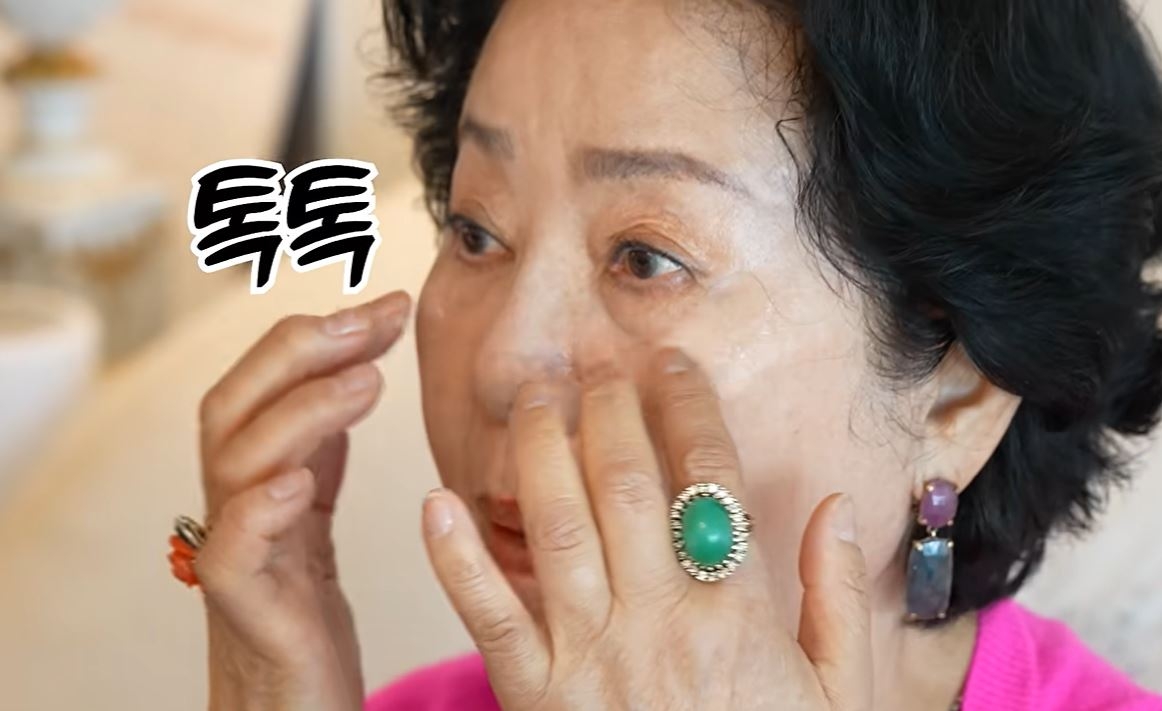
Actor Sunwoo Yong-yeo, 82, has drawn widespread attention after revealing a skincare routine that includes a cream priced at 2.76 million won ($2,070). She uses eight basic skincare products in total, and the disclosure has sparked growing curiosity about whether expensive cosmetics actually deliver meaningful anti-aging benefits. Dermatologists say the price of a product matters far less than choosing ingredients suited to one's skin type and using them consistently.
Sunwoo shared the routine Thursday on her YouTube channel "Sunpung Sunwoo Yong-yeo," introducing cosmetics she has collected over 60 years alongside her everyday skincare practices.
She applied a serum priced at around 350,000 won, followed by a toner worth about 180,000 won and an eye cream costing around 340,000 won. She then brought out the 2.76 million won cream, saying, "I apply this last. It finishes everything off nicely." The routine featured eight skincare products in total.
Cosmetics prices vary widely depending on ingredients, manufacturing technology and brand. A product's ability to hydrate skin and reduce the appearance of wrinkles, however, depends not on its price tag but on the active ingredients it actually contains, its formulation and how it is used.
Does a 2.76 million won cream moisturize better? The answer lies in the skin barrier.
As skin ages, its ability to retain moisture and maintain barrier function changes. Oil secretion on the skin's surface decreases with age, and the lipid composition of the stratum corneum shifts, making dryness and itching more likely.
The stratum corneum — the outermost layer of skin — contains ceramides, cholesterol and fatty acids. These lipids fill the spaces between skin cells and prevent moisture from escaping. When the skin barrier weakens, water loss increases and the skin can become more sensitive to external irritants.
The most common moisturizing ingredients are ceramides, glycerin and hyaluronic acid. Ceramides help replenish the lipids that make up the skin barrier, while glycerin and hyaluronic acid draw in moisture and keep the skin hydrated.
Clinical trials have confirmed the effectiveness of ceramide-containing moisturizers.
A 2019 study published in the international journal Dermatologic Therapy compared a ceramide-containing moisturizer with a standard hydrophilic cream in 24 adults with dry skin.
Researchers had participants apply different moisturizers to each shin and measured skin hydration, transepidermal water loss (TEWL) and skin texture. TEWL — the amount of moisture that evaporates through the skin — is used to assess the condition of the skin barrier.
Areas treated with the ceramide moisturizer showed increased hydration and reduced TEWL. After twice-daily use over 28 days, improvements were also seen in skin texture and wrinkle-related measures, and some moisturizing benefits persisted for seven days after use was discontinued.
The study was a small-scale clinical trial examining the effects of a specific moisturizer. It suggests that the combination of moisturizing ingredients and their formulation can influence skin condition.
The American Academy of Dermatology (AAD) advises consumers choosing anti-aging cosmetics to focus on their skin type and the specific concerns they want to address rather than on price. Effective skincare products, the AAD notes, can be found across a wide range of price points.
Wrinkle-fighting ingredients are a different matter — the clinical case for retinoids.
The smoother, firmer appearance skin takes on after applying a moisturizer is linked to hydration. When the stratum corneum is adequately hydrated, fine lines that appear more pronounced in dry conditions can temporarily look less visible.
Age-related wrinkles and loss of elasticity, however, are closely tied to changes in collagen and elastin in the dermis. Collagen maintains the skin's shape and firmness, while elastin allows it to stretch and spring back. Repeated UV exposure and aging damage these components, deepening wrinkles and reducing elasticity.
Among the ingredients with the most well-researched wrinkle-reducing effects is retinoid, a derivative of vitamin A. Retinoids are involved in the differentiation and regeneration of skin cells and also affect collagen metabolism.
A 2025 analysis published in the international journal Dermatology Practical & Conceptual examined the wrinkle-improving effects of tretinoin, a type of retinoid.
Researchers pooled data from eight randomized clinical trials involving 1,361 participants ranging in age from 29 to 76, with observation periods spanning 16 weeks to two years.
The analysis found that participants who used tretinoin showed statistically significant improvements in both fine lines and deeper wrinkles compared with those who used a vehicle control with no active ingredient. The researchers concluded that tretinoin is an effective treatment ingredient for improving the signs of UV-induced skin aging.
Retinol, widely used in over-the-counter cosmetics, also belongs to the retinoid family. Tretinoin and retinol differ, however, in how they act on the skin, their potency and the degree of irritation they cause, so the same results should not be expected from both.
Retinoid ingredients can cause dryness, redness and stinging in the early stages of use. Those with sensitive skin are advised to start with a low concentration and adjust frequency based on how their skin responds. Retinoids should be avoided during pregnancy.
When choosing cosmetics, it is important to check whether a product contains ingredients with proven efficacy for one's primary concerns — whether wrinkles, pigmentation or dryness.
Does layering eight skincare products boost results? What really matters for aging skin.
Many people follow a multi-step routine like Sunwoo's, applying toner, serum, essence, eye cream and moisturizer in sequence in the hope that layering products will deliver better results.
Using multiple products, however, can mean applying overlapping concentrations of similar ingredients or repeatedly exposing the skin to potentially irritating ones.
The AAD notes that using several anti-aging products at the same time can cause skin irritation. Particular caution is warranted when combining exfoliating ingredients with retinoids, as the combination can intensify irritation.
A basic skincare routine is relatively straightforward: cleanse with a gentle face wash, apply any targeted functional products, then use a moisturizer to reduce moisture loss. Sunscreen is essential during the day.
The benefits of sun protection have been confirmed in long-term clinical trials.
A 2013 study published in the Annals of Internal Medicine analyzed the relationship between sunscreen use and skin aging in 903 adults in Australia.
Researchers divided participants into groups — those who applied sunscreen daily and those who used it only when they felt it was necessary — and tracked their skin condition over roughly four and a half years.
The group that used sunscreen daily showed 24 percent less skin aging progression than the group that used it only occasionally. The researchers said regular sun protection helps slow the visible aging of the skin's surface.
The AAD recommends a broad-spectrum sunscreen with SPF 30 or higher for everyday sun protection. Reapplying as needed based on sun exposure and combining sunscreen with physical barriers such as hats or parasols can also help.
When it comes to managing skin aging, choosing ingredients suited to one's skin and using them consistently matters far more than the price or number of products. Those concerned about dryness should focus on moisturizing ingredients, while those looking to address wrinkles or pigmentation should choose products with ingredients whose efficacy for those concerns has been verified.
Particularly from middle age onward, when skin tends to become drier and more sensitive, maintaining a stable skin barrier is more important than an overly complex routine. Adequate moisturization and sun protection form the foundation, and choosing products suited to one's own skin condition is the most reliable path to healthy skin.
rainbow@heraldcorp.com