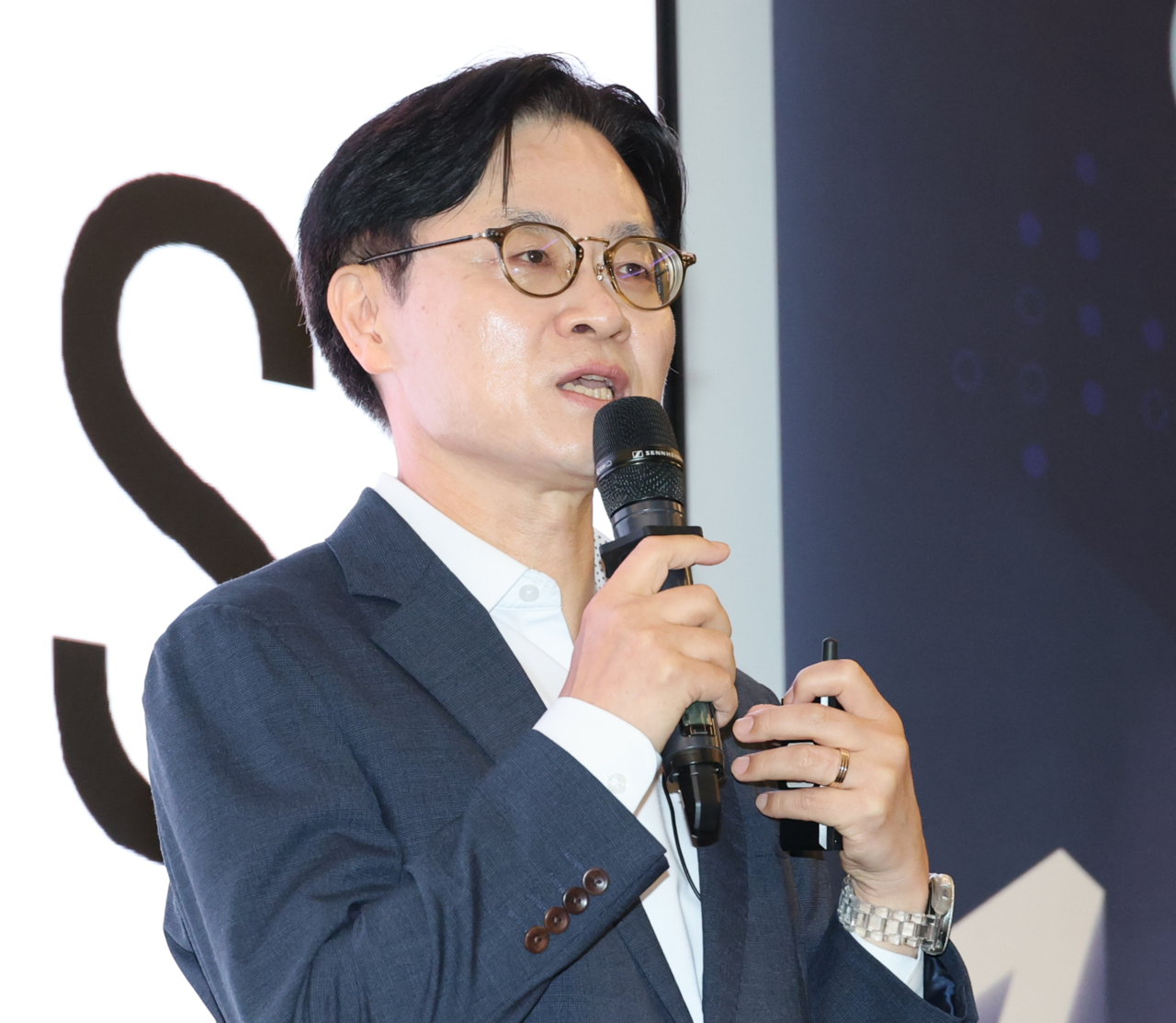
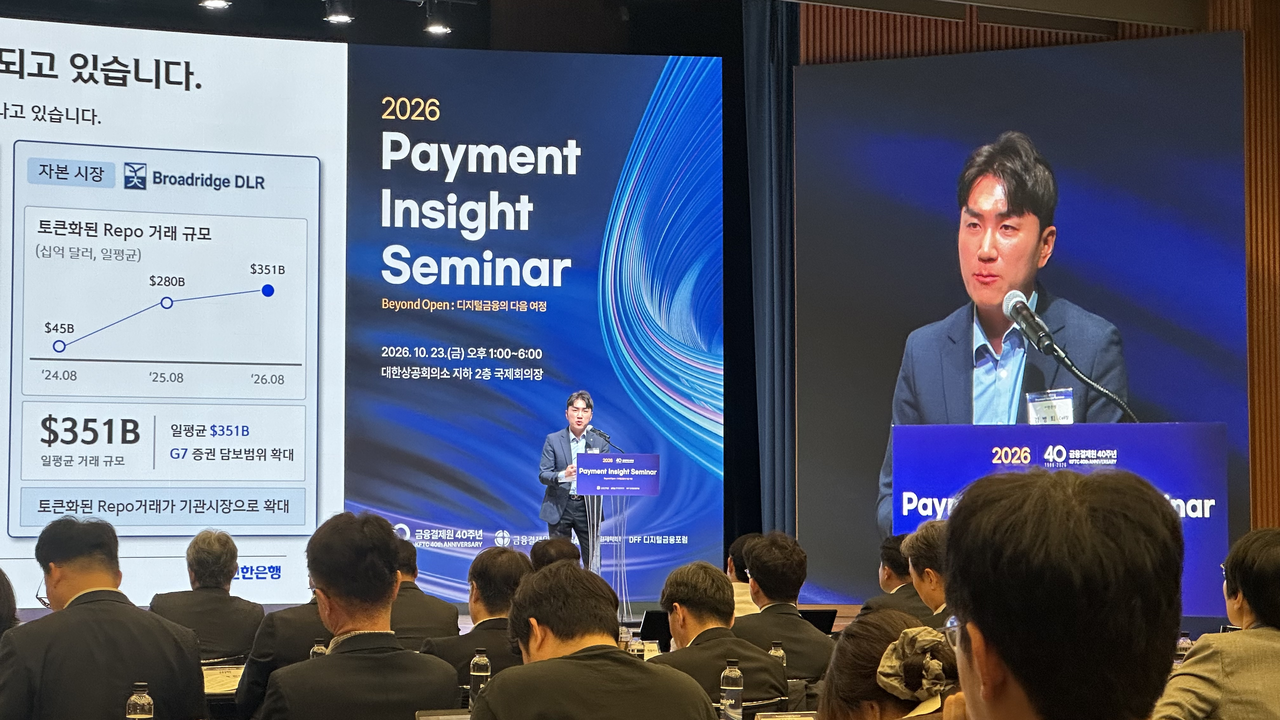
Korea Financial Telecommunications and Clearings Institute 2026 Payment Insight Seminar
Kim Byung-hee, head of Shinhan Bank's digital asset cell, presents
Visa, JPMorgan among global firms expanding blockchain use
'Banks' core roles in deposits, loans, foreign exchange and payments will endure'
As digital assets spread rapidly through financial markets, banks must go beyond launching new stablecoins and deliver financial services that customers can tangibly experience, an industry expert said. The ability to connect existing financial networks with digital assets — enabling round-the-clock transfers and foreign exchange — could prove decisive for banks' competitiveness, the expert added.
At the 2026 Payment Insight Seminar hosted by the Korea Financial Telecommunications and Clearings Institute at the Korea Chamber of Commerce and Industry in Seoul on Friday, Kim Byung-hee, head of Shinhan Bank's digital asset cell, said AI is a technology that creates value while digital assets change how that value moves. "As these two technologies reduce the time gaps that arise in economic activity, the circulation of value will accelerate — and we need to be ready for that," Kim said.
Kim said the spread of digital assets will also transform how banks handle payments and remittances. "When a company sends $1 million abroad today, a person manually compares exchange rates, fees and transfer times at each bank before deciding," he said. "In the future, the right currency and the optimal route could be selected automatically based on the transaction's conditions."
In global financial markets, the movement of funds using digital assets is already expanding. Visa's stablecoin payment and settlement volume recently surpassed an annualized $20 billion, more than eight times the level a year earlier. JPMorgan's blockchain-based payment platform Kinexys has also exceeded $4 trillion in cumulative transaction volume and processes an average of about $7 billion per day.
Tokenization technology is gaining traction in capital markets as well. US firm Broadridge operates a blockchain-based repurchase agreement, or repo, trading platform. "Broadridge's tokenized repo platform handles an average of $351 billion per day, and in August alone this year it processed $7.5 trillion in transactions," Kim said. "Digital assets are moving beyond the stage of issuing tokens into one where they actually move real money and assets."
Kim also cited the treasury management practices of German engineering company Siemens as an example. Global corporations managing different currencies and accounts across countries can find themselves with surplus funds in one region and a shortfall in another.
"The more accounts and cash pools a global company has, the heavier the burden of managing its funds," Kim said. "Starting in 2021, Siemens improved its system so that funds move automatically when certain conditions are met, and as a result it cut its deposit accounts and cash pools by more than 50 percent."
He added that the significance lies not in shaving a few seconds off a transfer, but in fundamentally changing the structure of how money is managed. "It is about keeping existing finance in place while adding one new payment route where it is needed," he said.
Kim also said that for digital assets to take root within the regulated financial system, "monetary singleness" — the principle that different forms of money maintain the same value — must be ensured. Even as diverse payment instruments such as CBDCs, deposit tokens and stablecoins emerge, the value of money available to customers must remain uniform, he said.
"One won in a deposit, one won in a deposit token and one won in a won-denominated stablecoin must all be accepted by customers as having the same value," Kim said. "The challenge ahead for the financial sector may not be creating new forms of money, but connecting different forms of money within a shared framework of trust."
Kim drew a line against the notion that the rise of digital assets would render traditional finance obsolete. "The four fundamental roles of a bank — deposits, loans, foreign exchange and payments — will not change," he said. "When digital assets enter the picture, those roles will only expand further."
He particularly cautioned against approaching corporate customers simply by promoting a new stablecoin. "We must not go to corporate customers and say, 'Here is a new stablecoin — please use it,'" Kim said. "We need to show them that we can now offer services that were previously difficult to provide: round-the-clock transfers, optimized foreign exchange and remittances, and asset management."
kyoung@heraldcorp.com