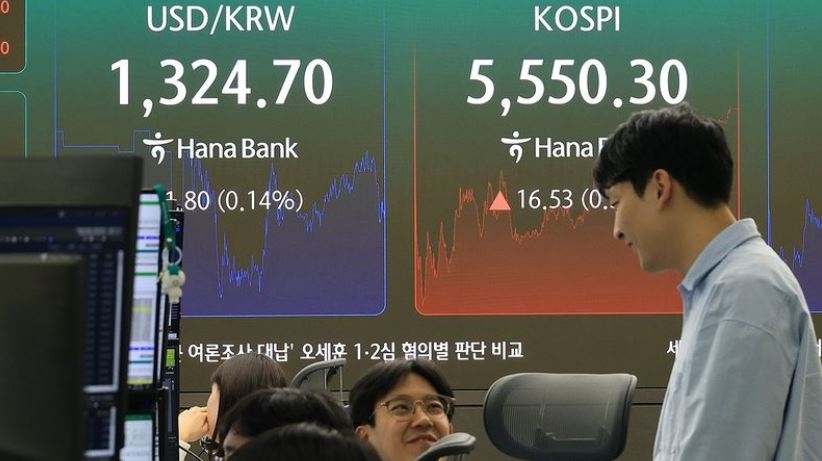
Retail investor enthusiasm for South Korea's stock market is fading fast as the domestic bourse endures a sharp correction. Investor deposits held in brokerage accounts — which once approached 140 trillion won ($106 billion) — have fallen by more than 51 trillion won in just over four months, while margin financing has also contracted sharply. With the Kospi sliding from the 7,000 level to around 5,500, a growing number of investors are shifting their attention to US equities.
Investor deposits stood at 88.68 trillion won as of Thursday, according to the Korea Financial Investment Association. That is the lowest reading in roughly nine months, since the 88.05 trillion won recorded on Jan. 13.
The simultaneous decline in market-ready cash and margin borrowing is raising concerns that the domestic market's demand-supply foundation is weakening.
Investor deposits hit an all-time high of 139.69 trillion won on June 4, when a Kospi rally drew a surge of retail money into brokerage accounts.
The picture changed as the market reversed course.
Deposits fell below 100 trillion won on Oct. 14 and broke through the 90 trillion won floor on Wednesday. That represents a decline of more than 10 trillion won in just six trading sessions.
By Thursday the figure had shrunk to 88.68 trillion won — down 51.01 trillion won, or about 36.5 percent, from the June peak. The drop within this month alone amounts to roughly 15 trillion won.
Investor deposits represent funds parked in brokerage accounts that have not yet been deployed to buy shares. Because the balance reflects how much firepower retail investors have available to purchase stocks, it is widely used as a key indicator of market buying capacity.
The domestic market has been falling steeply. The Kospi, which was trading above 7,000 earlier this month, tumbled to 5,533.77 on Thursday as the index shed 3.52 percent in a single session, badly denting investor sentiment.
On Friday the index dipped as low as the 5,300 level in early trade before recovering to close at 5,550.30, but market volatility remains elevated.
Not all of the decline in deposits, however, represents money leaving the market entirely. When investors use deposited funds to buy shares, the balance falls even if the money stays in domestic equities.
In fact, retail investors net-bought 44.17 trillion won worth of Kospi shares between June 4 and Friday, and added a further 3.15 trillion won on the Kosdaq over the same period. Net purchases of ETFs reached 28.25 trillion won.
A substantial portion of the deposit decline is therefore attributable to stock and ETF purchases rather than outright withdrawals.
The problem is that fresh inflows have slowed sharply even as existing funds continue to flow into equities.
During the first-half rally, new money poured into brokerage accounts faster than investors could spend it on shares, keeping deposits on an upward trend. Now, buyers remain active in the downturn, but the new capital needed to replenish those purchases is not arriving in sufficient volume.
Analysts warn that if foreign and institutional investors mount large-scale selling, retail investors may lack the additional buying power to absorb it.
Margin financing balances are also shrinking as the share-price decline drags on.
Margin financing refers to funds borrowed from brokerages to purchase shares. A falling balance signals that leveraged stock investment is contracting.
The outstanding margin financing balance stood at 30.27 trillion won as of Wednesday, down 3.12 trillion won from 33.39 trillion won at the start of this month.
The pullback has been especially pronounced in large-cap semiconductor stocks, which have suffered the steepest declines recently.
SK hynix's margin financing balance fell for seven consecutive trading sessions from Oct. 13, shrinking by roughly 650 billion won. Samsung Electronics saw its margin balance contract by nearly 500 billion won over the same period.
The declines reflect investors repaying borrowed funds or liquidating holdings as share prices dropped sharply.
When shares bought on margin fall below a certain threshold, brokerages can demand additional collateral. If investors cannot meet that requirement, the brokerage forcibly sells the shares — a process known as a margin call liquidation.
Such forced selling adds to supply pressure, pushing prices lower and potentially triggering further liquidations in a vicious cycle.
Forced liquidations did spike temporarily during the recent sell-off. However, the value of margin call liquidations on Wednesday came to 12.9 billion won, down from 22.6 billion won the previous trading day.
The decline in margin balances also reflects voluntary loan repayments by investors, not only forced liquidations.
Market watchers are paying close attention to the simultaneous contraction in margin borrowing and investor deposits. Analysts say investors are increasingly focused on reducing their exposure and risk rather than treating the price drop as a buying opportunity.
As volatility in the domestic market widens, retail investors are turning their attention overseas.
According to Korea Securities Depository data, domestic investors net-bought approximately $4.64 billion worth of US equities in July, a sharp increase from the net-purchase position they had shifted into in June after net-selling in April and May.
Buying momentum eased somewhat in August and September but picked up again this month, with net purchases of US stocks reaching roughly $4.8 billion through Wednesday.
Analysts say the wild swings and heavy foreign selling in the domestic market have worn down investor patience.
"The pace at which customer deposits — the funds waiting on the sidelines to buy shares — are flowing in is markedly slower than the Kospi's own trajectory," said Heo Jae-hwan, a researcher at Eugene Investment & Securities. "The enthusiasm for the domestic market has cooled."
Kang Hye-seong, a researcher at Sangsangin Securities, agreed. "Since July, retail money has been moving from Korea to the United States," she said. "The won's strength since August has stimulated demand for dollar conversion and reduced the appeal of investing at home."
The outlook for domestic market flows hinges on whether investor sentiment can recover.
With foreign selling continuing and fresh retail inflows slowing, the buying base needed to support a market rebound is eroding.
Analysts also say the market needs a restoration of confidence in the semiconductor sector's earnings recovery and longer-term growth prospects.
Kim Jae-seung, a researcher at Hyundai Motor Securities, said a rebound in the domestic market would require upward revisions to 2027 corporate earnings forecasts and renewed market confidence in 2028 profit expectations.
The domestic market is struggling to attract fresh capital even as existing investors continue to buy heavily. With more money flowing toward US equities, whether retail investors can find a compelling reason to re-engage with the Korean market is emerging as a key variable in any potential recovery.
rainbow@heraldcorp.com