South Jeolla Province and Gwangju are moving to streamline procedures for amending the metropolitan urban plan to allow greenbelt release quota exemptions, in a bid to accelerate development of the Honam semiconductor national industrial complex.
The South Jeolla-Gwangju integrated special city said Monday it had submitted to the city council a proposal titled "Request for Public Opinion on the 2040 Gwangju Metropolitan Urban Plan." A public hearing is scheduled for Tuesday, after which the plan will go through follow-up deliberations and council approval before being finalized in the first half of 2027.
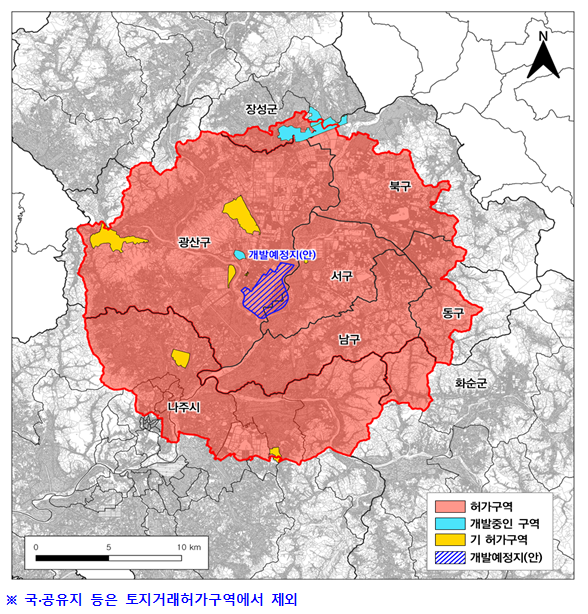
The move follows the selection in July of the area around Gwangju's military airport as a candidate site for the semiconductor national industrial complex. The city had previously gathered opinions from the Gwangju City Council and South Jeolla Provincial Council in March and April, but revised and resubmitted the plan to incorporate additional content.
The revised plan stipulates that if a national or regional strategic project is designated as a greenbelt release quota exemption project through Cabinet deliberation, the exemption may be applied even before the metropolitan urban plan is formally amended, with the project to be reflected in the plan at a later stage.
The provision is designed to let the Honam semiconductor national industrial complex move forward quickly should the government grant a quota exemption, bypassing the need for a separate urban plan amendment. The relevant rules are being put in place in advance to avoid delays.
Concerns had been raised that a large-scale greenbelt release on the military airport site could exhaust the region's allocated release quota, making it difficult to secure development land needed to attract semiconductor materials, components and equipment companies and build additional industrial complexes.
The government introduced a greenbelt release quota exemption system for national and regional strategic projects outside the Greater Seoul area in 2024, and last February designated three sites as exempt projects: the Gwangju future vehicle national industrial complex, the Jangseong Nano Second General Industrial Complex, and the Damyang Second General Industrial Complex.
The Honam semiconductor national industrial complex must separately obtain its own exemption designation from the government.
Once the metropolitan urban plan is amended, projects granted a quota exemption by the government will be able to proceed immediately without going through a separate urban plan amendment. The current greenbelt release quota for the Gwangju metropolitan area stands at 16.69 square kilometers — 8.88 square kilometers for the former Gwangju area and 7.81 square kilometers for South Jeolla Province.
A metropolitan urban plan sets the long-term development direction for areas spanning two or more local governments, covering the basic framework for land use, industrial layout, wide-area transportation networks and greenbelt management.
The plan covers Gwangju and parts of Naju, Damyang, Jangseong, Hwasun and Hampyeong, and includes proposals to foster AI, semiconductor and future vehicle industry hubs, expand the regional rail network, and create a multi-centered metropolitan lifestyle zone through the distribution of industrial functions across localities.
sij@heraldcorp.com