Share of units over 40 sq. m in Seoul hits year-high of 28.1%
Prices rise for units above 60 sq. m while smaller units decline
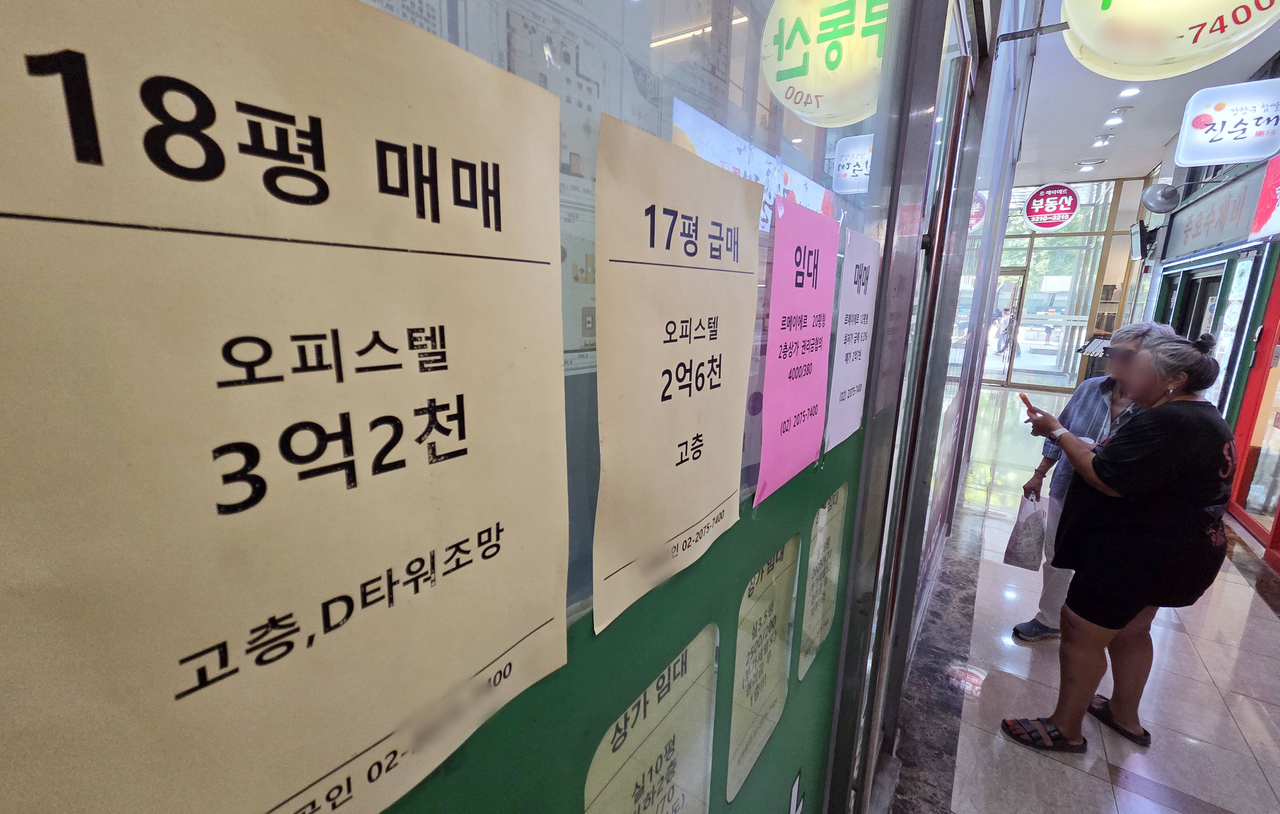
The share of mid-size officetel transactions in Seoul has risen by more than 5 percentage points over the past year, data showed Monday.
According to an analysis of Ministry of Land, Infrastructure and Transport officetel actual transaction price data — excluding corporate and public institution deals — by real estate platform Zigbang, the share of individual purchases of officetel units larger than 40 square meters (exclusive use area) nationwide stood at 38.4 percent in September this year, up 3.3 percentage points from 35.1 percent in the same month last year.
Total individual officetel purchases nationwide fell 20.7 percent over the period, from 2,536 to 2,010 transactions. Deals for units above 40 square meters also declined, dropping from 889 to 772, but the decrease of 13.2 percent was smaller than the overall market contraction. As total transactions shrank, the relatively smaller drop in larger-unit deals pushed their share of individual purchases higher.
The shift was more pronounced in Seoul. In September this year, 163 of the 581 individual officetel purchases in Seoul involved units larger than 40 square meters, accounting for 28.1 percent — up 5.3 percentage points from 22.8 percent in September last year and the highest share in the past year.
Particularly notable was the decline in the most actively traded 20–30 square meter segment, whose share fell from 44.0 percent to 38.4 percent, with transaction volume dropping 31.6 percent from 326 to 223 deals.
By contrast, the 40–60 square meter segment saw its share rise from 12.1 percent to 16.9 percent, with transaction volume increasing 8.9 percent from 90 to 98 deals. This stands out against the 21.6 percent overall decline in individual officetel purchases in Seoul, which fell from 741 to 581 transactions over the same period.
The 60–85 square meter segment also saw its share edge up from 5.9 percent to 7.1 percent. However, units above 85 square meters slipped from 4.7 percent to 4.1 percent, meaning the trend did not extend uniformly across all larger-unit categories.
The shift in Seoul is better characterized as a decline in the share of ultra-compact units in the 20–30 square meter range, with a relative increase concentrated in the 40–60 square meter mid-size segment, rather than a broad surge in large-unit transactions.
The rising share of transactions above 40 square meters was not limited to Seoul. In Gyeonggi Province, the share climbed from 42.5 percent in September last year to 44.0 percent this September, while Incheon rose from 56.3 percent to 59.7 percent.
Among regional cities, Busan showed the most striking change, with the share of individual purchases above 40 square meters jumping 13.0 percentage points to 40.1 percent from 27.1 percent. However, the actual number of such transactions in Busan remained unchanged at 61 deals over the period, meaning the higher share partly reflects the overall decline in total transactions rather than an increase in larger-unit buying.
As of September this year, several regions recorded shares above 40 percent for units larger than 40 square meters in individual purchases: North Jeolla Province at 50.0 percent, Daegu at 46.9 percent, North Chungcheong Province at 42.9 percent, and South Jeolla Province and Gwangju combined at 42.6 percent. Regional divergence was also evident: Daegu's share fell from 56.4 percent a year earlier to 46.9 percent, while Daejeon's dropped sharply from 37.2 percent to 22.0 percent.
Divergence by unit size is also visible in recent price trends. According to the Korea Real Estate Board's officetel price trend data for the third quarter of this year, Seoul officetel sale prices rose 0.07 percent quarter-on-quarter. Units of 40 square meters or smaller fell 0.06 percent, while the 60–85 square meter segment gained 1.07 percent and units above 85 square meters rose 1.57 percent, reflecting stronger price momentum in larger units.
"Seoul's housing market is grappling with high apartment prices alongside sustained housing cost burdens," said Kim Eun-seon, head of Zigbang's big data lab. "In this environment, interest may grow not only in ultra-compact officetel products with low price tags, but also in products that can provide the living space actually needed for residential use."
She added that while the increase in 40–60 square meter transactions in Seoul despite an overall decline in officetel deals is worth watching, "it is difficult to conclude that this is a direct result of apartment demand shifting to officetels." If the share of mid-size transactions is maintained or expands going forward, she said, "it may be possible to examine whether the criteria driving officetel demand are broadening from price and rental yield to living space and usability."
hwshin@heraldcorp.com