UNIST demonstrates world-record efficiency in photoelectrode
Production costs also reduced, raising hopes for commercialization

Researchers at the Ulsan National Institute of Science and Technology have developed an organic photoelectrode capable of producing hydrogen from water using only sunlight — without any external power supply — raising hopes for the commercialization of next-generation green hydrogen production technology.
A team led by Kim Jin-young, a professor at UNIST's Graduate School of Carbon Neutrality, along with professors Lee Jae-sung and Lim Han-kwon of the Department of Energy and Chemical Engineering, announced Monday that they had developed a "tandem photoelectrode" by stacking two layers of light-absorbing organic semiconductors, enabling hydrogen production without an externally applied voltage.
Solar water-splitting technology using photoelectrodes — which harness light energy to drive electron movement — has drawn attention as a means of producing green hydrogen, a process that emits no carbon dioxide. When the semiconductor inside a photoelectrode absorbs light, electrons migrate to a catalyst and trigger a hydrogen-generating reaction.
Until now, photoelectrodes using organic semiconductors could not generate enough voltage from a single absorption layer to split water into hydrogen and oxygen, requiring an external power source.
To overcome this, the research team stacked two semiconductor layers that absorb light at different wavelengths to secure the voltage needed for water splitting. They also developed and integrated a new interconnecting material — combining molybdenum oxide with the organic molecule 2PACz — to prevent voltage losses between the two layers. Unlike conventional materials, the new compound does not absorb moisture and facilitates charge transfer while avoiding the acidity problems that had plagued earlier approaches.
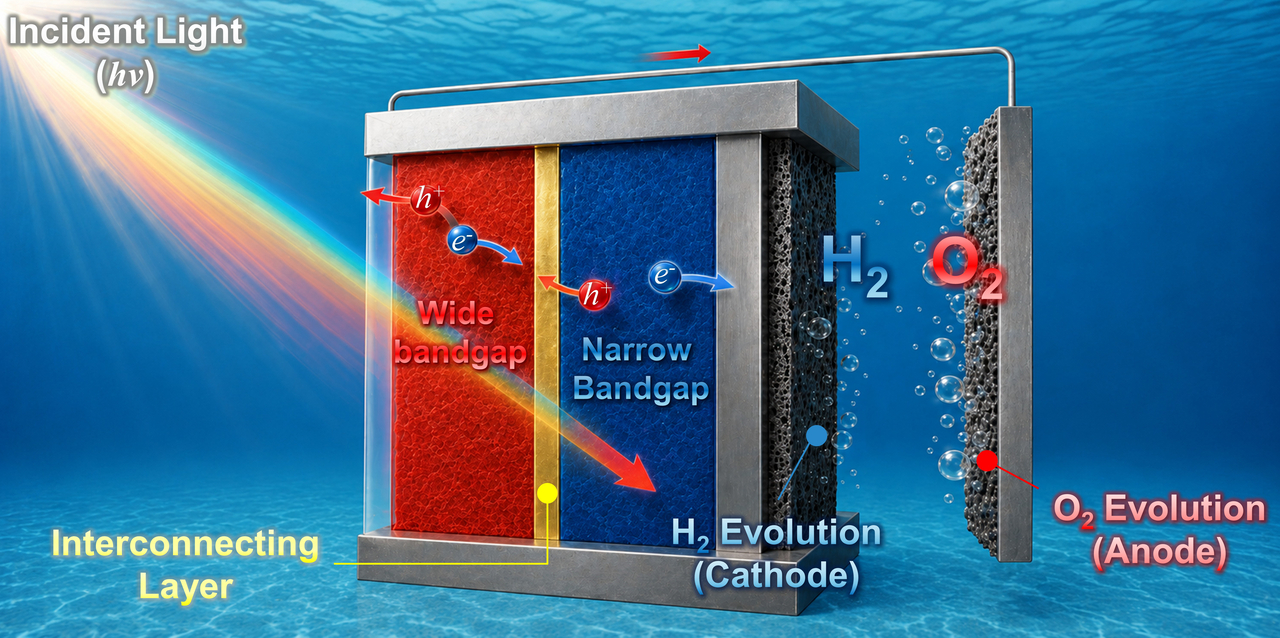
In experiments, a 0.56-square-centimeter photoelectrode split water without any external power and achieved a solar-to-hydrogen conversion efficiency of 7.9 percent — the highest recorded for an organic semiconductor-based photocathode. Stability tests showed the electrode retained 86 percent of its initial photocurrent after 10 hours, far surpassing the 36 percent retention of conventional devices. The team also improved cost-effectiveness by replacing precious metals in the oxygen-evolution electrode with a catalyst made from nickel, iron and cobalt.
A full techno-economic analysis found that, at the current efficiency level, producing hydrogen at a facility generating 10 metric tons per day would cost an estimated $9.26 per kilogram. If the solar-to-hydrogen conversion efficiency is raised to the theoretical limit of 16 percent and daily output is scaled up to 30 metric tons, the production cost could fall to $4.26 per kilogram.
"This research resolves the instability and corrosion problems in the interconnecting layer that had been degrading performance in stacked organic semiconductor electrodes," Kim said. "It can contribute to lowering the cost of green hydrogen production."
The study was co-authored by researchers Kim Jae-hyung, Lee Yeon-jung and Moon Jong-a, along with Dr. Darmesh Hansora, and was published online Sept. 6 in Applied Catalysis B: Environment and Energy, a leading international journal in environmental and energy catalysis.
cityblue@heraldcorp.com